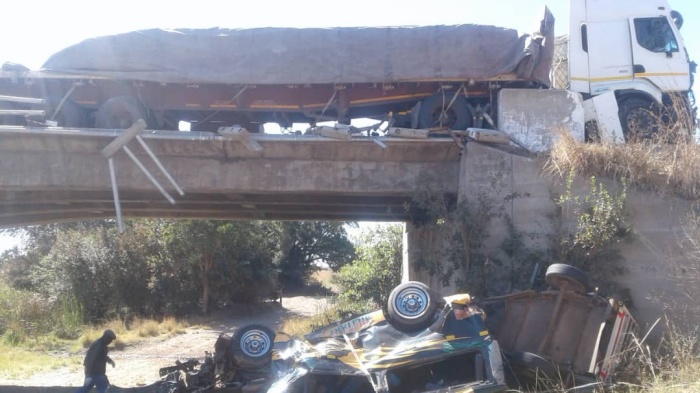
The haulage truck encroached into the center lane and collided head-on with a commuter omnibus at Ngezi Bridge in Featherstone along the Harare-Beitbridge highway, killing 19 people
The driver of the haulage truck that recently encroached into the center lane and collided head-on with a commuter omnibus at Ngezi Bridge in Featherstone along the Harare-Beitbridge highway, killing 19 people, appeared at the Chivhu magistrates’ court over the weekend facing 19 counts of culpable homicide.
The haulage truck encroached into the center lane and collided head-on with a commuter omnibus at Ngezi Bridge in Featherstone along the Harare-Beitbridge highway, killing 19 people
Jeremiah Haisoswi (30) of Epworth appeared before Magistrate Miss Rufaro Panavanhu charged with causing the deaths of 19 passengers who were in the commuter omnibus that was travelling from Murambinda to Harare.
The haulage truck that Haisoswi was driving encroached onto the lane of the commuter omnibus, resulting in the crash.
Sixteen people died on the spot while three others died on admission at Chivhu Hospital.
Haisoswi was remanded out of custody on free bail to July 16 for trial. The Herald
South Africa-based multi award-wining dancehall artiste Buffalo Souljah, real name Thabani Ndlovu, has sparked what seems to be the biggest tiff between African reggae musicians.
Buffalo Souljah
Buffalo Souljah took to social media and “dethroned” Ghanaian dancehall singer Shatta Wale of the “King of African Dancehall” title ending with the two artistes exchanging words.
The two took to their war to the studio and churned out tunes aimed at outclassing each other.
Posting on his micro-blogging site Twitter, Buffalo Souljah, who has 10 continental awards, claimed that he was the true King of African dancehall. “Now Ghana youths tagged me about this. Let me make things clear, there is only one King of dancehall in Africa, Buffalo Souljah,” he tweeted.
“Even Shatta Wale knows that he is a King of Ghanaian Dancehall. We are not talking about Zimbabwe or Ghana but Africa check the demographics.”
Irked by Buffalo Souljah’s sentiments Shatta Wale dared him to drop the first “diss song”.
“Ghana, somebody should warn Buffalo Souljah that when I start I can’t stop. This nigga just wants a beef with me and I f***n love beef.
“If he is a man he should throw the shot first. I’m waiting,” tweeted Shatta Wale.
On Sunday Buffalo Souljah fired the first shots in new single “Ripshattawale.”In the song Buffalo Souljah claims to be marching on his rival’s home turf to take all his fans.
He described Shatta Wale as a minor in music. The song created a social media frenzy, with Shatta Wale responding with a song titled “Fool Boy.” Both songs are trending creating what dancehall music lovers have equated to Jamaica’s Sting where leading musicians settle their differences in music battles.
Clashes are common in dancehall music. Critics say the singers use clashes to shore up their popularity among fans. The Buffalo Souljah and Shatta Wale “beef” as the clashes are labelled is one of the biggest in the genre in Africa thus far. The Herald
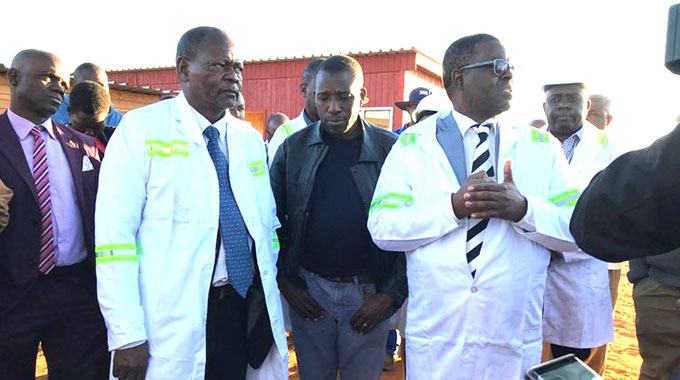
Energy and Power Development Minister Fortune Chasi (right) and Minister of State for Matabeleland South Abedinico Ncube (left) view the Gwanda solar project site
Energy and Power Development Minister Fortune Chasi has demanded completion of the multi-million dollar 100 megawatts Gwanda solar project saying he wanted to see electricity being generated from the power station after Government paid US$5,1 million in tax payers’ money for its construction.
Energy and Power Development Minister Fortune Chasi (right) and Minister of State for Matabeleland South Abedinico Ncube (left) view the Gwanda solar project site
The energy minister also said an explanation from Zesa Holdings, the holding arm of the group’s power generation unit, on why there have been crippling delays to the implementation of the Gwanda solar project was necessary.
This comes as Zimbabwe is grappling rolling power cuts due to electricity shortages that have been occasioned by significantly reduced electricity output at Kariba South hydro plant, which had its water ration for power generation significantly cut down by Zambezi River Authority due to receding lake water levels.
Minister Chasi was in Gwanda on Friday to apprise himself with the progress at the slow moving solar project, for which State-owned Zimbabwe Power Company (ZPC), paid a staggering US$5,1 million to have pre-commencement works done, ahead of actual phased construction, with little of initial works done thus far, which includes land clearance and site fencing and topography studies.
Earlier, the Energy and Power Development Minister had toured the outdated Bulawayo Power Station, which was de-commissioned a few years ago and is set for major systems overhaul under a multi-million dollar re-powering programme.
Delays in the implementation of the Gwanda solar project have already resulted in a contractual dispute between Zesa and contractor, Intratrek Zimbabwe, which saw the power utility attempting to terminate the agreement.
Zesa wanted to terminate the agreement on the grounds that the contractor had violated the parties’ contract after failing to complete pre-construction works within the stipulated time as agreed, despite receiving payment of US$5,1 million.
But Intratrek, in its heads of arguments, accused the State power utility of frustrating the project including through causing the arrest of the company’s director, Wicknell Chivayo.
The project contractor also argued that delays on the project were not its fault given that financial closure was scuppered by the negative effect of Government’s legacy debts in China where Intratrek intended to raise project finance.
Construction of the Gwanda solar plant was quoted at US$172 million, but Intratrek had offered to cut down the price to US$132 million commensurate with the falling costs of constructing solar energy plants across the entire world.
The firm further claimed that this was confirmed by actions of the Ministry of Finance and Economic Development, which in 2016 and on realising challenges of raising funding in China’s Export and Import Bank (China Eximbank), instructed CBZ Bank to float energy bonds to raise requisite funding for the project.
As such, when Zesa tried to terminated the Gwanda project contract, Intratrek contested the purported cancellation of the project agreement and won in a ruling delivered by the High Court last year, declaring the contract valid and demanded that the parties find a way to ensure that the solar power project is implemented.
While the contract for the project was signed in October 2015 and part payment made to the contractor (Intratrek Zimbabwe) for the pre-construction works to be done, little progress has been recorded on site at a time the country is now facing acute shortage of electricity that has spawned severe rolling power cuts.
The minister reiterated that the Gwanda solar project needs to be completed as soon as possible “because money was paid and the contractor needs to deliver the 100 megawatts as per contract signed with ZPC.”
Also commenting after visiting the Gwanda solar project site in the company of Zesa and ministry officials, Minister Chasi said he was depressed by what he saw regarding progress on implementation and demanded that the project should be made to produce power as originally envisioned or the money paid be returned.
“I can’t express the level of depression that I am experiencing right now. (A bad) power situation is in the country. I was expecting that some magnificent amount of work would have been done.
“I feel that as a ministry and as Government, this is a big let down and we are now going back to look at this situation. I am aware that there has been litigation; the project owners won; what I need are megawatts. I am also focusing and zeroing in on Zesa itself to understand why there was a delay,” the minister said.
He said the solar project started a long time ago and the country could not afford to have the solar project delayed for an extended period of time given the current power situation.
Zesa recently appealed at the Supreme Court against High Court judge Tawanda Chitapi’s ruling in favour of Intratrek and declaring the contract between the parties to be valid and in force.
While Zesa’s appeal is still pending at the Supreme Court, Intratrek recently had its application for execution pending appeal granted with the judge saying action was required on Gwanda given the power situation in the country.
Justice Chitapi added that the parties should spend more time on implementation at the project site instead of merry dancing in board rooms and court of law because the power required was not for Intratrek or ZPC, but the whole country. The Herald
A KLM airlines cargo plane yesterday dropped a flap mid-air in Chitungwiza, but landed safely at Robert Gabriel Mugabe International Airport.
Civil Aviation Authority of Zimbabwe (CAAZ) public relations and communications manager Mrs Anna Julia Hungwe confirmed the incident last night.
“The aeroplane dropped a flap in Chitungwiza, but landed safely at the Robert Gabriel Mugabe International Airport.
“Investigations into the incident are ongoing,” she said.
According to website www.howthingsfly.si.edu <http://www.howthingsfly.si.edu>, “the purpose of the flaps is to generate more lift at slower airspeed, which enables the airplane to fly at a greatly reduced speed with a lower risk of stalling.
“This is especially useful during take-off and landing.
“When extended further, flaps also generate more drag which slows the airplane down much faster than just reducing throttle.”
There were no reports of any casualties from the incident. The Herald
The two-day public interviews for the eight posts of judges of the High Court opened in Harare yesterday with the first batch of 10 aspiring candidates being interviewed by the Judicial Service Commission’s nine-member panel.
Luke Malaba
Chief Justice Luke Malaba led the interviews asking a set of four standard questions.
The questions included naming three types of jurisdiction the High Court has in criminal matters and in what circumstances does the Prosecutor-General have the right to appeal to the Supreme Court against a judgment of the High Court in a criminal matter.
Interviewees were also required to explain the principles governing the exercise by the High Court of jurisdiction in respect of arbitral awards brought to the court for review.
Chief Justice Malaba said speedy disposition of cases is a constitutional obligation on every judicial officer, and asked how do the interviewees intended to ensure, if appointed, speedy disposition of cases while at the same time ensuring a fair hearing to those appearing before them.
Advocate Webster Chinamora, who was the first to be grilled, acquitted himself well applying his mind with aplomb of a veteran lawyer, as he was comfortable fielding questions from the panel.
When asked to tell the commissioners his greatest strength and weakness, he said he was an avid researcher who loved analytical thinking and writing.
“You have before you my curriculum vitae and a sample of some of the work I have done which demonstrates my aptitude for research and analytical thinking which I think is an essential asset of a judge,” he said.
He also referred to his impressive record of academic publications, which includes three-book chapters, one of which is in the Encyclopaedia of International and Comparative Private Law.
However, Zvishavane-based lawyer Mr Tichaona Chivasa had a bad day in office as he struggled with questions, some of which were elementary.
He had a nightmare in answering the first standard question on the jurisdiction of the High Court on criminal matters.
Mr Chivasa came for the interviews despite the fact that he failed the test on the writing of a judgment. He was, however, allowed to exercise his right to participate in the public interviews.
Bulawayo-based lawyer Mr Christopher Dube-Banda put up a sterling performance in the manner he answered questions.
He said he was a man fit for the job given the fact that he had garnered sufficient layers of experience throughout his 25 years in private practice.
“If appointed I will take it upon myself deal with the cases before me as expeditiously as possible,” he said with a voice booming with authority.
“I will not sit on cases placed before me. I can say that am a diligent person and consider myself a hard working person. I am not that kind of person who leaves things for tomorrow. I deal with things as they come and am conscious of the Constitution on this requirement and the rights of people appearing before courts.”
Not to be out done was Labour Court judge Justice Evangelista Kabasa, who left the panellists unanimously content with her work and judicial intelligence.
The other six interviewees are Sheila Kanyangarara, Cemis Madembo, Benhilda Manyowa, Simba Mawere, Emilia Muchawa and Richard Mufuka. The Herald
Zimbabwe is lagging behind in terms of conclusively reaffirming its borders with neighbouring countries to avoid potential conflicts arising from the exploitation of resources and other disagreements that may affect good relations.
Mildred Chiri
The border reaffirmation exercise is in line with the African Union Border Programme (AUBP) that requires all member States of the continental body to complete all international boundaries reaffirmations by the year 2023.
This was revealed by the Auditor-General, Mrs Mildred Chiri, in her 2018 annual report tabled before Parliament last week.
The AUBP was adopted in 2007, during the 8th Ordinary Session of Heads of State and Government of the African Union in Addis Ababa under the theme “preventing conflicts and promoting integration” and one of its ambitious goals was “the delimitation and demarcation of African boundaries” where this had not yet taken place by 2017.
This deadline was extended to 2023, following a programme review in 2016.
Mrs Chiri warned that delays in reaffirming boundaries was likely to give rise to more conflicts along the border areas and urged the Government to speed up the process.
“Taking long to reaffirm the boundaries may give rise to more conflicts along the border areas with neighbouring countries,” she said.
The Government, through the Surveyor-General Department, had planned to reaffirm at least 200 kilometres of its international boundaries every year, but it only managed to reaffirm 53km, which translate to 27 percent of the planned annual output.
Mrs Chiri attributed the delay to lack of coordination in resource mobilisation among the countries involved.
“Despite the fact that the department managed to get $119 941, which is 70 percent, out of the total budget of $172 508, the output did not correspond to the resources utilised during the year under review,” she said. The Herald
Wilfried Zaha scored the winner as the Ivory Coast beat Mali 1-0 to reach the Africa Cup of Nations quarter-finals.
Earlier this month, Crystal Palace rejected a £40m bid from Arsenal for forward Wilfried Zaha
The Crystal Palace forward, who has been linked with a summer move to Arsenal, raced on to Sylvain Gbohouo’s deep free-kick and got to the ball before Mali goalkeeper Djigui Diarra.
Mali had been wasteful with Moussa Marega and Moussa Djenepo both missing good opportunities when well placed.
The Ivory Coast play Algeria in the last eight on Thursday (17:00 BST).
The Elephants have won the competition twice – in 1992 and 2015 – but only advanced through this year’s opening phase as runners-up after losing 1-0 to group winners Morocco.
The Ivory Coast struggled in the first half against Group E winners Mali and failed to register a shot on target in the opening 45 minutes.
Mali’s Moussa Djenepo, who this summer moved to Southampton from Standard Liege, posed a constant threat on the left wing but Marega scuffed a good chance wide at the near post when he failed to connect properly.
Abdoulay Diaby also had a free-kick turned over the bar by Ivory Coast goalkeeper Gbohouo before Djenepo wasted a good chance when he was indecisive in front of goal.
The Ivory Coast came more into the game after the break with Aston Villa’s Jonathan Kodjia being denied by Diarra.
However, Diarra was beaten a few minutes later when Zaha, who had been quiet throughout the match, reacted quickest to score in the 76th minute and take his country into the last eight. BBC Sports
An aircraft built by South African teenagers has successfully landed in Egypt six weeks after it set off from Cape Town.
The project team celebrates
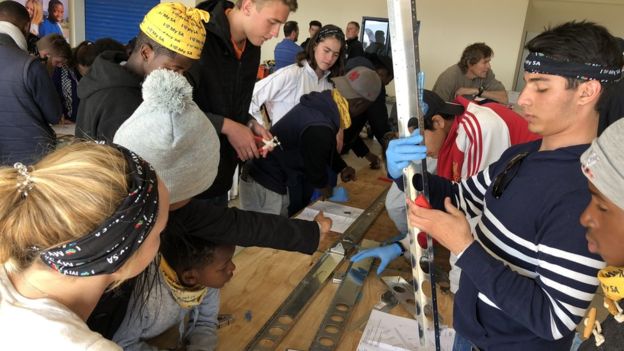
The four-seater Sling 4 plane was assembled by a group of 20 students from vastly different backgrounds.
The crew landed in Namibia, Malawi, Ethiopia, Zanzibar, Tanzania and Uganda during the 12,000km (7,455 mile) trip.
Pilot Megan Werner, 17, founder of U-Dream Global project, said she was thrilled by the accomplishment.
“I’m so honoured to have made a difference around the continent at the places we’ve stopped.
“The purpose of the initiative is to show Africa that anything is possible if you set your mind to it,” she added.
Another Sling 4 plane, flown by professional pilots, accompanied the teen flyers, whose goal was to give motivational talks for other teenagers along the way.
The teenagers built the aircraft in three weeks from a kit manufactured in South Africa by the Airplane Factory. Construction included assembling thousands of small parts.
Megan’s father, Des Werner, who is a commercial pilot, said it would normally take 3,000 man hours to assemble a Sling 4.
The impressive feat had its challenges, Megan said.
In the Ethiopian capital, Addis Ababa, they could not get fuel.
“When we eventually got it, the support aircraft started leaking fuel so they couldn’t fly with us and only two people – Driaan van den Heever, the safety pilot, and I carried on,” Megan said.
“We were concerned about flying across Sudan because of the political unrest in that country.”
Megan was one of six in the group to have obtained a pilot’s licence, and the six shared flying duties in their silver aircraft, which is emblazoned with maps of Africa on both wings together with sponsors’ logos.
Their basic pilot’s licences presented a further challenge as they only allow flying at a height where the ground is still visible and prohibit entering cloud.
The last leg, from Addis Ababa to Cairo via Aswan, tested the pilots’ mettle.
“Driaan van den Heever and I flew alone for 10 hours, without the support aircraft, so it was two teenagers, all by ourselves with no support,” Megan said.
The two pilots encountered a problem with one of their avionic systems about an hour into Egyptian airspace. So they decided it would be better to land at the closest domestic airport in Cairo, instead of the international airport as planned.
“That created a little chaos but it was done in the interest of safety,” Des Werner said.
“In the end it was just a loose connection which they sorted out but the bureaucratic process took a while to sort out because they had to complete a report,” he added.
“When we landed in Egypt the authorities wanted to arrest us, take our passports and licences but luckily after about four hours, everything was sorted out and we got some more fuel and carried on to Aswan. We then flew from Aswan to Cairo and it was a really awesome feeling to land here,” said Megan.
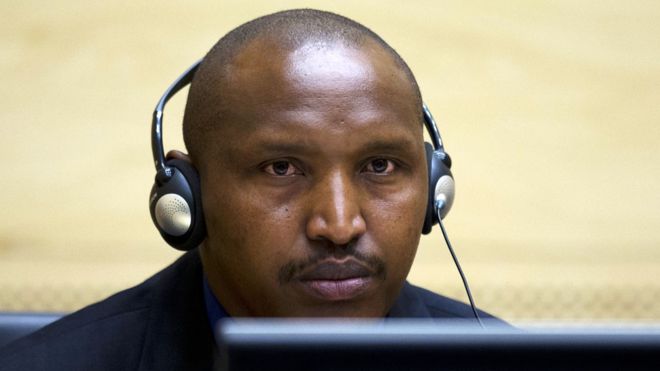
A former Congolese rebel leader has been found guilty of war crimes and crimes against humanity.
Bosco Ntaganda was convicted of leading a brutal campaign in eastern DR Congo
Fighters loyal to Bosco Ntaganda carried out gruesome massacres of civilians, said judges at the International Criminal Court (ICC).
Ntaganda, nicknamed “Terminator”, was convicted on 18 counts including murder, rape, sexual slavery and using child soldiers.
He becomes the first person convicted of sexual slavery by the ICC.
Ntaganda, who will be sentenced at a later hearing, is the fourth person convicted by the ICC since its creation in 2002. He has 30 days to appeal against the convictions.
The 46-year-old former rebel has been involved in numerous armed conflicts in both Rwanda and the Democratic Republic of Congo.
Ntaganda surrendered at the US embassy in Rwanda in 2013.
Analysts said it was an act of self-preservation, motivated by the danger he was in after losing a power-struggle within his M23 rebel group.
Who is Bosco Ntaganda?
Born in 1973, grew up in Rwanda
Fled to DR Congo as a teenager after attacks on fellow ethnic Tutsis
At 17, he began his fighting days – alternating between being a rebel and a soldier, in both Rwanda and DR Congo
2002-3: Militia leader in Congolese region of Ituri
2006: Indicted by the ICC for allegedly recruiting child soldiers in Ituri
In charge of troops who carried out 2008 Kiwanji massacre of 150 people
2009: Integrated into Congolese national army and made a general
2012: Defects from the army, sparking a new rebellion which forces 800,000 from their homes
2013: Surrenders to US embassy in Kigali, Rwanda, after splits in his rebel group
What did he do?
A three-judge bench found Ntaganda guilty on all 18 counts of war crimes and crimes against humanity committed in the mineral-rich north-eastern region of Ituri between 2002 and 2003.
Ntaganda was a “key leader” who gave orders to “target and kill civilians” judge Robert Fremr said in the ruling.
Prosecutors had said Ntaganda was key in planning and running operations for the Union of Congolese Patriots (UCP) rebels and its military wing, the Patriotic Forces for the Liberation of Congo (FPLC).
The armed group conducted attacks against people perceived not to belong to the Hema ethnic group, the ICC found.
In one attack, fighters killed 49 captured people in a banana field behind a village using “sticks and batons as well as knives and machetes”.
“Men, women and children and babies were found in the field. Some bodies were found naked, some had hands tied up, some had their heads crushed. Several bodies were disembowelled or otherwise mutilated,” Judge Fremr said.
Violence in the region has killed more than 60,000 people in the region since 1999, as militias battle each other for control of scarce mineral resources, rights groups say.
The judges ruled that Ntaganda had personally killed a Catholic priest, while the fighters he commanded ran rampage in the region.
The crimes took place when Ntaganda served as the deputy chief of general staff of Thomas Lubanga – who was the leader of the UCP. He was the first person to be convicted by the ICC in 2012 and sentenced to 14 years.
All of those convicted so far by the ICC are from Africa. A fifth person, Jean-Pierre Bemba, the former vice-president of DR Congo, was initially found guilty of war crimes before being cleared on appeal last year.
The International Federation for Human Rights (known by its French acronym FIDH) called Monday’s judgment a day of victory for Ntaganda’s victims and a day of hope for others.
But it added in a statement: “While Ntaganda’s conviction is a milestone… and a victory for all those who pursued justice for crimes committed in Ituri, several suspected criminals still enjoy impunity.”
What is Ntaganda’s background?
Ntaganda fought under the command of Rwanda Patriotic Front (RPF) leader, now Rwandan president, Paul Kagame to end the 1994 genocide against his ethnic group – the Tutsi.
After Rwanda’s unrest spilled over into neighbouring DR Congo, he started to flip between fighting rebellions and serving in national armies – both Rwandan and Congolese.
In 2012, he became the founding member of the M23 rebel group after he defected with hundreds of soldiers from the Congolese national army.
His fighters later took over DR Congo’s eastern city of Goma before agreeing to withdraw. At least 800,000 people reportedly fled their homes.
The M23 rebel group was eventually defeated by Congolese government forces in 2013. BBC News
London, United Kingdom —The grandson of anti-apartheid hero Nelson Mandela has delivered a damning condemnation of “Israeli apartheid”, in a high-profile expression of solidarity between South Africans and Palestinians.
Zwelivelile Mandela, an MP of the ruling African National Congress (ANC), made the comments on Saturday at the Palestine Expo, an annual event in London aimed at showcasing Palestinian history, heritage and culture. Last year, it attracted 15 000 visitors.
Addressing a large audience, Mandela said that the Nation-State Law passed in 2018 declaring Israel to be the historical homeland of the Jewish people “confirmed what we have always known to be the true character and reality of Israel: Israel is an apartheid state”.
He also outlined what had constituted apartheid for black South Africans – from the creation of bantustan reservations to land expropriation and the daily assault on dignity.
“All these characteristics were present in apartheid Israel since its inception but have now been codified and given a constitutional status and expression by the Nation-State Law.
“Apartheid Israel perpetuates statutory discrimination through the very definition by the law as a Jewish state; by doing so it renders non-Jews as second-class citizens, alternately as foreigners in the land of their birth.”
Also speaking at the event was Israeli journalist Gideon Levy, who criticised efforts by the United States to resolve the Palestinian-Israeli conflict through investment.
He told the London audience that not only could the deal not be taken seriously, but if it were pursued it would put an end to “all Palestinian rights and aspirations”, and added that, as a result, a global intervention was now required to put pressure on Israel.
“We need the world because Israel will not change by itself – as long as Israel and Israelis are not punished and don’t pay for the occupation, for the crimes, don’t expect any change. It will not come from within Israel.”
Levy was also scathing about how Western politicians and media have succumbed to a “very efficient” campaign by Israel to label any criticism of the country’s activities as anti-Semitic.
“Here we face now a new stage in which criticising Israel becomes not only impossible but almost criminal. I have never seen such a phenomenon in which struggling for justice becomes criminalised – this is unheard of.
“The formula is very formalised and very efficient, and we shouldn’t let it be so efficient: you dare to criticise the occupation? You dare to criticise Israel?
You dare to have some sympathy with the Palestinians, the victims? You dare to speak about justice? You know what you are: you are an anti-Semite. This paralyses everybody.”
Ilan Pappe, a professor at the University of Exeter and director of the European Centre for Palestinian Studies, also blasted the mainstream media’s coverage of Israeli activities and how these have been concealed behind the “fabrication of institutional anti-Semitism”.
Pappe said it was important to acknowledge the historical context in which the treatment of Palestinians in areas such as Gaza had taken place.
“Unfortunately, the world doesn’t know what goes on in Gaza. In this country, the mainstream media, whether it is Sky News or the BBC, or the main newspapers, don’t mention the Gaza Strip.
“They mention every word that they think attests to institutional anti-Semitism in the Labour Party but they would not mention what happened yesterday when 49 young Palestinians were shot by Israeli snipers.
Neither did they mention the 52 who were shot last week.”
Human rights activist Issa Amro, who is based in Hebron – which is at the sharp end of Israeli settler appropriation of Palestinian land – told attendees that the city had become the “micro-centre of apartheid, discrimination and segregation”.
Amro described his activism trying to resist the growing scale at which Palestinian homes were being demolished by the Israeli authorities in order for settlers to take their land and resources.
He said demolitions had increased significantly since Donald Trump became the US president in early 2017, and current Israeli policy was to now even require some Palestinians to demolish their own homes.
“Don’t be afraid of ‘anti-Semitism’ because the message of this conference should be that criticising Israeli human rights violations is not anti-Semitism,” he said.—Al Jazeera.



 Civil Aviation Authority of Zimbabwe (CAAZ) public relations and communications manager Mrs Anna Julia Hungwe confirmed the incident last night.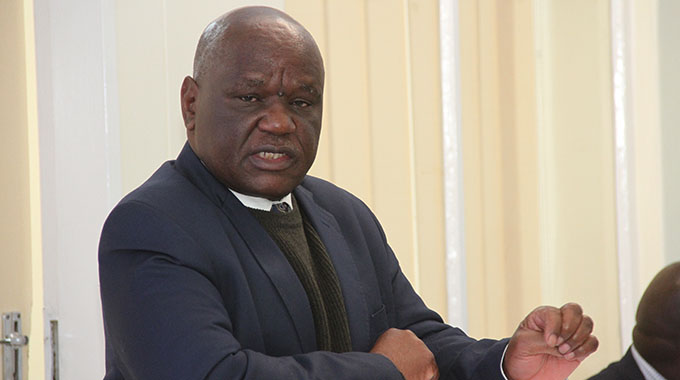


 Megan was one of six in the group to have obtained a pilot’s licence, and the six shared flying duties in their silver aircraft, which is emblazoned with maps of Africa on both wings together with sponsors’ logos.