A Bulawayo woman claimed her cousin dished dirt on her in front of her husband claiming she was a prostitute and that she once bedded a police officer apparently in exchange for favours.
Sitshengiselo Ndlovu in white jersey
Sitshengiselo Ndlovu (pictured above) from Cowdray Park said her cousin Mthulisi Ndlovu was making up stories that she was sleeping with other men in her husband’s absence.
Sitshengiselo said this at the Bulawayo Civil Court where she was seeking a restraining order against Mthulisi claiming she had put her marriage on the brink of collapse because of her accusations that she was cheating on her husband.
Mthulisi Ndlovu
“Mthulisi Ndlovu is my cousin and we have some irreconcilable differences. She has been insulting me while calling me a prostitute in front of my husband and that I slept with a police officer. She also falsely accused me of assaulting her on two separate occasions and following my arrest I was taken to court where I was made to pay a fine for a crime I didn’t commit.
“As if that is not enough, Mthulisi took a herdboy who was looking after my homestead despite the fact that he is wanted by the police in connection with a rape case. She claims the herdboy whose whereabouts are not known now is her relative,” complained Sitshengiselo.
She further said Mthulisi once filed a false police report to the effect that she had stabbed her with a kitchen knife.
In response, Mthulisi however, refuted the accusations saying Sitshengiselo was the one who was in the habit of verbally and physically abusing her.
“It is not true that I’m abusing her. She is the one who is always perpetrating violence against me and as corroboration she was once convicted of domestic violence after she had assaulted me,” said Mthulisi.
In his judgment the presiding magistrate Tinashe Tashaya ordered the two cousins not to abuse each other verbally, physically, and emotionally as well as not to visit each other. B-Metro.
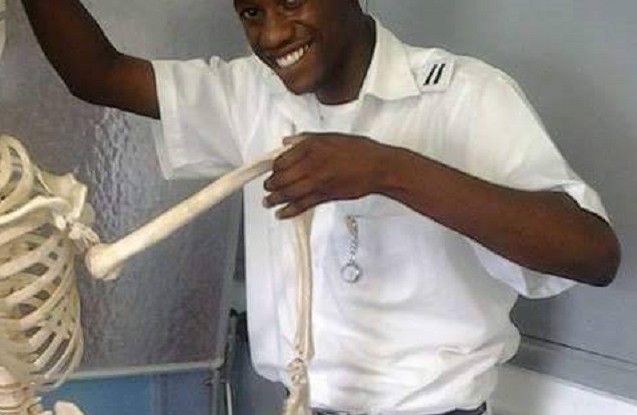
Simbarashe Ndemera (32, pictured above) a nurse at Lutheran Church-run Mnene District Hospital in Mberengwa has disappeared from the face of the earth after the community bayed for blood over his sexual relationship with a teenager.
Simbarashe Ndemera
Parents and his bosses need answers as to why he locked up a Lower Sixth female pupil from the nearby Mnene High School.
Mnene District Hospital shares a boundary with Mnene Primary and High School all of which are also run by the Lutheran Church.
Sources within the church-run institution’s complex said the male nurse had been having an affair with the boarding school girl that he kept at his cottage for four days.
“She went missing and the school authorities then sent an SOS after realising that she was not given a pass to leave the school. The Boarding Mistress then got a tip off that Ndemera was having an affair with the girl and could be the one with her,” said the source.
The source said the Boarding Mistress only identified as Mrs Shava later teamed up with some teachers and went to Ndemera’s bachelor quarters intending to search his room.
“When they got there, they found the room locked with Ndemera inside. He initially denied them entry and told them to obtain a warrant of search from the police if they wanted access to his room. The hospital authorities were later alerted and used force to gain entry into his room where they then found the missing girl,” said the source.
The source said some angry parents later besieged his quarters demanding that he be reported to the police for having an affair with the minor.
The school has since suspended the girl and the under fire Ndemera left work without notice.“It’s a hot issue at Mnene Hospital at the moment. Ndemera just went missing, he is not reporting for duty as we speak.”
Contacted for comment Ndemera confirmed that he was not at work but denied reports he fled the hospital.
“I did not flee, I notified my bosses that I needed to go and see my mother who is not well in Harare. I am in Harare right now but will go back to work,” said Ndemera.
Mnene High School headmaster Francis Hove confirmed that the school would discipline the girl who escaped from the school dormitories without a pass but would not be drawn into commenting further. B-Metro.
Some call it the silly season, perhaps justifiably. Silly probably because whenever Zimbabwe prepares for an election, as is the case now, all manner of creepy crawlies emerge from the woodwork making all kinds of inordinate noises to claim the vote in the name of democracy.
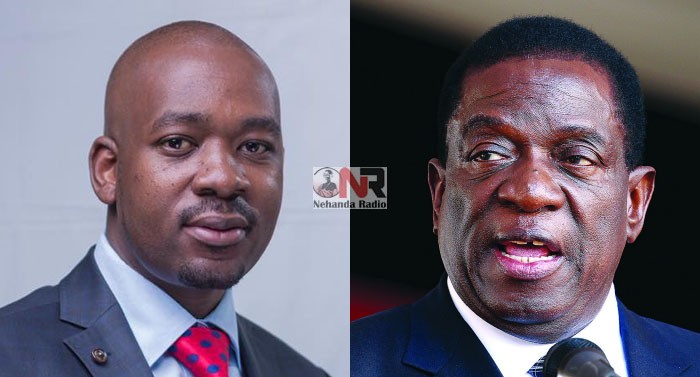
Opposition leader Nelson Chamisa and President Emmerson Mnangagwa
Yes, democracy – that Greek invention that opened the eyes of the world to a profound dimension to human civilization – governments of the people, by the people and for the people.
But there is nothing Greek, or civilized about the crazy time we are going through right now.
The atmosphere is loaded, pregnant with weird spontaneity. Suspend disbelief to grasp some of the pronouncements Zimbabweans have to contend with.
We’ve even had promises of bullet trains where no railway lines exist; spaghetti roads when existing ones a rutted tracks unfit even for ox-drawn carriages, village airports where aircraft may need to hop over jutting kopjes – all signifying instant economic transformation.
We must also believe in a magic wand to bring container-loads of cash to the banks so we would no longer need to sleep in bank queues. Trust that millions of jobs will instantly materialize, and we will all enjoy free health care and education. Incredibly, even corruption will be vanquished and poverty eradicated. Everything that Zimbabweans so desperately long to hear. And believe too.
This is time to bamboozle the imagination of a traumatized populace. Monsters turn into angels, rocks into pearls, blood into a sparkling elixir of life – the wailing of tortured souls reverberates like sweet music – for behold, an anointed savior approaches from this profusion of electoral pandemonium. And you my brother, miss not this golden opportunity to exercise your God-given right to vote – thus rings the clarion call with incessant monotony.
Monstrous banners bearing images of contesting candidates, their oily smiles fixated at capturing the hearts and souls of a bruised population, suddenly emblazon every open wall space on dilapidated buildings and fence posts. Ageing Jacaranda trees leaning languidly over equally dilapidated roads and streets are bedecked with sizzling regalia. Ahoy – it is election season in Zimbabwe – eyes, ears, minds preened for the historic plebiscite.
It gets even more interesting.
Suspension of disbelief foisted on the population as candidates outdo each other in the manifesto stakes. They somehow feel they have a license to treat the electorate like inveterate retards who will believe in anything and everything.
The ruling Zanu PF is telling supporters all their desires over the past 38 years will suddenly be fulfilled by the “new dispensation” despite the fact that the actors are the same ones from the previous one. Minus, of course, deposed dictator Robert Mugabe and his band of not-so-merry G-40 acolytes.
Political views in Zimbabwean parlance are not just about making promises that one has neither the will nor the wherewithal to fulfill. It is mostly about being the loudest, and finding the choicest fibs and expletives to vilify and discredit opponents.
Truth is no object – you can even flatter your listeners by ascribing to them supernatural powers of anointing kings, and vanquishing villains. Outrage sells when competition is at its most intense.
This little diversion is in order.
Indeed, the July 30 poll is rendered all the more riveting by the absence from the ballot paper of the dour image of the founding father, Robert Mugabe and his long time nemesis, Morgan Tsvangirai of the Movement for Democratic Change (MDC) who sadly passed away last February (May his soul rest in peace).
Meanwhile, 94 year-old Mugabe, with a sardonic smirk on his wrinkled brow, gazes upon the unfolding drama from the sidelines where events of November 15, 2017 consigned him. A cruel twist to a long and illustrious political career that ended abruptly with not as much as a whimper.
For the older generation – there is something surreal about the prevailing scenario not unlike the 1980 independence elections. The undisguised euphoria of a new dawn – a nation awakening from the stupor of a prolonged affliction of a deleterious condition. Mugabe had become something of a national curse – a malignant tumor on the soul of the nation which, although excruciating for many, Zimbabweans endured with remarkable stoicism.
And that is because Zimbabweans are truly a remarkable people. The euphoria of the July 30 plebiscite has aroused political passions never before witnessed in Zimbabwe since independence in 1980. Despite the peculiar circumstances, the coup de tat, which perpetrators chose to sanitize by calling it “Operation Restore Legacy” the result was welcomed with jubilation as thousands marched on the streets of Harare to celebrate the fall of Mugabe on November 18.
Even those that hero-worshiped him and eulogized him as the “one centre of power” in the “revolutionary party” now admit his pervasive grip of all institutions of governance rendered him untouchable. Cowards who cringed in his wake suddenly found their voices to denounce “the dictator” who had become “captured” by his ambitious wife. The old adage, power corrupts and absolute power corrupts absolutely, became symbolic of Mugabe’s rule.
Those opposing or criticizing him did so at great peril to themselves. The mysterious and still unsolved disappearance of human rights activist cum-journalist Itai Dzamara, among scores of others, remain a sobering testament to the fate of those who dared Mugabe’s four decades of iron fisted rule. But that’s a story for another day.
Back in the present, in this pulsating milieu, 1 652 Zimbabweans from 55 political parties are contesting the 210 available National Assembly seats while an unprecedented 23 are gunning for the presidency in the 2018 elections.
It is not the intention of this discussion to de-campaign anyone, but an attempt to interrogate that which has inspired so many and given them the confidence to seek public office. It is an attempt to focus on merits and demerits of the ambitions of the candidates in a holistic and objective way.
Let us suppose the aspiring leaders –presidential hopefuls, MPs, Councillors, the whole gamut, had to undergo an aptitude test to assess their suitability of the offices they seek would even a small fraction of them pass the test. Questions would, for instance, seek to show proof of commitment to public service, a track record of community involvement, basic numeracy to an average literacy level, and proof of well grounded understanding of key fundamentals of informed governance.
From the patently ridiculous pronouncements many of them are making, do most of them have the slightest inkling or understanding of how governments operate? Do they have basic knowledge of institutional dynamics in government administrative structures to be able to marshal the capital, human and other requisite resources necessary to drive a nascent 21st century democracy.
One gets the sense that many of the candidates may actually have a romantic notion that power is all about the occasional waffle in public fora or in Parliament as the key criteria and measure of performance in the lofty offices they seek to occupy. How can the electorate be assured the men and women, well-meaning as they all seem, are not just seeking power for the sake of it.
Power without responsibility – as such was the fundamental weakness of the Mugabe leadership modus operandi where merit, experience and competence were subordinated to the whims of political expediency.
When one talks of eradicating poverty, do they understand the sociological dynamics within which poverty thrives and what effective mechanisms are feasible to combat the scourge. The catastrophic failure of the condemned Mugabe administration was precisely a failure to grasp the basic tenets of effective governance. To be charitable, one might say perhaps more likely out of ignorance rather than by design, Mugabe allowed state institutions to collapse around him with the consequence of virtually centralizing their functions in his office.
Government became a medium to rubber-stamp his decisions while leaders in the state institutions, stripped of any real power, focused on feathering their own nests resulting in run-down state institutions and run-away corruption at every level. Not surprisingly, many were quite happy to subsist in this miasma content to follow the leader in blaming their failures on so called illegal sanctions imposed by the evil West.
Therefore, in my view the greatest challenge for the Zimbabwean voters on July 30 is sifting through the bombast and dishonest rhetoric to identify genuine talent and conviction among the multitude of candidates. This is a lot easier said than done for a people emerging from a painful history of electoral skulduggery, violence, intolerance and opaque leadership.
Leading contenders, Zanu PF’s Emmerson Mnangangwa, with the advantage of incumbency, and MDC Alliance’s Nelson Chamisa, whose youthfulness and a clean past may stand him in good stead, may not necessarily be the best candidates for the high office. But as things stand, and if the numbers being bandied around are anything to go by, they represent the most likely choices Zimbabweans have.
So it stands to reason that one of them may well be the next president of Zimbabwe.
The rest we can only entrust to divine intervention.
Desmond Kumbuka is a freelance journalist based in Harare and can be reached on [email protected]
A PAIR of twins (originally from Zimbabwe) have been jailed after repeatedly raping and sexually assaulting an 11-year-old girl over a period of months.
Bolton Crown Court
Steven and Stanley Muchemwa, aged 31, were given 14 and 15 year sentences respectively yesterday at Bolton Crown Court after a judge branded the abuse “particularly shocking”.
The offences occurred at the twins’ home in Dunsop Drive, Bolton, where both men raped her, usually in their bedroom and sometimes when other children were also sleeping in the same room.
During the course of the trial the girl’s mother told Judge Graeme Smith that her world had “come crashing down around her” when she heard what had been happening.
The girl’s mother said she was “completely shocked” after her daughter revealed the ordeal to the head teacher at her school and “devastated” that she had trusted the men to take care of her.
She went on to say that there had been a “massive change” in the girl’s personality since the incidents, saying she had become “clingy” and was not sleeping well due to bad dreams.
The court heard that Steven first started touching the girl early in 2016 when she was just 10 years old, while the pair would go on to rape her in the school summer holidays after she had turned 11.
Giving evidence during the trial, the girl said that, when Steven first raped her, his brother Stanley had walked into the room while it was happening but had taken no action to stop it.
Both men had initially pleaded not guilty to the charges, although Steven would go on to change his plea to guilty before the trial began.
Prosecuting, Kathryn Johnson, said: “Stanley had seen what his brother was doing. It was following that that Stanley started to rape her.”
Adding: “He would tell her he was teaching her what to do for when she had a boyfriend.”
Ms Johnson went on to say that Stanley had told the girl she would get into trouble if she told anyone about what had been happening.
She told her head teacher in October 2016, in what Judge Smith described as a “brave decision”.
Ms Johnson recounted what the teacher found, saying the girl was in an “extremely distressed state” when she began to explain her experiences.
She added: “Initially she wouldn’t explain why she was so upset. She told the headteacher she had been abused.
“Police and social services attended and spoke to her and her mother was contacted.”
Following a trial earlier this year, Stanley was found guilty of one count of sexual assault of a child under 13 and four counts of rape of a child under 13.
His brother Steven was found guilty of two counts of sexual assault and seven counts of rape, both of a girl under 13.
He was also found guilty of one count of assault on a female, and a further count of causing or inciting a child to engage in sexual activity.
HARARE – The Zimbabwe Election Support Network (Zesn) has called on the Zimbabwe Electoral Commission (Zec) to avail an electronic version of the voters’ roll for the July 30 elections to avoid unnecessary conflict.
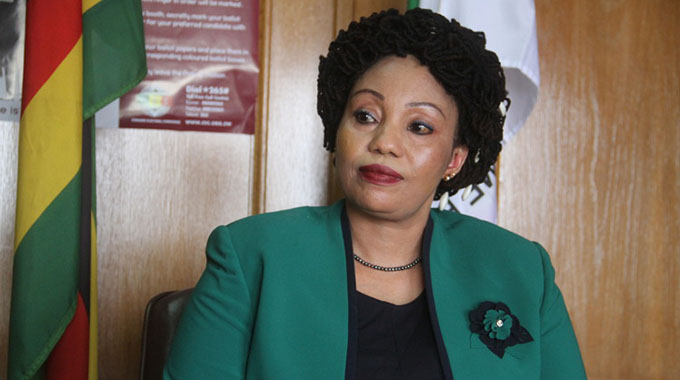
Zec chairperson, Priscilla Chigumba
In a statement following their own independent audit of the voters’ roll which concluded that there were not so many irregularities on it as given to stakeholders by Zec, Zesn chairperson Andrew Makoni said because they do not have it in electronic format they could not establish if the Priscilla Chigumba-led electoral body’s de-duplication process had not had an impact on the final roll.
“Zesn was not able to assess the impact of the de-duplication process itself as the Zec has not provided an electronic copy of the 2018 Preliminary Voters’ Roll or the Exclusion List so in the interest of transparency Zesn encourages the Zec to release these documents to interested stakeholders,” the statement reads in part.
The elections monitoring body also said it was evident that the Zec continues to make revisions to the 2018 voters’ roll making the Zesn findings inconclusive.
“For example, there are 11 344 more registrants on the List of Polling Stations released by Zec on 7 July 2018 than on the 2018 voters’ roll.
“Zesn calls on the Zec to provide political parties and observer groups with the version of the voters’ roll that will be issued to polling stations and used on election day, “Makoni said.
The Nelson Chamisa-led MDC Alliance has particularly been at the forefront in demanding that Zec releases the roll before polling day in line with the dictates of the Electoral Act.
According to Zesn, more than two million voters who appeared on the 2013 preliminary voters’ roll failed to find their way onto the 2018 biometric voters’ roll (BVR).
It concluded that the 2018 voters’ roll was way better than that used in 2013 and could have resulted in the removal of the problematic ghost voters that hogged the limelight in that poll.
“Overall, Zesn finds that the 2018 voters’ roll received on June 18 is an improvement over the 2013 preliminary voters’ roll.
“2 676 395 (45 percent registrants on the 2013 preliminary voters’ roll could not be matched by national ID number to the 2018 voters’ roll and, therefore, are likely to no longer be registered.
“Over 2 470 156 (43 percent ) of registrants on the 2018 voters’ roll are likely to be first time registrants as their ID numbers are not included in the 2013 voters’ roll,” Zesn said in its findings.
“Overall, rural registration decreased by 436 457 (10 percent) while urban registration increased by 230 218 (14 percent,” Zesn said.
The report raised red flags, saying over 5 percent of the registered voters using the same address were posted to different wards, which did not make sense.
“263 998 (5 percent) registrants registered at addresses for which there are registrants are assigned to different wards.
All registrants with the same address should be assigned to the same ward,” the report read.
Zec must avail the final voters’ roll to observers and political party agents, poll observer group, the Election Resource Centre (ERC), has said.
Meanwhile, ERC director Tawanda Chimhini, said the provisional voters’ roll must also be posted outside the polling stations.
“We need to help the election Commission put up the necessary infrastructure that guarantees that the final voters’ roll is the roll that will be used on polling day.
“The voters’ roll that will be used on the polling day must be availed to observers and political party agents so that when voting is happening there is independent verification of people voting.
“The final voters’ roll can also be posted outside the polling stations,” Chimhini said.
Zec has been embroiled with civic groups and the opposition political parties on the voters’ roll.
Chimhini added that there is need to champion transparency and accountability in finalising the voters’ roll.
“There is need to ensure that all the subsequent processes in coming up with the final voters’ roll are characterised by transparency, accountability and verifiability of everything that has happened in the past,” the ERC executive director said.
He, however, acknowledged that there have been some improvements around the voters’ roll that Zec released compared to the previous ones.
“While we acknowledge that indeed some issues have been addressed the things that are being picked up as challenges are things that we hope that the election Commission will be able to pick up quickly in finalising this roll,” Chimhini said. Daily News.
After spending more than 10 years without receiving municipal water, residents of Mabvuku and Tafara heaved a sigh of relief last weekend when the Harare City Council (HCC) resumed pumping the resource to their homes.
The two high density suburbs had, for more than a decade, been hard hit by a water crisis, prompting council and aid agencies to drill boreholes in strategic areas for use by the residents.
Following the recent completion of a pipe replacement exercise, HCC has now resumed pumping water to both suburbs.
“We had been making efforts over the last few months to deliver water to Mabvuku and Tafara. Last weekend, people started receiving water and we hope that supply will improve as pipe replacement continues,” said council spokesperson Michael Chideme.
Several other suburbs have had perennial water challenges, among them Hatcliffe, Highlands, Msasa Park, Borrowdale, Hopley, Southley Park, Caledonia, Glen Lorne, Budiriro and parts of Highfield and Glen View.
Chideme told the Daily News yesterday that the affected areas will start receiving water once council has resolved the prevailing challenges impeding them from getting water supplies.
Community Water Alliance (CWA) chairperson Hildarberta Rwambiwa has welcomed the resumption of water supplies to Mabvuku-Tafara, saying the development indicates that HCC was effectively using funds sourced from the Africa Development Bank under Zimfund Phase 2.
She said access to potable water was a constitutional right which all Zimbabweans were entitled to enjoy.
“Progressive realisation of the human right to water entails that government and its agencies must improve sufficiency, availability, accessibility and quality of potable water,” she said.
“The inadequacy of resources should not be an excuse that should be used to place implementation of the right to water on hold”.
The CWA chairperson implored council to expedite the pipe replacement programme to improve distribution to the rest of Harare.
She also urged residents to pay for services in order to guarantee the sustainable provision of water in their areas.
“As we head towards 30 July 2018 elections, our votes should reflect our demand for availability, accessibility and quality of potable water. We should vote for issues and water is a very important issue within local authorities in Zimbabwe,” Rwambiwa said.
While rehabilitation is being done on the city’s distribution network and water treatment plants, rationing has not been ruled out with officials arguing that the growing population is bearing heavily on water supply. Daily News.
HARARE – The ruling Zanu PF party is being accused of hijacking the distribution of food aid and farming inputs —to make sure opposition members in Mashonaland East’s Uzumba constituency do not access them.
A Zimbabwean gathers cobs in a sack for milling at her village in Musana Bindura on September 2, 2015. Photo: AFP PHOTO/JEKESAI NJIKIZANA
Supporters of the MDC Alliance claimed that having hijacked the programme, Zanu PF officials were withholding food handouts and farming inputs for the 2018/19 season from them to force them to vote for their candidate in the forthcoming harmonised elections.
In Uzumba’s ward 13, opposition supporters alleged that Livingstone Kademeteme, a local councillor, distributed maize seed on a mountain on Wednesday to avoid MDC supporters who had teamed up to confront him.
Kademeteme denied the allegations.
He instead blamed local traditional leaders of leaving out some names form their respective villages for reasons he said he did not know.
“The people who are probably doing that are local village heads who, for one reason or the other — which I do not know — may choose not to include some of their subjects from the list of beneficiaries and I have since told people in the ward that they should report such cases to me so that I confront the village heads to demand an explanation,” Kademeteme said.
Zanu PF Mashonaland East provincial chairperson Joel Biggie Matiza said the inputs were not enough to be accessed by all, hence the complaints.
“Sometimes the inputs will be few so we distribute them in phases and those who would have been left out at the time may think they have been marginalised because of their political beliefs but that is not the case.
“We distribute government inputs fairly and those who may not be able to get during the first phase will always get on the next one,” Matiza said.
Perckson Kazingizi, an aspiring member of Parliament for the MDC Alliance (Uzumba constituency), however, accused Kademeteme of intimidating his supporters and threatening them with violence if they vote for him.
His will be facing sitting Zanu PF MP Simbaneuta Mudarikwa.
“I have since reported several cases of intimidation and violence but nothing has been done.
“As I speak right now, I am coming from Mutawatawa Police Station to make another report after I was advised by the (MDC) national chairperson) Morgen) Komichi,” Kazingizi said, while calling on the Zimbabwe Electoral Commission to take action.
“People are living in fear here because of the threats and there is every reason to be worried because the people from this side know what Zanu PF is capable of doing going by what they have experienced in the past”.
Mudarikwa was not immediately available for comment as his phone went unanswered.
He is, however, on record as having declared in May last year that his constituency was a “no-go area” for opposition parties — a statement described by the MDC at the time as “reckless, barbaric and meant to incite violence” ahead of the July 30 polls. Daily News.
HARARE – Zimbabwe’s harmonised elections look set to end in a presidential run-off pitting Zanu PF leader and current President Emmerson Mnangagwa and his main rival, Nelson Chamisa, of the MDC Alliance.
Opposition leader Nelson Chamisa and President Emmerson Mnangagwa
A survey by Afrobarometer yesterday, exactly 10 days before the much-awaited crunch July 30 elections, shows Mnangagwa getting 40 percent of the vote, while his closest rival, Chamisa, has 37 percent — necessitating a presidential run-off and possibly a government of national unity (GNU).
“The presidential race tightened a month ahead of July 30 voting among registered likely voters, and incumbent Mnangagwa’s lead over challenger Chamisa (from previous researches) dropped from 11 to just three percentage points between early May and early July,” the survey results show.
According to the Constitution, the winner must get 50 percent plus one vote.
Unlike the other pre-election baseline surveys in April and May by the Pan-African Forum Limited (PAFL) and Trends and Insights for Africa (TIFA) projecting an outright victory for Mnangagwa, “the new findings point toward a close election outcome denying the winner a broad electoral mandate, and confirm majority support for a GNU”.
The Afrobarometer findings also reveal that Chamisa appears to have benefited from a slight increase in party identification and a popular perception that he would be the candidate better able to address Zimbabweans’ top campaign issue — job creation.
The results also suggest that 26 percent of urbanites trust Mnangagwa while in rural areas 48 percent have faith in him.
Chamisa, on the other hand, is trusted by 49 percent of urban dwellers but trails in rural areas where he garnered 30 percent.
According to the report, while the proportion of Zimbabweans who fear becoming victims of electoral violence dropped by eight percentage points since May 2018, the electorate is still wary of the possibility of political violence after the polls.
“Zimbabweans remained apprehensive about the possibility of electoral manipulation: As was the case in May 2018, significant minorities were worried about ballot secrecy, counting of votes, announcement of incorrect results, post-election violence, and the military not accepting election results.
“More than four in 10 Zimbabweans (43 percent) said they personally feared becoming a victim of electoral intimidation or violence.
“The decline in expressions of political fear, the report say, is reinforced by a growing majority (68 percent) who said the current government is performing “fairly well” or “very well” at preventing electoral violence (up from 63 percent in May).”
In May, PAFL — linked to a Zanu PF apologist, Nyekorach Matsanga — claimed that Mnangagwa would win 70 percent of the vote if elections were held at that point in time, while Chamisa would only win 24 percent of the vote.
Earlier, TIFA had given Mnangagwa 68, 5 percent of the vote against Chamisa’s 19,5 percent.
In contrast, a Mass Public Opinion Institute and Afrobarometer, however, predicted at the time a closely contested presidential race between Mnangagwa and Chamisa, saying the Zanu PF leader, aged 75, could get 42 percent of the vote, while his rival who turned 40 on February 2, could garner 31 percent.
There have been reports of discussions to shepherd the country’s main political actors into a second GNU to avoid possible tensions after the July 30 ballot which could exacerbate a hugely polarised political atmosphere currently obtaining in the country.
Under the facilitation of academic, Ibbo Mandaza, there were exploratory discussions last month. These discussions could be continued depending on the response from the main parties, especially Zanu PF and the MDC.
“We have been facilitating the talks since 2015 and, in light of what we think would be a disputed election, we are focusing on a post-election transitional authority so as to bring about peace and reconciliation, and a return to constitutionalism which includes the army going back to the barracks.
“We are aware that some parties are already talking about a GNU and we will talk to Zanu PF when the time comes. This is a platform where concerned parties are also talking to the region and the international community for re-engagement. We spoke to representatives of all (the) political parties but there were no principals,” said Mandaza at the time, without specifying the parties that took part in the talks. Daily News.
HARARE – In a sentence that could serve as a deterrent to would-be offenders, four villagers have been slapped with a total of 36 years — each serving nine years’ imprisonment — after they were found guilty of hunting a specially protected animal.
Poachers target rhino calves in Zimbabwe
Masvingo magistrate Peter Madiba handed down the sentence after a full trial that will now see Godfrey Makechemu, 47, Ignatius Maiga, 30, Farai Chauno, 27, and Celestino Shate, 35, spending lengthy jail terms.
Madiba ruled that the quartet, not being holders of a valid permit had intentionally and unlawfully hunted rhinoceroses, which are specially protected animals by following their spoor.
They were also found guilty of a second count of possession of a firearm without a firearm certificate as well as a third count of contravening the Firearms Act by fitting onto a firearm a silencing device without having obtained written permission of the comptroller.
The complainant was represented by legal counsel Prisca Daka of Speak out for Animals (Sofa) — an animal law organisation based in Zimbabwe with lawyers dedicated to protecting animals through the legal system.
The organisation was founded by Ever Vimbai Chinoda, whilst pursing her LLM in Animal Law at Lewis and Clark Law School in April, 2017.
During trial it was proven that on the December 17, 2017, at Save Valley Conservancy, Bikita, Masvingo, the four accused persons hatched a plan to hunt and kill some rhinoceros.
The court heard that on the same date, the game rangers who were on patrol discovered rhino spoor alongside human footprints as well as traces of blood alongside the rhino spoor and a tennis shoe was also discovered.
The game rangers tracked the spoor and found a 404 spent cartridge.
They intensified the tracking of the accused persons before laying an ambush along Chiremwaremwa Road outside the conservancy which was the possible escape route.
While waiting, a silver Toyota Fortuner driven by Maiga entered the ambushed area from the northern side of the conservancy.
The vehicle was stopped by the rangers who went on to search the vehicle from where they discovered an axe, 404 rifle fitted with a telescopic device and a silencer.
Eleven rounds of ammunition where also discovered from the right side of Maiga’s pocket.
The tennis shoes which accused five was wearing were also received and produced in court as part of the exhibits.
They were later convicted of infringing Section 45(1)(a) of the Parks and Wild Life Act [Chapter 20:14] which provides that No person shall — hunt any specially protected animal. Daily News.
HARARE – Harare City Council has begun installing high mast lighting or tower lights in 11 high and medium density suburbs.
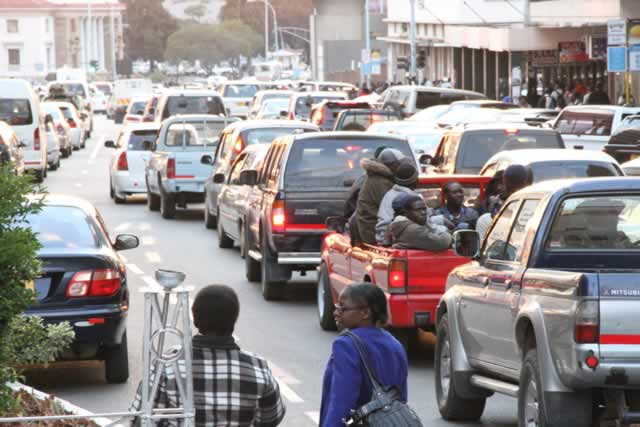
Traffic in Harare
Council spokesperson Michael Chideme said the idea is to have a safe and well-lit city for the residents to enjoy.
The tower lights come as the city was blasted during a 100-day review for keeping their tower lights lit during the day which cost the city thousands in electricity bills every month.
“Among some of the suburbs to benefit are Msasa Park, Mbare, Westlea, Rugare, Cold Comfort and Kuwadzana extension. We did this to ensure residents’ safety especially during the night,” Chideme said.
He added that teams are already on the site to erect tower lights which will be distributed among the suburbs.
At a 100-day Rapid Results Review workshop recently, city engineer Calvin Chigariro complained how tower lights were being left on during the day resulting in high power bills monthly.
Chigariro said the city had to rely on complaints by residents as council did not have a central switch for the lights.
“The city’s power bill is very high and this is not only from residents in Mbare flats and institutional use but also from tower lights. We were once billed $100 000 for a single tower light that had not been paid for since 2013,” he said.
According to the State of the City’s Address earlier this year, a total of 1 050 solar street lights have been installed across Harare.
An additional 110 were installed along Kirkman Road all achieved through public private partnerships. Repairs of old street lights was also done in areas such as Belvedere, Cranborne, Milton Park and Gunhill. Daily News.