President Emmerson Mnangagwa has called for racial unity ahead of landmark elections, telling white farmers their lands will not be taken.
Supporters of Zimbabwean President Emmerson Mnangagwa listen to his address during a rally organized for the white community in Harare, Saturday, July 21, 2018. Zimbabwe’s president is trying to rally white minority voters as the race in this month’s historic election becomes too close to call. President Emmerson Mnangagwa told a meeting in the capital, Harare, that the era of land seizures from white farmers is over. The deeply unpopular land grabs under former leader Robert Mugabe contributed to the economic collapse of the once-prosperous country. (AP Photo/Tsvangirayi Mukwazhi)
Former President Robert Mugabe’s government supported the seizure of hundreds of white-owned farms which they saw as unfairly taken by settlers.
But Mr Mnangagwa, 75, told a crowd in Harare that the controversial policy was a thing of the past.
“We should cease to talk about who owns the farm in terms of colour,” he said.
“It is criminal talking about that. A farmer, a black farmer, a white farmer, is a Zimbabwean farmer.”
Supporters of Zimbabwean President Emmerson Mnangagwa listen to his address during a rally organized for the white community in Harare, Saturday, July 21, 2018. Zimbabwe’s president is trying to rally white minority voters as the race in this month’s historic election becomes too close to call. President Emmerson Mnangagwa told a meeting in the capital, Harare, that the era of land seizures from white farmers is over. The deeply unpopular land grabs under former leader Robert Mugabe contributed to the economic collapse of the once-prosperous country. (AP Photo/Tsvangirayi Mukwazhi)
Mr Mnangagwa’s move to ease the concerns of white voters comes ahead of historic elections on 30 July.
White Zimbabweans have traditionally voted for opposition parties such as the Movement for Democratic Change (MDC) as opposed to Mr Mnangagwa’s Zanu-PF party.
A supporter of President Emmerson Mnangagwa listens to his address during a rally organized for the white community in Harare, Saturday, July 21, 2018. Zimbabwe’s president is trying to rally white minority voters as the race in this month’s historic election becomes too close to call. President Emmerson Mnangagwa told a meeting in the capital, Harare, that the era of land seizures from white farmers is over. The deeply unpopular land grabs under former leader Robert Mugabe contributed to the economic collapse of the once-prosperous country. (AP Photo/Tsvangirayi Mukwazhi)
He told the crowd that his government was “racially blind” and acknowledged the failure of his predecessor’s controversial land reforms.
The farm seizures led to a crash in Zimbabwe’s agricultural output, an exodus of skilled white farmers and widespread unemployment among black farm labourers.
There are more than 120 political parties registered for this month’s elections, and there are likely to be 23 presidential candidates to choose from on the ballot.
Supporters of Zimbabwean President Emmerson Mnangagwa listen to his address during a rally organized for the white community in Harare, Saturday, July 21, 2018. Zimbabwe’s president is trying to rally white minority voters as the race in this month’s historic election becomes too close to call. President Emmerson Mnangagwa told a meeting in the capital, Harare, that the era of land seizures from white farmers is over. The deeply unpopular land grabs under former leader Robert Mugabe contributed to the economic collapse of the once-prosperous country. (AP Photo/Tsvangirayi Mukwazhi)
Mr Mnangagwa is favourite to win the poll, but analysts say he also has enemies – both for overthrowing his former mentor and for being a previous enforcer of Mr Mugabe’s government.
The main opposition leader is Nelson Chamisa, 40, a lawyer and preacher who rose to the top of the MDC in February.
He is hugely popular, especially among the young and unemployed, and would become the country’s youngest ever president if elected.
The youth vote is expected to be key. More than half of Zimbabweans are now under 25 and about 43.5% of registered voters are under 35. BBC News
Zimbabwe’s President Emmerson Mnangagwa addressed a crowd of white voters on Saturday in an attempt improve relations ahead of a July 30 election, a marked shift from his predecessor Robert Mugabe whose policies became increasingly racially divisive.
A child plays next to Zimbabwean President Emmerson Mnangagwa’s election campaign poster during a rally organized for the white community in Harare, Saturday, July 21, 2018. Zimbabwe’s president is trying to rally white minority voters as the race in this month’s historic election becomes too close to call. President Emmerson Mnangagwa told a meeting in the capital, Harare, that the era of land seizures from white farmers is over. The deeply unpopular land grabs under former leader Robert Mugabe contributed to the economic collapse of the once-prosperous country. (AP Photo/Tsvangirayi Mukwazhi)Supporters of Zimbabwean President Emmerson Mnangagwa listen to his address during a rally organized for the white community in Harare, Saturday, July 21, 2018. Zimbabwe’s president is trying to rally white minority voters as the race in this month’s historic election becomes too close to call. President Emmerson Mnangagwa told a meeting in the capital, Harare, that the era of land seizures from white farmers is over. The deeply unpopular land grabs under former leader Robert Mugabe contributed to the economic collapse of the once-prosperous country. (AP Photo/Tsvangirayi Mukwazhi)A supporter of President Emmerson Mnangagwa listens to his address during a rally organized for the white community in Harare, Saturday, July 21, 2018. Zimbabwe’s president is trying to rally white minority voters as the race in this month’s historic election becomes too close to call. President Emmerson Mnangagwa told a meeting in the capital, Harare, that the era of land seizures from white farmers is over. The deeply unpopular land grabs under former leader Robert Mugabe contributed to the economic collapse of the once-prosperous country. (AP Photo/Tsvangirayi Mukwazhi)Supporters of Zimbabwean President Emmerson Mnangagwa listen to his address during a rally organized for the white community in Harare, Saturday, July 21, 2018. Zimbabwe’s president is trying to rally white minority voters as the race in this month’s historic election becomes too close to call. President Emmerson Mnangagwa told a meeting in the capital, Harare, that the era of land seizures from white farmers is over. The deeply unpopular land grabs under former leader Robert Mugabe contributed to the economic collapse of the once-prosperous country. (AP Photo/Tsvangirayi Mukwazhi)Supporters of Zimbabwean President Emmerson Mnangagwa listen to his address during a rally organized for the white community in Harare, Saturday, July 21, 2018. Zimbabwe’s president is trying to rally white minority voters as the race in this month’s historic election becomes too close to call. President Emmerson Mnangagwa told a meeting in the capital, Harare, that the era of land seizures from white farmers is over. The deeply unpopular land grabs under former leader Robert Mugabe contributed to the economic collapse of the once-prosperous country. (AP Photo/Tsvangirayi Mukwazhi)A supporter of President Emmerson Mnangagwa listens to his address during a rally organized for the white community in Harare, Saturday, July 21, 2018. Zimbabwe’s president is trying to rally white minority voters as the race in this month’s historic election becomes too close to call. President Emmerson Mnangagwa told a meeting in the capital, Harare, that the era of land seizures from white farmers is over. The deeply unpopular land grabs under former leader Robert Mugabe contributed to the economic collapse of the once-prosperous country. (AP Photo/Tsvangirayi Mukwazhi)
Mnangagwa, who came to power when Mugabe was removed in a de facto coup in November, is on the campaign trail ahead of what is expected to be a tight contest with his main rival, Nelson Chamisa, the 40-year-old leader of the Movement for Democratic Change (MDC).
The white Zimbabweans who are left in the country – estimated at around 30,000 – would usually vote MDC or for another opposition party, given the strained relationship with Mnangagwa’s ruling ZANU-PF.
But Mnangagwa, a 75-year-old former Mugabe ally, has pledged to fix racial divisions and end the violent seizure of white-owned commercial farms, a policy that Mugabe said was intended to redress post-colonial imbalances.
Many farms ended up in the hands of powerful politicians, soldiers or local chiefs and fell into disrepair.
“I know of some chiefs who have moved from one farm to another. Then they run it down. Then he leaves that farm and he is issued another one. He runs it down. That time is gone,” Mnangagwa told a crowd of several hundred white Zimbabweans in Borrowdale, a wealthy suburb in the capital Harare.
Mnangagwa is hoping to revive a once promising economy, end chronic cash shortages and bring down soaring unemployment. In order to do this he needs the help of Western donors who want to see the issue of white-owned land addressed.
Many of the white Zimbabweans in the albeit partisan crowd saw Mnangagwa’s fig leaf as a major turning point.
“He’s recognising everyone as the same. We’re all one now, which is beautiful,” said mining engineer Cais Carstens.
“This has never happened before, so it’s good.”
Opponents dismissed the event as a publicity stunt backed by people with political and financial interests.
“I’m not surprised. You have to look at where this took place,” said David Coltart, an MDC senator.
“There are some very wealthy whites there who have long established connections with ZANU. It’ll be the community who have business connections.”
SLAVE era American political activist Harriet Tubman once said, “Every great dream begins with a dreamer. Always remember, you have within you the strength, the patience, and the passion to reach for the stars to change the world”.
Kuda Mahachi with Elizabeth Malunga
These above words are certainly ringing true in the ears of Warriors midfield talisman Kudakwashe Mahachi who for several years harboured a dream of turning out for The Ghost, as Soweto giants Orlando Pirates are popularly known.
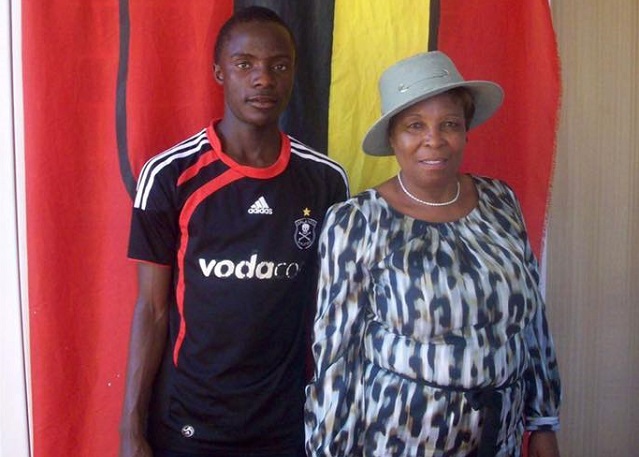
A quick scroll through his Facebook picture archive reveals that 10 years ago, Mahachi was just another budding soccer player gleefully posing for pictures in Orlando Pirates’ traditional black and white stripes.
One can never erase their digital footprint and the internet never forgets, and this is certainly true for Mahachi whose decade-old yearning is about to be satisfied as he has moved to a club that he used to post about enthusiastically on social media.
In the picture, that was taken at Bantu Rovers offices, a skinny Mahachi stands side by side with well-known Zimbabwe Women’s Football administrator, Elizabeth Malunga, donning an Orlando Pirates replica jersey.
Fast forward to 2018, he captions the picture “Dreams do come true indeed” and the former Golden Arrows midfielder believes joining Orlando Pirates was a huge transition in his career.
The 24-year-old winger spent three years at Golden Arrows, on loan from Mamelodi Sundowns. He completed his move to the Soweto Giants last month.
Mahachi admits he will need some time to adapt.“It is a huge transition coming from a small team to a big team, and it takes a bit of time to understand because there is a huge difference in approach,” he said.
“We train differently, we prepare differently and the overall level of professionalism is amazing. Not only do we analyse the opponent which is the norm but we also have to analyse ourselves from a group perspective and at an individual level,” added the ginger haired footballer.
The former Chicken Inn player will play alongside fellow Zimbabwean, Marshall Munetsi.
“It will take time for me to gel because I’m naturally a shy person. It helps to have my Zimbabwean homeboy Marshall Munetsi and people like Thembinkosi Lorch whom I enjoy speaking to. The process has also been made simple by the fact that I know most of the players here,” he said. B-Metro.
HE religiously took the advice of his Sensei — a Japanese term for a karate teacher or master — that his skills are only meant for the ring but never for ordinary members of the public.
Flatah Ndlovu
As such he endures the occasional thorough beating from his wife but despite being trained in martial arts he never retaliates.
That’s the story of Kennas Khumalo who is often heard by his neighbours wailing in agony from beatings allegedly administered by his wife Flatah Ndlovu.
The couple lives in Mpopoma suburb in Bulawayo.
It’s not unusual for neighbours to see or hear the father of two pleading for forgiveness as the wife beats him up with an electric chord.
For all the pain and humiliation that he endures, Khumalo opened up to B-Metro.
“My wife beats me up so badly using anything she can lay her hands on including an electric chord and sometimes even bites me. The scars that you see on my arms are not from fighting other people but were inflicted by my wife,” said Khumalo as he showed this reporter injuries from the alleged beatings.
Asked why he doesn’t leave his seemingly abusive wife, Khumalo replied: “She threatens to commit suicide if I leave her.”
A neighbour, who is a friend to Khumalo but requested anonymity, described how the tormented man was beaten up like a child being punished by a parent.
“It’s so sad to hear a grown man screaming like a child being disciplined by a parent when he is being beaten by his wife. Every time he arrives home late or does not give his wife money, he gets a hiding,” said the neighbour.
The alleged “husband beater” Ndlovu doesn’t see anything wrong with “disciplining” the father of her children. In fact, she calls him a whiner who cries whenever she raises the whip.
“It is not like I beat my husband, we do fight but he whines a lot, he is very emotional and always cries when we disagree,” said Ndlovu. B-Metro.
A 28-YEAR-OLD man broke into a 68-year-old granny’s house, assaulted her, raped her five times and sodomised her twice.
Isheanesu Dzingiso (28) of Plot 15, Julena in Somabhula allegedly abused the old woman until she urinated on herself.
In 2016, he was convicted of unlawful entry, assault, aggravated indecent assault and rape by Gweru regional magistrate Morgan Nemadire.
Dzingiso was sentenced to 60 years imprisonment on all the counts, but 10 years were suspended on condition of good behaviour.
For count one and two Dzingiso was sentenced to 10 years in prison and for counts three to seven he was sentenced to 10 years imprisonment for each leaving him with an effective 50 years in jail.
Bulawayo High Court judge Justice Martin Makonese sitting with Justice Thompson James Mabhikwa during a criminal appeals court reduced the sentence to 21 years following an appeal by Dzingiso challenging his sentence.
In his grounds of appeal through his lawyers Gundu and Dube Legal Practitioners, Dzingiso argued that the sentence imposed by the court a quo was excessive and induced a sense of shock.
He said the magistrate erred by failing to treat the five counts of rape as one for purposes of sentence.
They further argued that there was unnecessary splitting of charges by the lower court.
Justice Makonese said the custodial sentence imposed on Dzingiso was too harsh and severe. He set aside the sentence and substituted it with an effective 21 years and six months imprisonment.
Justice Makonese said all the five counts of rape would run concurrently.
According to State papers, on September 13 in 2016, the 68-year-old woman was alone at her homestead when Dzingiso broke into her house.
Dzingiso gained entry into the complainant’s bedroom by damaging the door hinge.
At around 12 midnight, Dzingiso found the complainant standing by the door and forced her to sit down but she managed to pull his legs and he fell down. Dzingiso rose from the floor and punched and slapped the complainant several times on her face.
He grabbed the complainant’s neck and started head butting her on her forehead several times and the granny suffered some bruises on her neck and face.
The complainant fell unconscious due to the attack and Dzingiso lifted her dress and raped her.Dzingiso also tore the victim’s dress and raped her once more through the anus. He raped her five times and stopped when she urinated.
Dzingiso covered the complainant with a blanket and told her to go to sleep. However, she managed to sneak out of the house and ran to her neighbour’s house and reported the matter.
The neighbour teamed up with other neighbours and found Dzingiso asleep in the complainant’s bed and tied him up. Dzingiso was taken to the police station the following day and the complainant was referred to Gweru Hospital for treatment. B-Metro.
A Bulawayo woman claimed her cousin dished dirt on her in front of her husband claiming she was a prostitute and that she once bedded a police officer apparently in exchange for favours.
Sitshengiselo Ndlovu in white jersey
Sitshengiselo Ndlovu (pictured above) from Cowdray Park said her cousin Mthulisi Ndlovu was making up stories that she was sleeping with other men in her husband’s absence.
Sitshengiselo said this at the Bulawayo Civil Court where she was seeking a restraining order against Mthulisi claiming she had put her marriage on the brink of collapse because of her accusations that she was cheating on her husband.
Mthulisi Ndlovu
“Mthulisi Ndlovu is my cousin and we have some irreconcilable differences. She has been insulting me while calling me a prostitute in front of my husband and that I slept with a police officer. She also falsely accused me of assaulting her on two separate occasions and following my arrest I was taken to court where I was made to pay a fine for a crime I didn’t commit.
“As if that is not enough, Mthulisi took a herdboy who was looking after my homestead despite the fact that he is wanted by the police in connection with a rape case. She claims the herdboy whose whereabouts are not known now is her relative,” complained Sitshengiselo.
She further said Mthulisi once filed a false police report to the effect that she had stabbed her with a kitchen knife.
In response, Mthulisi however, refuted the accusations saying Sitshengiselo was the one who was in the habit of verbally and physically abusing her.
“It is not true that I’m abusing her. She is the one who is always perpetrating violence against me and as corroboration she was once convicted of domestic violence after she had assaulted me,” said Mthulisi.
In his judgment the presiding magistrate Tinashe Tashaya ordered the two cousins not to abuse each other verbally, physically, and emotionally as well as not to visit each other. B-Metro.
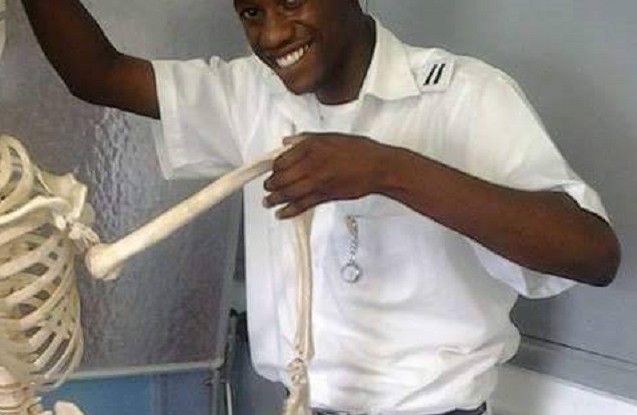
Simbarashe Ndemera (32, pictured above) a nurse at Lutheran Church-run Mnene District Hospital in Mberengwa has disappeared from the face of the earth after the community bayed for blood over his sexual relationship with a teenager.
Simbarashe Ndemera
Parents and his bosses need answers as to why he locked up a Lower Sixth female pupil from the nearby Mnene High School.
Mnene District Hospital shares a boundary with Mnene Primary and High School all of which are also run by the Lutheran Church.
Sources within the church-run institution’s complex said the male nurse had been having an affair with the boarding school girl that he kept at his cottage for four days.
“She went missing and the school authorities then sent an SOS after realising that she was not given a pass to leave the school. The Boarding Mistress then got a tip off that Ndemera was having an affair with the girl and could be the one with her,” said the source.
The source said the Boarding Mistress only identified as Mrs Shava later teamed up with some teachers and went to Ndemera’s bachelor quarters intending to search his room.
“When they got there, they found the room locked with Ndemera inside. He initially denied them entry and told them to obtain a warrant of search from the police if they wanted access to his room. The hospital authorities were later alerted and used force to gain entry into his room where they then found the missing girl,” said the source.
The source said some angry parents later besieged his quarters demanding that he be reported to the police for having an affair with the minor.
The school has since suspended the girl and the under fire Ndemera left work without notice.“It’s a hot issue at Mnene Hospital at the moment. Ndemera just went missing, he is not reporting for duty as we speak.”
Contacted for comment Ndemera confirmed that he was not at work but denied reports he fled the hospital.
“I did not flee, I notified my bosses that I needed to go and see my mother who is not well in Harare. I am in Harare right now but will go back to work,” said Ndemera.
Mnene High School headmaster Francis Hove confirmed that the school would discipline the girl who escaped from the school dormitories without a pass but would not be drawn into commenting further. B-Metro.
Some call it the silly season, perhaps justifiably. Silly probably because whenever Zimbabwe prepares for an election, as is the case now, all manner of creepy crawlies emerge from the woodwork making all kinds of inordinate noises to claim the vote in the name of democracy.
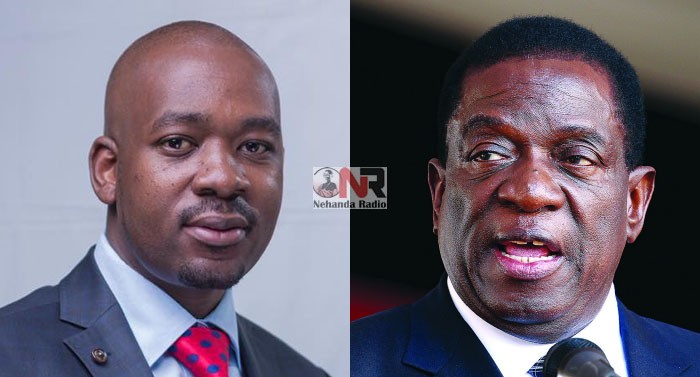
Opposition leader Nelson Chamisa and President Emmerson Mnangagwa
Yes, democracy – that Greek invention that opened the eyes of the world to a profound dimension to human civilization – governments of the people, by the people and for the people.
But there is nothing Greek, or civilized about the crazy time we are going through right now.
The atmosphere is loaded, pregnant with weird spontaneity. Suspend disbelief to grasp some of the pronouncements Zimbabweans have to contend with.
We’ve even had promises of bullet trains where no railway lines exist; spaghetti roads when existing ones a rutted tracks unfit even for ox-drawn carriages, village airports where aircraft may need to hop over jutting kopjes – all signifying instant economic transformation.
We must also believe in a magic wand to bring container-loads of cash to the banks so we would no longer need to sleep in bank queues. Trust that millions of jobs will instantly materialize, and we will all enjoy free health care and education. Incredibly, even corruption will be vanquished and poverty eradicated. Everything that Zimbabweans so desperately long to hear. And believe too.
This is time to bamboozle the imagination of a traumatized populace. Monsters turn into angels, rocks into pearls, blood into a sparkling elixir of life – the wailing of tortured souls reverberates like sweet music – for behold, an anointed savior approaches from this profusion of electoral pandemonium. And you my brother, miss not this golden opportunity to exercise your God-given right to vote – thus rings the clarion call with incessant monotony.
Monstrous banners bearing images of contesting candidates, their oily smiles fixated at capturing the hearts and souls of a bruised population, suddenly emblazon every open wall space on dilapidated buildings and fence posts. Ageing Jacaranda trees leaning languidly over equally dilapidated roads and streets are bedecked with sizzling regalia. Ahoy – it is election season in Zimbabwe – eyes, ears, minds preened for the historic plebiscite.
It gets even more interesting.
Suspension of disbelief foisted on the population as candidates outdo each other in the manifesto stakes. They somehow feel they have a license to treat the electorate like inveterate retards who will believe in anything and everything.
The ruling Zanu PF is telling supporters all their desires over the past 38 years will suddenly be fulfilled by the “new dispensation” despite the fact that the actors are the same ones from the previous one. Minus, of course, deposed dictator Robert Mugabe and his band of not-so-merry G-40 acolytes.
Political views in Zimbabwean parlance are not just about making promises that one has neither the will nor the wherewithal to fulfill. It is mostly about being the loudest, and finding the choicest fibs and expletives to vilify and discredit opponents.
Truth is no object – you can even flatter your listeners by ascribing to them supernatural powers of anointing kings, and vanquishing villains. Outrage sells when competition is at its most intense.
This little diversion is in order.
Indeed, the July 30 poll is rendered all the more riveting by the absence from the ballot paper of the dour image of the founding father, Robert Mugabe and his long time nemesis, Morgan Tsvangirai of the Movement for Democratic Change (MDC) who sadly passed away last February (May his soul rest in peace).
Meanwhile, 94 year-old Mugabe, with a sardonic smirk on his wrinkled brow, gazes upon the unfolding drama from the sidelines where events of November 15, 2017 consigned him. A cruel twist to a long and illustrious political career that ended abruptly with not as much as a whimper.
For the older generation – there is something surreal about the prevailing scenario not unlike the 1980 independence elections. The undisguised euphoria of a new dawn – a nation awakening from the stupor of a prolonged affliction of a deleterious condition. Mugabe had become something of a national curse – a malignant tumor on the soul of the nation which, although excruciating for many, Zimbabweans endured with remarkable stoicism.
And that is because Zimbabweans are truly a remarkable people. The euphoria of the July 30 plebiscite has aroused political passions never before witnessed in Zimbabwe since independence in 1980. Despite the peculiar circumstances, the coup de tat, which perpetrators chose to sanitize by calling it “Operation Restore Legacy” the result was welcomed with jubilation as thousands marched on the streets of Harare to celebrate the fall of Mugabe on November 18.
Even those that hero-worshiped him and eulogized him as the “one centre of power” in the “revolutionary party” now admit his pervasive grip of all institutions of governance rendered him untouchable. Cowards who cringed in his wake suddenly found their voices to denounce “the dictator” who had become “captured” by his ambitious wife. The old adage, power corrupts and absolute power corrupts absolutely, became symbolic of Mugabe’s rule.
Those opposing or criticizing him did so at great peril to themselves. The mysterious and still unsolved disappearance of human rights activist cum-journalist Itai Dzamara, among scores of others, remain a sobering testament to the fate of those who dared Mugabe’s four decades of iron fisted rule. But that’s a story for another day.
Back in the present, in this pulsating milieu, 1 652 Zimbabweans from 55 political parties are contesting the 210 available National Assembly seats while an unprecedented 23 are gunning for the presidency in the 2018 elections.
It is not the intention of this discussion to de-campaign anyone, but an attempt to interrogate that which has inspired so many and given them the confidence to seek public office. It is an attempt to focus on merits and demerits of the ambitions of the candidates in a holistic and objective way.
Let us suppose the aspiring leaders –presidential hopefuls, MPs, Councillors, the whole gamut, had to undergo an aptitude test to assess their suitability of the offices they seek would even a small fraction of them pass the test. Questions would, for instance, seek to show proof of commitment to public service, a track record of community involvement, basic numeracy to an average literacy level, and proof of well grounded understanding of key fundamentals of informed governance.
From the patently ridiculous pronouncements many of them are making, do most of them have the slightest inkling or understanding of how governments operate? Do they have basic knowledge of institutional dynamics in government administrative structures to be able to marshal the capital, human and other requisite resources necessary to drive a nascent 21st century democracy.
One gets the sense that many of the candidates may actually have a romantic notion that power is all about the occasional waffle in public fora or in Parliament as the key criteria and measure of performance in the lofty offices they seek to occupy. How can the electorate be assured the men and women, well-meaning as they all seem, are not just seeking power for the sake of it.
Power without responsibility – as such was the fundamental weakness of the Mugabe leadership modus operandi where merit, experience and competence were subordinated to the whims of political expediency.
When one talks of eradicating poverty, do they understand the sociological dynamics within which poverty thrives and what effective mechanisms are feasible to combat the scourge. The catastrophic failure of the condemned Mugabe administration was precisely a failure to grasp the basic tenets of effective governance. To be charitable, one might say perhaps more likely out of ignorance rather than by design, Mugabe allowed state institutions to collapse around him with the consequence of virtually centralizing their functions in his office.
Government became a medium to rubber-stamp his decisions while leaders in the state institutions, stripped of any real power, focused on feathering their own nests resulting in run-down state institutions and run-away corruption at every level. Not surprisingly, many were quite happy to subsist in this miasma content to follow the leader in blaming their failures on so called illegal sanctions imposed by the evil West.
Therefore, in my view the greatest challenge for the Zimbabwean voters on July 30 is sifting through the bombast and dishonest rhetoric to identify genuine talent and conviction among the multitude of candidates. This is a lot easier said than done for a people emerging from a painful history of electoral skulduggery, violence, intolerance and opaque leadership.
Leading contenders, Zanu PF’s Emmerson Mnangangwa, with the advantage of incumbency, and MDC Alliance’s Nelson Chamisa, whose youthfulness and a clean past may stand him in good stead, may not necessarily be the best candidates for the high office. But as things stand, and if the numbers being bandied around are anything to go by, they represent the most likely choices Zimbabweans have.
So it stands to reason that one of them may well be the next president of Zimbabwe.
The rest we can only entrust to divine intervention.
Desmond Kumbuka is a freelance journalist based in Harare and can be reached on [email protected]
A PAIR of twins (originally from Zimbabwe) have been jailed after repeatedly raping and sexually assaulting an 11-year-old girl over a period of months.
Bolton Crown Court
Steven and Stanley Muchemwa, aged 31, were given 14 and 15 year sentences respectively yesterday at Bolton Crown Court after a judge branded the abuse “particularly shocking”.
The offences occurred at the twins’ home in Dunsop Drive, Bolton, where both men raped her, usually in their bedroom and sometimes when other children were also sleeping in the same room.
During the course of the trial the girl’s mother told Judge Graeme Smith that her world had “come crashing down around her” when she heard what had been happening.
The girl’s mother said she was “completely shocked” after her daughter revealed the ordeal to the head teacher at her school and “devastated” that she had trusted the men to take care of her.
She went on to say that there had been a “massive change” in the girl’s personality since the incidents, saying she had become “clingy” and was not sleeping well due to bad dreams.
The court heard that Steven first started touching the girl early in 2016 when she was just 10 years old, while the pair would go on to rape her in the school summer holidays after she had turned 11.
Giving evidence during the trial, the girl said that, when Steven first raped her, his brother Stanley had walked into the room while it was happening but had taken no action to stop it.
Both men had initially pleaded not guilty to the charges, although Steven would go on to change his plea to guilty before the trial began.
Prosecuting, Kathryn Johnson, said: “Stanley had seen what his brother was doing. It was following that that Stanley started to rape her.”
Adding: “He would tell her he was teaching her what to do for when she had a boyfriend.”
Ms Johnson went on to say that Stanley had told the girl she would get into trouble if she told anyone about what had been happening.
She told her head teacher in October 2016, in what Judge Smith described as a “brave decision”.
Ms Johnson recounted what the teacher found, saying the girl was in an “extremely distressed state” when she began to explain her experiences.
She added: “Initially she wouldn’t explain why she was so upset. She told the headteacher she had been abused.
“Police and social services attended and spoke to her and her mother was contacted.”
Following a trial earlier this year, Stanley was found guilty of one count of sexual assault of a child under 13 and four counts of rape of a child under 13.
His brother Steven was found guilty of two counts of sexual assault and seven counts of rape, both of a girl under 13.
He was also found guilty of one count of assault on a female, and a further count of causing or inciting a child to engage in sexual activity.
HARARE – The Zimbabwe Election Support Network (Zesn) has called on the Zimbabwe Electoral Commission (Zec) to avail an electronic version of the voters’ roll for the July 30 elections to avoid unnecessary conflict.
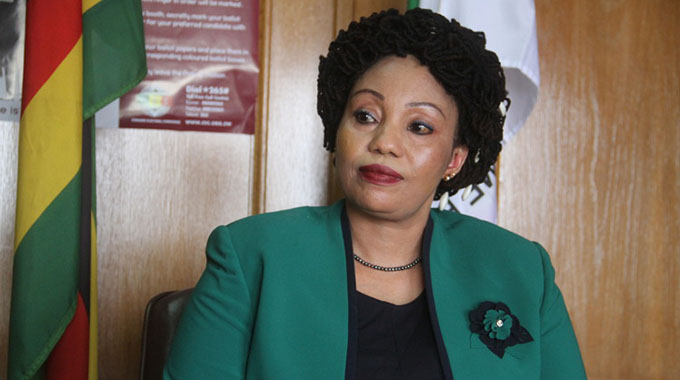
Zec chairperson, Priscilla Chigumba
In a statement following their own independent audit of the voters’ roll which concluded that there were not so many irregularities on it as given to stakeholders by Zec, Zesn chairperson Andrew Makoni said because they do not have it in electronic format they could not establish if the Priscilla Chigumba-led electoral body’s de-duplication process had not had an impact on the final roll.
“Zesn was not able to assess the impact of the de-duplication process itself as the Zec has not provided an electronic copy of the 2018 Preliminary Voters’ Roll or the Exclusion List so in the interest of transparency Zesn encourages the Zec to release these documents to interested stakeholders,” the statement reads in part.
The elections monitoring body also said it was evident that the Zec continues to make revisions to the 2018 voters’ roll making the Zesn findings inconclusive.
“For example, there are 11 344 more registrants on the List of Polling Stations released by Zec on 7 July 2018 than on the 2018 voters’ roll.
“Zesn calls on the Zec to provide political parties and observer groups with the version of the voters’ roll that will be issued to polling stations and used on election day, “Makoni said.
The Nelson Chamisa-led MDC Alliance has particularly been at the forefront in demanding that Zec releases the roll before polling day in line with the dictates of the Electoral Act.
According to Zesn, more than two million voters who appeared on the 2013 preliminary voters’ roll failed to find their way onto the 2018 biometric voters’ roll (BVR).
It concluded that the 2018 voters’ roll was way better than that used in 2013 and could have resulted in the removal of the problematic ghost voters that hogged the limelight in that poll.
“Overall, Zesn finds that the 2018 voters’ roll received on June 18 is an improvement over the 2013 preliminary voters’ roll.
“2 676 395 (45 percent registrants on the 2013 preliminary voters’ roll could not be matched by national ID number to the 2018 voters’ roll and, therefore, are likely to no longer be registered.
“Over 2 470 156 (43 percent ) of registrants on the 2018 voters’ roll are likely to be first time registrants as their ID numbers are not included in the 2013 voters’ roll,” Zesn said in its findings.
“Overall, rural registration decreased by 436 457 (10 percent) while urban registration increased by 230 218 (14 percent,” Zesn said.
The report raised red flags, saying over 5 percent of the registered voters using the same address were posted to different wards, which did not make sense.
“263 998 (5 percent) registrants registered at addresses for which there are registrants are assigned to different wards.
All registrants with the same address should be assigned to the same ward,” the report read.
Zec must avail the final voters’ roll to observers and political party agents, poll observer group, the Election Resource Centre (ERC), has said.
Meanwhile, ERC director Tawanda Chimhini, said the provisional voters’ roll must also be posted outside the polling stations.
“We need to help the election Commission put up the necessary infrastructure that guarantees that the final voters’ roll is the roll that will be used on polling day.
“The voters’ roll that will be used on the polling day must be availed to observers and political party agents so that when voting is happening there is independent verification of people voting.
“The final voters’ roll can also be posted outside the polling stations,” Chimhini said.
Zec has been embroiled with civic groups and the opposition political parties on the voters’ roll.
Chimhini added that there is need to champion transparency and accountability in finalising the voters’ roll.
“There is need to ensure that all the subsequent processes in coming up with the final voters’ roll are characterised by transparency, accountability and verifiability of everything that has happened in the past,” the ERC executive director said.
He, however, acknowledged that there have been some improvements around the voters’ roll that Zec released compared to the previous ones.
“While we acknowledge that indeed some issues have been addressed the things that are being picked up as challenges are things that we hope that the election Commission will be able to pick up quickly in finalising this roll,” Chimhini said. Daily News.