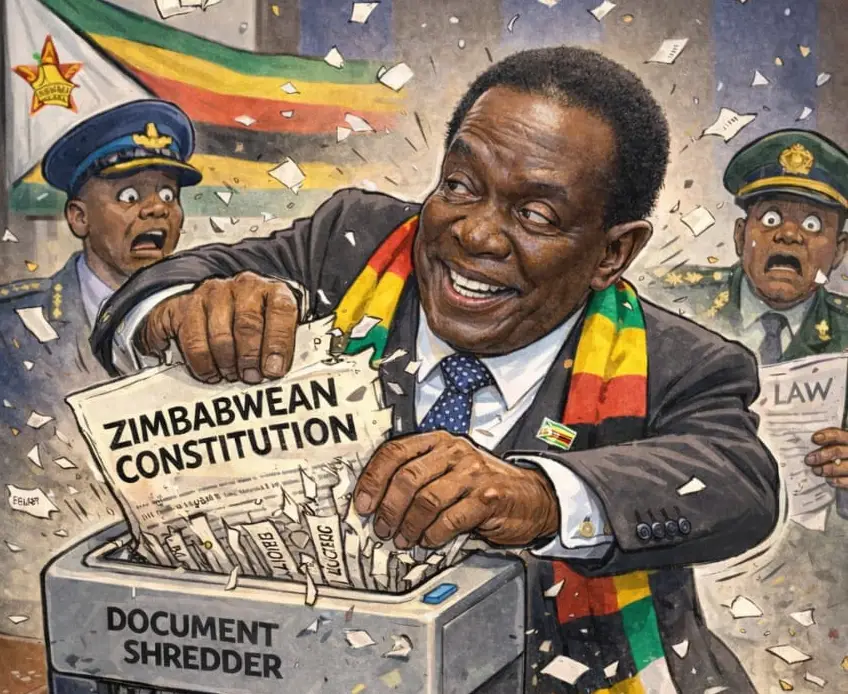
What if Zimbabwe’s political story is not tragic because it went wrong, but because it went exactly as power demands?
For decades, Zimbabweans have narrated their politics as a sequence of betrayals, missed opportunities and strongmen who refused to let go.
It is a story told in tones of disappointment, sometimes outrage, often resignation. Yet there is another, more unsettling way to read it. Strip away the moral language. Ignore the promises. Look instead at outcomes, patterns, incentives.
What emerges is not chaos but coherence. Zimbabwe’s politics begins to look less like failure and more like a disciplined, if ruthless, exercise in the acquisition and preservation of power.
Seen this way, the country does not defy political theory. It confirms one of its oldest and most uncomfortable versions.
Niccolo Machiavelli, the Florentine diplomat writing in the turbulence of Renaissance Italy, argued that politics is not a morality play. It is a contest of survival.
In his signature book The Prince, he advised rulers to master “how not to be good” when circumstances require it, to understand that “it is much safer to be feared than loved,” and to recognise that appearances matter more than intentions.
Virtue, in this framework, is often theatre. Power is the substance. If this sounds cynical, it is because Machiavelli was less interested in how the world should work than in how it actually does.
Zimbabwe, across its modern history, reads like a case study.
Consider the moment of independence in 1980. Robert Mugabe emerged not only as a liberation hero but as a statesman capable of reconciliation.
“If yesterday I fought you as an enemy, today you have become a friend,” he declared, extending a hand to former adversaries. It was, on its face, a generous gesture, one that helped stabilise a fragile new nation.
But generosity in politics is rarely just generosity. Machiavelli warned that a ruler must appear merciful while quietly securing his position.
Mugabe’s early posture of unity did not contradict consolidation. It facilitated it. While the rhetoric soothed, the machinery of power was being assembled. Rival centres of influence were not accommodated indefinitely. They were managed, absorbed, or, when necessary, eliminated.
The Gukurahundi campaign of the early 1980s remains the starkest example. Officially a response to dissident activity, it functioned in practice as a decisive assertion of dominance over Joshua Nkomo’s ZAPU.
The violence was swift, concentrated and politically transformative. Machiavelli, writing centuries earlier, advised that injuries should be inflicted all at once, so that their sting fades and resistance is broken.
By the time the Unity Accord was signed in 1987, the outcome was clear. Zimbabwe had moved from a contested political field to something closer to a one-party state.
There are those who argue that this reading is too harsh, that it reduces complex historical events to cold calculation. Context matters, they say. The early years of independence were unstable. There were genuine security concerns. Leaders made difficult choices under pressure.
All true. But Machiavelli’s point was never that rulers act without reason. It was that when survival is at stake, they will choose effectiveness over virtue. The question is not whether Gukurahundi had justifications. It is whether it achieved its political objective. It did.
Power, once consolidated, rarely rests. It must be defended, often pre-emptively. This is where Zimbabwe’s more ambiguous episodes demand attention.
The deaths of key figures like Josiah Tongogara in 1979 and Solomon Mujuru in 2011 occupy a shadowy place in the national memory.
Official accounts describe accidents. Public suspicion has never entirely accepted those explanations.
Tongogara, a formidable commander during the liberation struggle, died in a car crash just as Zimbabwe stood on the brink of independence. Mugabe himself acknowledged the loss, calling him “a very important man.”
Yet in Machiavellian terms, importance is precisely what makes a figure dangerous. Independent authority, especially in moments of transition, can complicate the emergence of a singular centre of power.
Decades later, Solomon Mujuru represented a different kind of threat. Not a rival for the presidency, but a kingmaker with deep influence across the military and political establishment.
His death in a fire at his farm was ruled accidental. Still, in a system where proximity to power often invites both privilege and peril, such events are rarely interpreted at face value.
It is tempting to dismiss these suspicions as conspiracy. Perhaps some are. Yet what matters is not only what happened, but what people believe could happen. Machiavelli understood this instinctively. Fear, once established, does not require constant reinforcement.
It becomes part of the political atmosphere, shaping behaviour in ways that are difficult to measure but impossible to ignore.
By the late 1990s, a new challenge emerged. The Movement for Democratic Change transformed popular discontent into organised opposition. For the first time, ZANU PF faced a credible electoral threat. Here again, the response followed a familiar pattern.
Coercion, patronage and narrative were deployed in combination.
Land reform stands out as both policy and strategy. It addressed a genuine historical injustice while simultaneously redrawing the political map. “The land is ours,” Mugabe insisted. “It is not European and we have taken it, we have given it to our people.”
The message resonated. It also realigned loyalties, binding beneficiaries to the state and weakening the opposition’s base.
Critics saw this as opportunism dressed in revolutionary language. Supporters saw long-delayed justice. Both interpretations can be true. Machiavelli would not have been troubled by the contradiction.
For him, the measure of a political act is not its moral purity but its effectiveness. Land reform secured support where it mattered most. That, in the calculus of power, is decisive.
If Mugabe perfected the art of holding power, the events of November 2017 revealed how fragile even entrenched authority can be. The military intervention that ended his rule was executed with remarkable discipline.
There were tanks on the streets, but also reassurances on television. “This is not a military takeover of government,” Major General Sibusiso Moyo declared.
The statement was, strictly speaking, unconvincing. Yet it served its purpose. Machiavelli advised rulers to cloak necessity in legitimacy, to act decisively while maintaining the appearance of order.
The operation removed Mugabe, avoided widespread violence and secured regional acceptance. It was, in its own way, a textbook manoeuvre.
But coups, even carefully managed ones, create their own dilemmas. They elevate new leaders and, crucially, new kingmakers.
In Zimbabwe’s case, Constantino Chiwenga emerged as the central figure behind the transition. As commander of the defence forces, he was not merely a participant. He was the architect of the moment.
Emmerson Mnangagwa, who assumed the presidency, owed his position in part to that intervention. And here, Machiavelli offers a warning as old as politics itself.
Those who help others to attain power often sow the seeds of their own vulnerability. “He who is the cause of another becoming powerful is ruined,” he wrote.
At first glance, the post-2017 arrangement appeared stable. Chiwenga moved into the vice presidency. Mnangagwa consolidated his authority as a civilian leader. There was talk of a “new dispensation,” of reform and re-engagement.
Yet beneath the surface, the logic of power was already at work.
Chiwenga’s strength did not derive from his office. It came from his history, his networks and his association with the military. That made him both indispensable and potentially threatening.
For Mnangagwa, the challenge was clear. He had to maintain the alliance without becoming subordinate to it.
Machiavelli would recognise the problem immediately. A ruler elevated by powerful allies must eventually assert independence or risk becoming their instrument.
The process is rarely dramatic. It unfolds through small, cumulative shifts. Influence is redistributed. Access is controlled. Visibility fluctuates.
In the years since 2017, Chiwenga’s political trajectory has reflected this quiet recalibration. Periods of illness and absence have limited his public presence. Decision-making has appeared increasingly centralised around the presidency.
None of this necessarily proves a coordinated effort to sideline a rival. Politics is rarely so neat. But the pattern is consistent with a broader principle. Potential competitors are managed not through open confrontation, but through gradual containment.
There is a deeper irony here. Zimbabwe’s political history is littered with powerful intermediaries who helped secure authority for others, only to find themselves marginalised or diminished.
Solomon Mujuru’s story fits this pattern. So, in a different way, does Chiwenga’s unfolding experience.
The kingmaker’s dilemma is perennial. To create power is not to control it. Once the crown is placed, it acquires its own logic.
What does all this say about Zimbabwe, and about politics more broadly?
One answer is that Zimbabwe is uniquely troubled, trapped in a cycle of strongman rule and institutional weakness. There is truth in that. But it is also incomplete.
The more uncomfortable possibility is that Zimbabwe is not exceptional enough. Strip away the particularities of history and geography, and the same dynamics appear elsewhere, albeit in subtler forms.
Machiavelli’s bleak view of human nature remains difficult to dismiss. People, he wrote, are “ungrateful, fickle, false, cowardly, covetous.”
Leaders who ignore this do so at their peril. Institutions can moderate these tendencies, but they do not erase them. Where institutions are fragile, the underlying impulses become more visible.
Zimbabwe’s politics, in this sense, is not an anomaly. It is a clearer expression of something universal.
This does not mean that change is impossible. It means that change requires more than new leaders or new slogans. It demands a reconfiguration of incentives, a strengthening of institutions, and, perhaps most difficult of all, a shift in political culture.
Without these, the script is likely to repeat. Different actors will step onto the stage. The lines will sound familiar.
Machiavelli, writing half a millennium ago, would not be surprised. He would recognise the patterns, the manoeuvres, the careful balance between fear and favour. He would see, in Zimbabwe’s story, not a deviation from political logic but its confirmation.
And that is the most unsettling conclusion of all. The tragedy of Zimbabwean politics is not that it has been irrational. It is that it has been, in its own way, entirely rational.
Gabriel Manyati is a Zimbabwean journalist and analyst delivering incisive commentary on politics, human interest stories, and current affairs.