By Vimbai Kamoyo
CHITUNGWIZA – Old ramshackle lorries that make a beeline from areas surrounding Chitanda and Masona villages in rural Seke into urban Chitungwiza, with loads of sand, give testimony of an environment under threat of massive degradation.

A visit to a locale that borders urban Chitungwiza-Unit M- and rural Seke revealed massive land poaching and massive breach of environmental laws and council by-laws.
Hideous gullies and craters are the only remnants on areas that sand is dug to construct beautiful houses and shops in Chitungwiza. They are the marks of unlicensed people who argue that they are doing so to sustain their livelihoods.
Thirty-eight year old Nathan Mutanhi who is a sand poacher but living in Seke Unit “M” said they were involved in the illegal business because that was their way of eking a living.
“We have to sustain our families; families have to eat. This is how we eke our livelihood. Right now my wife is six-months pregnant and that calls for money. Where do you think I get the money if I do not work here? Right now there is no formal employment, is there?” asked Mutanhi rhetorically.
In 2013 the Zimbabwe National Statistics Agency (ZimStat) director-general Dzinotizei Mutasa said unemployment rate in Zimbabwe stands at 11 percent, a figure which was stridently disputed by independent economists who put it at over 80 percent.
Mutanhi’s sentiments were echoed by a man who identified himself only as David and said he works as a lorry driver.
“We are doing this for a living, it may be illegal but at least we are not robbing anyone or a bank. Surely, the environment is there to sustain people not the other way round. The money is good and the investment is little,” he said with a chuckle.
Sand fetches an average price of US$75 per cubic metre (a cubic metre equals about 13 wheel barrows).
While they may be eking a living from poaching the sand, it is the environment that is bearing the brunt of their actions as dangerous pits and repulsive gullies are left to cover large swathes of land. The community too is not amused.
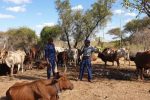
Cattle herder Tendai Dzawe from Chitanda village said sand poaching has brought with it a myriad of problems to the people of their village and surrounding ones.
“These people have brought nothing here but problems. They are destroying pastures and our animals have limited grazing areas now. They also do not reclaim the pits they dig resulting in water collecting there and subsequently becoming favorable mosquito breeding grounds. That means an increase in the cases of malaria in the areas that we live. The responsible authorities should move in fast and curb this rot before the environment is completely destroyed by these poachers,” said Dzawe.
Esther Chimanga from Masona village said land poaching was leaving their children exposed to the dangers of falling in to the pits that are left open.
“I am not happy at all with the sand poaching that is happening in our villages. Right now there are gullies and pits all over which are a danger to our little children who might fall into them. Our domestic animals might fall in to the pits as well.” she said.
Environmental Management Agency (EMA) spokesperson Steady Kangata expressed concern that the sand poachers were wrecking havoc despite heavy fines that are imposed on culprits.
“The issue of sand poachers is a big problem despite imposing heavy fines. (EMA charges US$5 000). Sand extraction must be done by those with licences after an agreement with those who own that land or the habitants of that land,” he said.
Meanwhile, a top official at Chitungwiza council said the municipality was finding it difficult to enforce town by-laws that prohibit getting sand without the council approval because of manpower shortages.
“We are aware of the destruction of sand poaching that is occurring around the town but we are crippled with manpower. However, once in a while we make raids just to minimize the damage. The fines are not deterrent as they still go back to the illegal business soon after paying the fines,” he said.
Chitungwiza has experienced massive construction of new buildings, extensions and renovations since the dollarization of the economy in 2009 and that has played a major role in the demand for the sand.
However, responsible should move quickly to put the situation under control before it explodes into a major ecological disaster that will be difficult to contain.