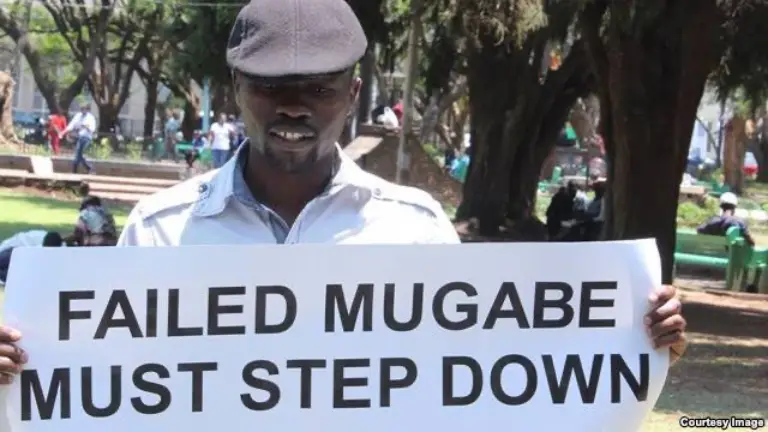
Monday 10 March 2025 marked 10 years since freelance journalist and pro-democracy activist Itai Dzamara was forcibly taken from a barbershop in Glen View, Harare, while getting a haircut.
His abduction on March 9, 2015, has become emblematic of Zimbabwe’s troubling history of enforced disappearances – a tactic that continues to haunt the nation’s political landscape.
Zimbabwe’s post-independence era has been marked by numerous high-profile abductions, creating a disturbing pattern that spans decades. From the disappearance of opposition figures to government critics, these cases share striking similarities in their execution and subsequent handling by authorities.
The country’s first recorded high-profile abduction dates to October 15, 1975, when nationalist leader Edson Sithole and his secretary Miriam Mhlanga were grabbed by unknown assailants, bundled into a car, and never seen again.
Decades later, an empty grave at the national Heroes Acre bears Sithole’s name, though his remains have never been found. This established a template that would be repeated throughout Zimbabwe’s history: critics of the government vanish, investigations stall, and families are left without closure or justice.
The list is long and troubling.
In 1990, Rashiwe Guzha, a secretary in the Central Intelligence Organisation (CIO), disappeared after breaking off an affair with then-CIO deputy director Edson Shirihuru.
Patrick Nabanyama, a polling agent for opposition MP David Coltart, was abducted in June 2000 and later declared dead by a magistrate in 2010, though his body was never recovered.
The modus operandi is consistent: unmarked vehicles, plainclothes operatives, quick extraction, and subsequent denial of involvement by all state agencies. Victims often disappear completely or reappear with fabricated charges designed to criminalize their activism.
## The Dzamara Abduction: Unanswered Questions
The abduction of Itai Dzamara follows this established pattern but stands out due to the complete absence of resolution.
On that fateful Monday morning in 2015, five unidentified men approached Dzamara at the barbershop, accused him of livestock theft, handcuffed him, and forced him into an unmarked vehicle with no registration plates.
Despite a High Court order compelling police to investigate and provide regular updates, the case has remained effectively dormant. The most glaring investigative failures include:
No cell site information analysis: Despite the widespread use of mobile phones by both perpetrators and witnesses, authorities failed to utilize cell tower triangulation to identify devices active in the area during the abduction.
This technology, which Zimbabwe acquired through its partnership with China and is reportedly operated from the Zimbabwe Defence College, could have mapped the movements of suspects and potentially led investigators to Dzamara’s location.
. Witness testimony ignored: Multiple witnesses identified the vehicle and provided descriptions of the abductors, yet these leads were never properly pursued.
. Pseudo public appeals: Standard investigative procedure would include public appeals for information and the release of suspect descriptions or composite sketches. This never occurred in Dzamara’s case particularly on the description of suspects.
. No forensic investigation: The barbershop scene was not properly secured for evidence collection, and no forensic analysis was ever released.
A Pattern of Investigative Failures
The failures in the Dzamara investigation mirror other high-profile security incidents that have gone unresolved despite abundant evidence.
Perhaps most notable is the 2018 White City Stadium bombing in Bulawayo, where an explosive device detonated near the VIP area during a campaign rally, killing two people and injuring over 40, including Vice Presidents Kembo Mohadi and Constantino Chiwenga.
Despite the explosion being captured on camera, the presence of three security cordons, and numerous witnesses, no one has been successfully prosecuted for the attack. I have worked in police protection and find it concerning that were no leads.
The combined resources of the security services which includes intelligence officers, bomb disposal experts, intelligence and psychological analysts have not produced anything in over 7 years is difficult to fathom.
Similarly, three separate incidents involving cyanide being left in the office of then-Vice President Emmerson Mnangagwa remain unresolved, despite the highly secured nature of the location and the presumed presence of surveillance systems.
These patterns suggest a troubling conclusion: when political motivations exist, Zimbabwe’s otherwise capable security apparatus can become selectively ineffective at investigating crimes.
The Ferret Team Connection
Recent revelations about internal CIO operations provide new context for understanding Dzamara’s disappearance.
According to information published by Dug Up in February 2025, tensions existed within the intelligence community between those who favoured reform and professionalization and those who preferred more aggressive tactics.
The report details how in 2021, then-CIO Director General Isaac Moyo rejected proposals to use the COVID-19 pandemic as cover for eliminating opposition figures. This decision reportedly led to friction with subordinates who felt their “hands were tied behind their back.”
At the time of Dzamara’s abduction, the specialized Ferret Team was operational, with resources and capabilities that far exceeded normal police units.
According to the recent Dug Up report, the current CIO Director General, Dr. Fulton Mangwanya, previously served as “CIO Ferrets” before being appointed to lead Zimbabwe’s Parks and Wildlife Management Authority.
The term “Ferret” is simply a randomly assigned name for one of several covert teams within the security services, designated by letters of the alphabet, with other teams potentially named “Kilo,” “Lima etc,” or similar.
The name “Ferret” gained prominence in the media, and the police have not corrected this misconception as it conveniently aligns with their operational secrecy.
A Theory Emerges
Based on the evidence and patterns observed in similar cases, a theory has emerged among security analysts and human rights investigators: Dzamara was likely abducted by a specialized state security unit, possibly the Ferret Team, but something went wrong during the operation.
In most politically motivated abductions, the victim either reappears with fabricated charges (as happened with Jestina Mukoko) or their body is discovered to send a message (as with Tonderai Ndira).
The complete disappearance of Dzamara without either outcome suggests an operation that did not conclude as planned.
In these operations, there is always a script. The complete disappearance without a body or charges suggests the script was abandoned. Something unexpected happened.
Human rights investigators point to the timing of the abduction – shortly after Dzamara had delivered a petition to then-President Robert Mugabe’s office demanding reforms and his resignation – as evidence of political motivation.
His one-man protests at Africa Unity Square had gained increasing attention, potentially marking him as a target.
The Cost of Silence
A decade after his disappearance, Dzamara’s family continues to live in limbo – unable to mourn properly without confirmation of his fate, yet increasingly resigned to the likelihood that he will never return. His wife, Sheffra, and their two children have become symbols of the human cost of political repression.
Human rights organizations continue to call for a credible investigation, but with each passing year, the prospects for resolution dim further. The case has become a symbol of impunity for human rights violations in Zimbabwe and the selective application of justice.
The unresolved case of Itai Dzamara serves as a chilling reminder of the risks faced by those who dare to challenge authority in a system where accountability remains elusive. The silence surrounding his fate speaks volumes about the state’s approach to dissent.
Until there is a full accounting for Dzamara and other victims of enforced disappearances, Zimbabwe’s journey toward genuine democracy and rule of law remains incomplete.
Dr Keith Silika is a former police officer with the Zimbabwe Republic Police (ZRP) and Greater Manchester Police in the UK. He is now a lecturer in Policing. His interests include criminology, policing, human rights and crime scene investigation.