By Africa Moyo
Employers in Zimbabwe are considering docking salaries for workers who squander productive time on cash queues but labour unions say they are prepared to fight such an “injustice” to the hilt. Cash shortages began in March this year and have since worsened.
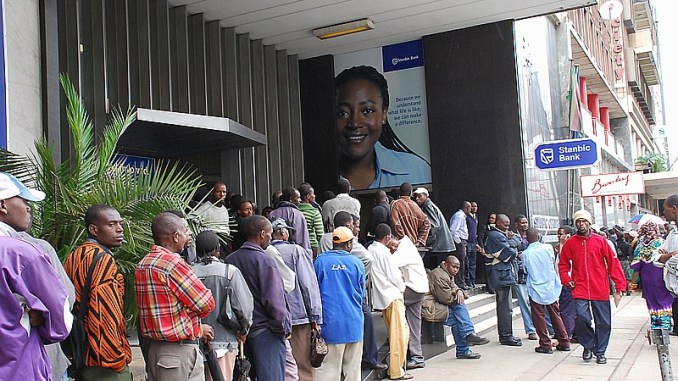
Banks are currently limiting withdrawals to between US$30 and US$100 per day. The Employers’ Confederation of Zimbabwe (Emcoz) president, Mr Joe Kahwema said that while industry had been afforded the opportunity to compete on the local market as a result of the recent import restrictions, workers have to work even harder than before.
It is believed that through increasing production and improving capacity and efficiencies, local companies will be able to reduce costs associated with locally-produced goods.
“This (deducting salaries) seems like the natural reaction. We have to understand that we have to earn the money we receive and if we are to spend all our time in bank queues, where are we going to get the money to pay the people?
“Zimbabwe has a very low productivity rating in the region. Absence from work can only worsen the productivity levels and this is how we price ourselves out of the market.
“Banks have ameliorated the situation by promoting plastic money,” said Mr Kahwema.
Though plastic money and alternative transacting methods are considered viable, some services such as public transport and rentals still heavily rely on cash. Emcoz is currently assessing the impact of cash-induced absenteeism on productivity.
The loss is thought to be significant.
There is debate on whether slashing workers’ salaries in such circumstances is legal. Last week, Advocate Arthur Marara, a partner at Mutamangira and Associates, said it is within employers’ rights to deduct wages that are commensurate with the time spent away from work.
Section 12A of the Labour Act specifically spells out that “no deduction or set-off of any description shall be made from any remuneration except — (a) where an employee is absent from work on days other than industrial holidays or days of leave to which he is entitled, the proportionate amount of his remuneration only for the period of such absence”.
“Essentially, Section 12A (6) is codifying a common law principle of no work no pay. However, the Labour Act does not provide for ‘hours’ of absence as in whether an employee can have salaries deducted for the hours that they would not be at work. That is certainly an arguable point,” said Advocate Marara.
He, however, also noted that it is prudent for employers and employees to engage in dialogue since cash shortages are a reality. Of interest is that some retrenchments are now being carrying out in accordance with the new amendments to the Labour Act.
“Employees are now being retrenched in terms of the new amendment as it has made termination flexible. There are no rules that have been set out to govern confirmation of decisions from labour officers and designated agents.
“There is still a lot of work to be done, and still need for more amendments to the Labour Act in order to ensure that disputes are expeditiously dealt with and disposed of. The labour laws are circumlocutory and make the whole process expensive and beyond the reach of many Zimbabweans,” added Advocate Marara.
Labour unions opine that reforms to the Labour Act give too much power to employers since they “make labour a commodity and an employee a mere production tool”.
Some experts say the labour law reforms create a worse situation than the original provisions of the Labour Act (28:01) in as far as termination of employment contracts is concerned.
Employers have been lobbying Government to amend the Labour Act in order to ensure that wages and salaries are linked to production. Most legacy debts carried on companies’ balance sheets are accrued due to unpaid wages and salaries, especially during times when the companies were idle.
But Zimbabwe Congress of Trade Unions (ZCTU) president Mr Peter Mutasa last week said that if employers takes this route, that will be tantamount to addressing the symptoms and completely ignoring the problem.
“Zimbabweans, collectively, Emcoz included, have the responsibility to demand policymakers to address the problem. Workers cannot be singled out for blame or punishment for a problem they have not caused, and which is affecting every Zimbabwean.
“Again, the planned action is not feasible legally for most collective bargaining agreements provide that workers must be paid during working hours; hence, the time they spend queuing for their hard-earned wages must be regarded as working hours.
“If the employers want workers to be at work, then they should source for cash and pay workers their weekly or monthly wages at the workplaces,” said Mr Mutasa. ZCTU said it is prepared to consider its options if employers take this route.
Reserve Bank of Zimbabwe (RBZ) Dr John Mangudya has proposed to introduce bond notes to alleviate paper money shortages. The RBZ says it will issue smaller denominations of bond notes — $2 and $5 — in November. Emcoz believes bond notes will help reduce the impact of liquidity challenges in the country.
“Yes, it is obvious that bond notes will reduce the cash shortages. The question we should be asking is: what will be the implication of the bond notes?’ This is a question we can only answer after the event.
“If the bond notes are introduced and controlled as promised by the Reserve Bank, then there should be no problem. However, if the bond notes are used as part of quantitative easing to assist the Government to meet recurrent expenditure obligations, then there will be serious problems and the bond note will suffer the same fate as the Bearer Cheques. This is the fear in the market,” said Mr Kahwema.
The bond notes will be backed by a US$200 million Africa Export-Import Bank (Afreximbank) facility. An initial US$75 million worth of bond notes will be injected into the market before the end of the year. The surrogate currency will be issued as an export incentive. Small-scale exporters of gold and tobacco will get 5 percent while large-scale exporters of the same will get 2 percent of their total exports. The Sunday Mail