President Robert Mugabe on Monday lashed out at “racist” western states wary of Zimbabwe’s power-sharing deal, saying foreign handouts were not a solution to the country’s economic woes.
“The West seeks to divide us and disturb our peace. If they do not want to deal with us why should we continue to want their help,” Mugabe told thousands gathered at a funeral for his ally and deputy Joseph Msika.
“Zimbabwe need not be tied to any one corner of the world, least of all, to a corner of former imperialist and racist colonisers. We are not part of western Europe and the United States.”
Mugabe’s rhetoric comes days after US Secretary of State Hillary Clinton pushed for greater reforms while on a visit to South Africa where the two countries pledged to work together to speed up Zimbabwe’s power-sharing pact.
The 85-year-old leader joined Prime Minister Morgan Tsvangirai in a unity government in February after disputed polls saw him lose his first post-independence majority.
But Western powers have pushed for evidence of reform and an international chill remains towards Mugabe amid reports of continued rights abuses and internal power-struggles over key posts.
Mugabe spurned foreign assistance, saying “great nations” were built on their own endowment at the funeral of Msika who was one of two deputy presidents from his party who joined the unity arrangement.
“Let everyone in the inclusive government and the country generally know that our nation will never prosper through foreign handouts,” he said.
Msika was one of the founder nationalists who waged a liberation war against the British colonial rule, and died of hypertension on Wednesday.
His burial was attended by senior government officials including Tsvangirai, deputy prime minister Mutambara and representatives of regional leaders including South Africa’s deputy president Kgalema Motlanthe. AFP
Robert “The Solution” Mugabe, in a shock move, has offered Dumiso Dabengwa the vice-presidency left vacant by death of John Msika.
Only a few minutes ago, I confirmed this with two senior ZANU PF and government officials.
Mugabe is said to have called Dabengwa yesterday and spent more than hour talking to him. Two emissaries have been dispatched to Bulawayo today to try and talk the former ZIPRA Commander into accepting the offer.
Mugabe, in explaining his motivations yesterday, said that, most importantly, he would like to be “flanked by fighters” in the ZANU PF presidium. He also mentioned the fact that John Nkomo, who many consider the logical choice, only got eminence during the late 1970s, when the Frontline States (Kaunda, Nyerere and others) pushed for a common front between Joshua Nkomo and Mugabe through the UANC of Bishop Muzorewa.
John Nkomo, the current ZANU PF chairman, was nominated by ZAPU to be their representative within Zimbabwe for the UANC.
Mugabe appears to be reluctant to confirm John Nkomo, to the extent that he even said that he would consider Simon Khaya Moyo, Zimbabwe’s current ambassador to South Africa.
Khaya Moyo was Joshua Nkomo’s aide during the Liberation War.
Mugabe told Dabengwa that it was he, Dabengwa, who had thrown ZANU PF away and that ZANU PF had never thrown him away. He pointed to the fact that the party has never formally expelled him.
Most interesting, though, is Mugabe’s claim that Msika himself had explicitly said his wish would be for Dabengwa to take over from him. This he apparently said late in 2007 when he wanted to retire and was forced by Mugabe to stay on. Msika subsequently repeated this in the last few months of his life, apparently.
Mugabe is reported to have told the late Vice-president when he wanted to retire: “You can never quit a struggle.” He still believes that he is fighting a “Third Liberation War”.
Mugabe appears to have been hinting at his approach to Dabengwa during his speech at the Msika home on Wednesday night. He repeatedly told the gathering that Msika had wanted “unity” amongst the people and that he implored Mugabe to ensure that unity prevailed in the country.
Of course, we all know that Mugabe considers his unity with ZAPU to be almost sacrosanct and he thinks everyone should see it the same way, no matter what wrongs are being done.
Dabengwa is said to be reluctant, but we now all know about Mugabe’s plotting and his seeming ability to resurrect himself from political ashes like the proverbial Phoenix.
Dabengwa himself knows that, were he to accept Mugabe’s offer, he would lose credibility with his constituency.
As one speaker said to him during the Bulawayo meeting last year when Dabengwa endorsed Simba Makoni’s bid for the presidency: “DD, we have always loved you, but we hated the jacket that you were now wearing (ZANU PF)”.
Still, Dabengwa has been invited to the burial of Msika on Monday and Mugabe has already indicated that he will want to speak to the ZAPU leader again on that day, after the proceedings.
This is going to be an extremely interesting week, then.
The way ZANU PF operates, Mugabe chooses his own deputies and no one else really has any say in it. Once Mugabe makes his choice known, the party always falls in line behind him, endorsing his choice.
Finance Minister Tendai Biti has warned that if Zanu PF does not resolve its long running succession dispute over who will replace President Robert Mugabe, the country could descend into Somalia-like chaos and see military coups.
“The succession debate in ZANU PF should be resolved very urgently as it can result in a military coup in this country. It is not a secret that there is chaos in ZANU PF about succession,” said Biti at a weekend meeting with business leaders in Bulawayo.
Internal fighting within Zanu PF is said to have escalated following the death of Vice President Joseph Msika last Tuesday. Two factions, one led by Defence Minister Emerson Mnangagwa and the other by retired army general Solomon Mujuru are said to be jostling for control.
Biti believes any one of those factions could resort to a military coup to seize power.
“We don’t want a military coup because of a failure to replace the leadership. Zimbabwe will be like Somalia and Ivory Coast if the succession issue is not urgently dealt with…a failure to deal with this issue will affect future generations of Zimbabweans.”
Kaizer Chiefs and Zimbabwean defender Onismor Bhasera is on the verge of sealing a move to English Premiership side Portsmouth after impressing during trials. The United Kingdom Home Office has however scuttled the deal by denying him a work permit.
Portsmouth Chief Executive Peter Storrie admitted even before the application that Bhasera stood little chance of getting the permit because of stringent UK Home Office rules.
Only footballers whose countries are ranked within the world’s top 70 can be considered for any permits. According to the latest FIFA/Coca Cola World Rankings, Zimbabwe is currently 97.
Storrie however vowed they would appeal on compassionate grounds given Zimbabwe’s current situation.
“The lad is a good player and has been on trial. We will now apply for a work permit. He’s played all the games for Zimbabwe; there are no issues with that at all. But unfortunately Zimbabwe needs to be in the top 70 but are 97th, so it would mean an appeal process,” Storrie said.
I had not realised the true extend, and impact of the Zimbabwe crisis on ordinary Zimbabweans until last weekend I embarked on a four and half hours drive from Johannesburg to Kabokweni, a tiny, far-flung township situated in a valley near Nelspruit, in South Africa’s Mpumalanga province.
I was visiting my two brothers, a cousin, a nephew and an uncle who now, due to circumstances back home, are trying to eke out a living there. To my utter amazement I soon discovered there are literally hundreds of Zimbabweans there, perhaps without a thought of returning home soon.
Commenting on how he has been forced to put away his degree certificates and resort to doing odd, often degrading jobs just to survive, all that my uncle said to me was, “Look what Mugabe has done to us!” I felt a deep sadness in the depths of my soul and began to agonise over the root causes on the crisis in Zimbabwe.
This morning, while taking a shower, that is usually my time of greatest inspiration, it suddenly occurred to me that the primary driver of the crisis in Zimbabwe and the consequent misery and suffering of the people is greed on the part of those in authority. For the avoidance of doubt, authority in Zimbabwe resides in ZANU-PF and its allies the so called war veterans, green bombers, and security forces.
Greed has so consumed those in authority so much that they have ceased to care about anything except their excessive desire to accumulate massive wealth which they neither deserve nor need. Political power, for them, is the vehicle through which they can satisfy their greed, and therefore, they would be prepared to shed blood to acquire and retain that political power.
In their twisted sense of logic, they are therefore justified in unleashing waves of electoral violence and coerce people to ‘vote’ them into political power, or to use other fraudulent means to attain political office.
Understanding that greed is the primary driver of the Zimbabwean crisis would lead to a better understanding of the paradoxical situation of Zimbabwe that, in the midst of all this suffering, you find multi-millionaires in United States dollar terms, on the streets of Harare.
This also explains how a person like Joseph Chinotimba, a mere municipal guard(no offence to this humble profession intended), who was virtually penniless before he discovered the benefits of ZANU-PF membership, can claim that due to loss of his mobile phone for just a week, he had lost business worth US$19 million! And this is not one of those Chinotimba jokes doing the rounds. What business is he into?
Clearly there are a few people who are directly benefiting from the suffering on millions of Zimbabweans. That same group of people is reaping where they did not sow. Again, this is not just a figure of speech, scores of those aligned to ZANU-PF are currently on an invasion spree of white-owned commercial farms and are literally reaping where they did not sow.
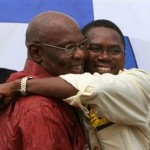
Mugabe & Tsvangirai share smile
Zimbabwe has enough resources to support all those who live in it, and also to support the region, but a few, politically connected and greedy people are busy plundering Zimbabwe and eating everyone’s share. I would not be surprised if there are people in Zimbabwe whose daily prayer is that the crisis never ends!
Greedy political leaders who do not care about the people they purport to represent invariably breed misery and suffering. This breed of political leaders often have the following distinctive characteristics:
(1) Although generally incompetent and lacking in business acumen, they are involved in all kinds of businesses;
(2) they measure they political achievements by the amount of wealth accumulated or cars they own;
(3) they publicly speak against the West and pose as pan- Africanists while privately sending their children to school in the West, drink wines imported from the West and do not miss on their monthly satellite television subscriptions;
(4) all their ill-gotten wealth is derived exclusively from their political connections;
(5) their lavish, and outlandish lifestyles are at odds with their professional salaries (for example, it is not surprising in Zimbabwe to come across a mere journalist working for state media, but with powerful political connections, owning several properties that he can never acquire on his journalist’s earnings).
This breed of political leaders is beyond redemption and cannot be expected to reform and be like the biblical Zaccheus, the chief tax collector who repented and gave away his ill-gotten wealth. Politicians of this kind, who unfortunately at present dominate the political scene in Zimbabwe, must be removed from office and mechanisms put in place to ensure that this breed becomes extinct.
This legacy of leaders who doggedly pursue self-serving interests must be broken. Without such a paradigm shift, charting a new political direction for Zimbabwe will remain a pipe dream. It is worthwhile noting for political leaders in government, particularly those in the MDC whom many of us look up to in hope, that greed is not a trait confined to leaders from one particular political party.
Zimbabwe desperately needs political leaders with integrity, who deeply care for others, and have the ability to self-transcend. Political leaders are judged not on the basis of the political party they belong to, but on content of their character and their service to humanity.
I am absolutely convinced that if we had leaders who really cared then Zimbabwe would not have gone through the horror, pain and suffering which characterised the past decade and continues. It is not an act of God, neither is it a freak of nature, that Zimbabwe finds itself in this multi-layered socio-economic, humanitarian and political crisis.
The issue boils down to want of able political leadership. Want of leaders who have already distinguished themselves in their private and professional lives who now take up public life leadership roles to serve, deriving satisfaction from putting a smile on an old woman’s face.
Dewa Mavhinga is a human rights lawyer and regular contributor on Nehanda Radio.
The MDC Youth Assembly secretary-general, Solomon Madzore, has called for the immediate release of four Zimbabwe National Students Union (ZINASU) students who were arrested on Wednesday.
Madzore said it was sad to note that students and other activists continued to be arrested and intimidated despite the formation of the inclusive government in February.
Clever Bere, the Zinasu president, Kudakwashe Chakabva, Archieford Mudzengi and Brian Kagodoro were arrested at the University of Zimbabwe after convening a meeting outside the main library to discuss exorbitant tuition fees.
They are being charged with trumped-up charges of disorderly conduct in public. The four were arrested with 10 other UZ students who have since been released.
Under unclear circumstances, the Zinasu leaders were today taken to the Attorney-General’s Office under unclear circumstance after they had been taken by the police to Harare’s Magistrate Courts.
“This disturbing and unfortunate trend of clamping down on students’ freedom of assembly, association and expression has been resurrected in defiance of the laws of the country. The behaviour of the past continues to haunt the new dispensation. We are worried that the inclusive government has not moved with speed in terms of shedding off the chequered behaviour of yester-year,” Madzore said.
“Students must have the fundamental right to gather, debate and organize action where their interests are being affected. The issue of tuition fees which are beyond the reach of the students is one such instance.”
The reopening of the UZ has been marred by the shortage of student accommodation, exorbitant tuition fees and a serious water crisis at the institution.
Mutare – Armed soldiers in Mutare, Manicaland province on Wednesday tore rally posters belonging to MDC President Morgan Tsvangirai that had been placed in Sakubva suburb and surrounding areas.
Tsvangirai is expected to give a keynote address at Manicaland’s MDC 10th anniversary celebratory provincial rally at Sakubva Stadium on 16 August.
On Monday, in preparation for this event, the MDC Manicaland provincial leadership had pasted posters in Mutare to publicise the rally.
However, a group of armed soldiers on Wednesday moved around the town in an army T35 Mazda truck, pulling down the posters.
The soldiers said they were removing the posters in preparation of the Heroes’ Day and Defence Forces commemorations to be held at the same venue next week and were working according to “instructions from above”.
Meanwhile, cases of political violence against MDC supporters are on the increase in the province with soldiers based at Vhumbunu Primary School in Mutasa Central harassing and torturing innocent villagers.
Last month at least 20 soldiers established a base at the school and are moving around with Zanu PF militia harassing people perceived to be MDC supporters.
The teachers have forced themselves to share accommodation with soldiers at the school, a situation which has also seriously affected school operations.
Some of the teachers have since fled from the school in fear of being victimised or tortured by the soldiers and Zanu PF militia.
The body of Vice President Joseph Msika has been flown to his rural home in Nyariri Village in Chiweshe to enable relatives to pay their last respects.
An air force of Zimbabwe helicopter carried the late Vice President’s body, departing from One Commando base in Harare to Mazowe District.
Msika died on Wednesday according to President Mugabe even though most reports put the date as Tuesday. Msika was born in Chiweshe and this is the reason his body has been taken there.
Later in the afternoon the body will be flown back to Harare whereupon it will be flown to Bulawayo and lie in state as his Matshemlope home. Zanu PF national chairman John Nkomo is accompanying the body on all these trips.
A big send off rally will be held for Msika at the White City Stadium on Saturday. Later in the evening his body will be taken to his family home in Harare’s posh Mandara suburb before the burial on Heroes’ Day on Monday.
JOB Sikhala, the former legislator for St Mary’s, has declared himself the new president of the Movement for Democratic Change (MDC-M), throwing the opposition party into confusion.
The so-called palace coup within the MDC-M came at a time Deputy Prime Minister Arthur Mutambara was in Uganda earlier this week together with President Robert Mugabe and co-Deputy Prime Minister, Thokozani Khupe on a tour of duty.
The latest development appears to show desperation on the part of Sikhala and some of his colleagues who appeared determined this week to disregard the party’s constitution in order to remain relevant within the MDC-M.
A section of the party’s constitution provides that members can call for an extraordinary congress if they are unhappy with their leadership where a vote of no confidence can be passed. Alternatively, they can also cause the party’s national council to relieve whoever they have lost faith in of his or her duties.
Section 5.2.5 of the constitution states that “an extraordinary congress may be called by (a) national council or (b) upon written request from at least one-third of members entitled to attend the congress or (c) upon the written request received from at least two-thirds from the provincial executive committee”.
The MDC-M security chief vowed on Tuesday that there was no formula for the removal of the party’s leadership. Sikhala and a number of MDC-M legislators have been on the warpath with Mutambara over the Deputy Prime Minister’s leadership style.
Deputy Prime Minister Mutambara had retaliated by suspending members of his national executive and lawmakers Abednico Bhebhe (Nkayi South), Njabuliso Mguni (Lupane East), Norman Mpofu (Bulilima East) and commercial farmer Alex Goosen for undermining his authority.
The legislators were later fired in a move they described as a legal nullity. “There is no formula when one is at war like this one. We have suspended or rather thrown out the constitution for now. So whatever constitutional issues that are raised, fall away. The war cry is that Mutambara has to go. I am warning each and every one of our members that Mutambara is no longer part and parcel of the revolution we started in 1999,” said Sikhala.
“I have taken over total control of the party. I was given the mandate by party supporters countrywide after they noticed that the party had become an appendage of ZANU-PF through Mutambara. Mutambara has lost it.
“He has gone against the democratic change process. As one of the founder members (of the MDC), I can gladly tell you that we havereached a decision that we have to take control of the situation that we find ourselves in. “Our actions have been endorsed by the majority of supporters and structures,” Sikhala said in an interview with The Financial Gazette.
MDC-M spokesperson Edwin Mushoriwa on Tuesday warned that the move by Sikhala was not only unconstitutional, but dangerous to democracy. “People are allowed to say what they want,” Mushoriwa said.
“It’s a dangerous statement to claim that they have taken over the leadership of the party. If people are unhappy with the leadership, they can call for an extraordinary congress accordingly and the matter will be resolved there or alternatively, they can cause the national council to relieve the accused persons of their duties if found guilty.
“So for Sikhala and company to claim that they have taken over the leadership of the party is not true. If they believe they can takeover unconstitutionally, then that is dangerous for all the forces of democracy.”
The party’s Mashonaland East provincial chairperson, Shupikayi Mandaza, and Taurai Magayi, who claimed to be leading Chitungwiza province, threw their weight behind Mutambara’s ouster.
“I don’t believe Mutambara should continue leading the party because he has lost the party’s ideology,” Mandaza said. Source: Financial Gazette


 As one speaker said to him during the Bulawayo meeting last year when Dabengwa endorsed Simba Makoni’s bid for the presidency: “DD, we have always loved you, but we hated the jacket that you were now wearing (ZANU PF)”.
 Biti believes any one of those factions could resort to a military coup to seize power.
 Storrie however vowed they would appeal on compassionate grounds given Zimbabwe’s current situation.
 “Students must have the fundamental right to gather, debate and organize action where their interests are being affected. The issue of tuition fees which are beyond the reach of the students is one such instance.”
 Later in the afternoon the body will be flown back to Harare whereupon it will be flown to Bulawayo and lie in state as his Matshemlope home. Zanu PF national chairman John Nkomo is accompanying the body on all these trips.