A 50 year old man from Bulawayo who set his room on fire and damaged property worth $9 980 after his live-in girlfriend ditched him, has been sentenced to two and a half years in prison.
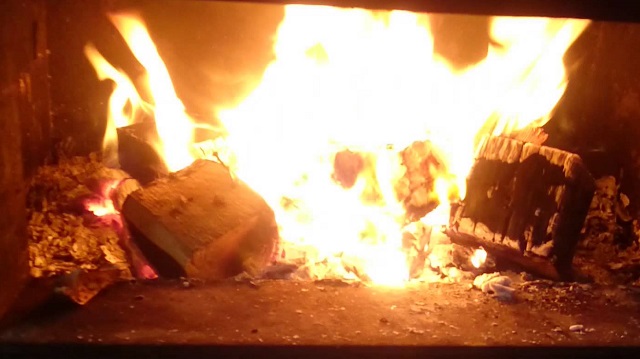
Connell Sibanda of Nkulumane suburb opened a gas cylinder and set his room alight while he was inside after his girlfriend Siboniso Dube (59) told him they should part ways.
The court heard that Sibanda, who is unemployed, and Dube lived together in her house.
Initially when he appeared in court, the estimated value of the burnt property was $7 000.
However, after the courts sought a quotation, the estimated value of the burnt property was revised to $9 980.
Sibanda pleaded guilty to malicious damage to property when he appeared before Western Commonage Magistrate, Mr Lungile Ncube.
Sibanda said he was heartbroken because Dube was leaving him for a man young enough to be her son.
Mr Ncube convicted him on his own plea and sentenced him to 30 months in prison of which six months were suspended on condition of good behaviour.
A further 12 months were suspended on condition that Sibanda pays $9 980 to Dube before October 30, 2018 and the remaining 12 months were suspended for 420 hours of community service at Western Commonage court.
In sentencing him, Mr Ncube said he had considered that Sibanda had pleaded guilty and that he is a first offender.
Prosecuting, Mr Kenneth Shava said on August 2 at around 4AM, Dube got out of her room and was suspicious when she heard a sound from Sibanda’s room.
“Dube tried to open the bedroom door which was locked. She went to the window and found her property burning,” he said.
The court heard that Dube was assisted by neighbours to break the window and they managed to rescue Sibanda.
The ceiling, roof, chest of drawers and the table were damaged. The Chronicle
Uncollected garbage piles in Gweru’s city centre. The City of Gweru has declared an outbreak of typhoid following the deaths of seven people
By Patrick Chitumba
The death toll due to the typhoid outbreak in Gweru has risen to eight with the cumulative total of suspected cases now over 1 500. Gweru typhoid taskforce coordinator, Dr Simon Nyadundu, said as of yesterday, 38 new cases were recorded from 621 people screened of typhoid.
Uncollected garbage piles in Gweru’s city centre. The City of Gweru has declared an outbreak of typhoid following the deaths of seven people
“A cumulative total of 1 506 suspected cases of typhoid have been reported in Gweru since July 20. Of these six are confirmed and zero are probable cases. Eight deaths have been reported since declaration of outbreak on August 6,” he said.
“Yesterday 38 suspects out of 621 screened were recorded. There are six admissions.”
Dr Nyadundu said water sampling is on-going though they were facing challenges of inadequate equipment.
He said Government has been providing water treatment pills to every household in the city.
Dr Nyadundu said they had also beefed up staff at council and Government health institutions.
“We have teams on the ground and we mobilised more staff from other districts so that we curb this water borne disease as a matter of urgency,” he said.
Health and Child Care Minister Dr David Parirenyatwa last week condemned borehole water in the city which he said is unsafe for human consumption.
The first case of typhoid in the city was recorded on July 20.
Dr Parirenyatwa visited patients admitted at Gweru Provincial Hospital, Mkoba 1 Clinic and Mkoba 13 Clinic to assess the impact of the outbreak.
He said patients admitted or seeking treatment for typhoid were spread across the city contrary to an earlier council report that the outbreak was confined to just a section of Mkoba suburb covering Villages 15, 18, 19 and 20.
The Minister said bottled water is at times not safe for drinking and residents should therefore embrace household water treatment for their drinking water.
The Gweru City Council two weeks ago declared an outbreak of typhoid in the city and appealed for outside assistance to contain the disease. The Chronicle
Inmates from Khami Prison in Bulawayo stumbled upon the remains of a self-proclaimed prophet who allegedly went missing about two years ago.
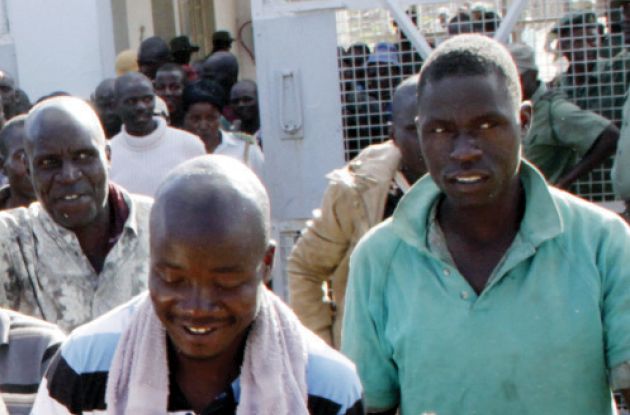
Inmates at Khami Prison in this file photo
Trynos Mathe’s skeletal remains were found on Friday at the Khami Prison Complex where he used to hold prayer sessions, police have confirmed.
Bulawayo police spokesperson Chief Inspector Precious Simango yesterday said police did not suspect foul play.
“We’re investigating a sudden death case following the discovery of human remains at Khami Prison Complex’s paddock. The remains are believed to belong to a male adult who is suspected to have been a prophet and used to pray at the same place,” said Chief Insp Simango.
“His remains were discovered by eight prison officers and 20 inmates who were out to extinguish a fire that had broken out at one of the prison’s paddocks.”
She said near the body, some clothes and a GTEL cellphone were discovered.
Chief Insp Simango said police had to extract information on his cellphone to identify him but are yet to locate his relatives. The Chronicle
A jailed Bulawayo traffic cop who turned his 15-year-old step-daughter into a sex slave, threatening to kill her if she exposed him, has approached the High Court challenging his 20 year jail term.
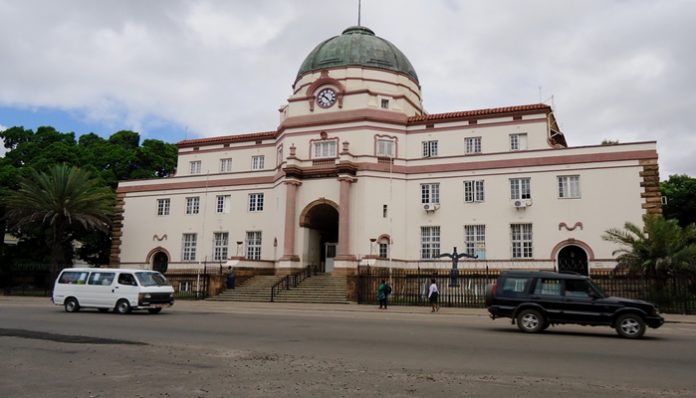
File picture of Bulawayo High Court
Custom Farai (34) was in 2016 convicted of rape by Bulawayo regional magistrate Mr Chrispen Mberewere. He was sentenced to an effective 15 years after five years were suspended for five years on condition of good behaviour.
Farai, through his lawyers, Mutuso, Taruvinga and Mhiribidi Attorneys, filed an application at the Bulawayo High Court challenging his conviction and sentence.
In papers before the court, the State was cited as the respondent.
In his grounds of appeal, Farai said the magistrate erred and misdirected himself at law by failing to appreciate that the State failed to place evidence proving beyond reasonable doubt that he raped his step daughter.
He argued that there were serious irregularities in the evidence given in court.
“The court a quo misdirected itself by making a finding of credibility of the testimonies of both the complainant and her mother despite contradictions. The magistrate erred and misdirected himself in finding that the State had proved its case beyond reasonable doubt when in fact it had failed to do so,” he argued.
“It is doubtful the appellant had an intentional and unlawful sexual intercourse with the complainant without her consent.”
The State, which is being represented by Mrs Sifiso Ndlovu-Sibanda, opposed the application.
She argued that the State managed to prove its case beyond reasonable doubt.
“In casu, they were grave aggravating circumstances which weighed heavily against the appellant to justify the sentence. Farai was a police officer, an enforcer of the law and was in loco parentis to the complainant. Thus, a sentence of 20 years with five years suspended was proper in the circumstances”.
According to court papers, sometime in 2014 the complainant moved from Mutare to stay in Bulawayo with her mother who is married to Farai.
On November 6 in 2014, the complainant’s mother left her alone at home while she went to the shops with her other siblings.
When Farai arrived home, he found the girl alone and she was sweeping one of the rooms.
He asked her to get his car keys from the bedroom. Farai followed the girl and while inside he pushed her onto the bed before he pinned her down with both hands and raped her once.
The girl bled during the process and messed up her clothes and the blankets.
Farai pointed an okapi knife at the complainant, threatening to stab her if she revealed the ordeal to anyone.
He ordered his step daughter to wash the blankets and when the complainant’s mother returned, she asked her why she was washing them but she was scared to tell her what had happened.
The court was told that Farai began habitually raping the girl whenever her mother was away.
She later informed her mother about the rape. A report was made to the police leading to Farai’s arrest. The Chronicle
A public inquiry in South Africa has started investigating alleged corruption by ex-President Jacob Zuma. The inquiry is looking into “state capture”, where the wealthy Gupta family is accused of trying to influence political decisions, including the naming of ministers.
Jacob Zuma
Accusations of graft dogged Mr Zuma’s presidency before he was forced to step down in February.
The former president and the Gupta family deny any wrongdoing.
Opening the inquiry, commission head Deputy Chief Justice Ray Zondo appealed for South Africans to share what they know.
Image captionIn 2016, thousands marched in the capital, Pretoria, calling for Mr Zuma to step down over the graft allegations
“We urge all South Africans who love this country to come forward and assist this commission in order that we may resolve this problem,” he said.
What is state capture?
Mr Zuma was ordered to set up the commission by the high court last December following a report by the public protector, South Africa’s anti-graft body.
It looked into whether the Gupta family influenced President Zuma’s choice of cabinet ministers.
One of the allegations is that in 2015 then-Deputy Finance Minister Mcebisi Jonas was offered 600m rand ($41m; £32m) by businessman Ajay Gupta if he accepted the post of finance minister.
Image captionThe front cover of the State of Capture report shows a hand that appears to be manipulating a puppet
The public protector also investigated claims that the Guptas had bribed state officials to win contracts at the state-owned electricity company, Eskom.
The Guptas said last year that there were no cases to answer and that they were in the process of clearing their name “in the face of unfounded media allegations”.
Analysis: Justice delayed
Milton Nkosi, BBC News, Johannesburg
For many, the old adage that justice delayed is justice denied applies here.
It is hoped that the commission will shed light on allegations of massive corruption that have gone on for far too long.
But for others, this is the beginning of a two-year process that will waste taxpayers’ money and may not result in any prosecutions.
The 76-year-old former head of state still commands considerable support within his party, the ANC.
His supporters believe that he has been unfairly targeted. They often say he has already been found guilty in trial by media.
This inquiry though will have little or no effect in next year’s elections as the party has moved to neuter its possible impact.
What are the allegations against Zuma?
The inquiry will look into whether the former president played any role in the alleged offering of cabinet positions to politicians.
One politician, former ANC MP Vytjie Mentor, told the public protector that Mr Zuma was at the Guptas’ Johannesburg home in 2010 when the Guptas offered her the post of public enterprises minister.
The family wanted her to cancel South African Airways route to India, she alleged.
The inquiry will also investigate whether Mr Zuma, and any other public officials, and their families, benefitted from the awarding of public contracts.
Mr Zuma’s son, Duduzane, woked for the Guptas and has also been implicated in the allegations.
He denies that his relationship with the business family was improper.
What powers does the commission have?
The inquiry, known as the Zondo Commission, does not have power to prosecute but the evidence it collects can be used in any future prosecution.
It can compel people to give evidence and Mr Jonas and Ms Mentor are expected to be among the first witnesses to appear.
The commission could take up to two years to release its findings. –BBC
When a onetime beauty queen walks into a courtroom in Puerto Rico this week, it will bring to an end a long wait endured by relatives of her wealthy former husband, who was stabbed to death in the street.
Áurea Vázquez Rijos in custody in Puerto Rico
Áurea Vázquez Rijos and Adam Joel Anhang’s romance was short-lived and ill-starred.
Now, almost 13 years after Anhang’s murder, a US federal court will finally decide whether the former beauty queen from Puerto Rico had her Canadian online gaming tycoon husband killed after just six months of marriage.
The trial, due to start on 21 August, only takes place after an extraordinary legal battle as Ms Vázquez fought extradition from both Italy and Spain.
It was the father of her late husband who used private detectives to track Ms Vázquez down in Italy after an innocent man had been jailed for the murder and later released.
“It took us five years and a lot of effort and energy to track her, since no sooner did we locate her, she got wind of it and moved on,” Abe Anhang old the BBC from his home in Winnipeg, Canada.
Anhang, a 32-year-old real estate and gaming software multimillionaire, was brutally beaten and stabbed to death one September evening in 2005 on a street in the historical quarter of the Puerto Rican capital, San Juan.
At first glance, the attack appeared to be a robbery gone wrong in which Ms Vázquez Rijos was also injured by the male assailant.
But, according to prosecutors, Anhang was duped into believing that he was meeting his wife in a San Juan restaurant that evening to discuss the terms of their divorce, when in fact he was being lured into a fatal trap.
Ms Vázquez Rijos, the accusation holds, knew that divorce would deprive her of access to much of her husband’s estate, estimated to be worth $24m (£19m), due to a pre-nuptial agreement the pair had signed.
Two years later, Jonathan Román Rivera, a kitchen worker from a nearby restaurant, was convicted of murdering Anhang in an opportunistic robbery.
That conviction was later overturned when a witness came forward, telling a US federal grand jury how she saw the killer hit Anhang with a street cobble stone and knife him several times.
He then spoke with Ms Vázquez briefly before striking her with moderate force, the witness added.
In 2008, a federal grand jury indicted Ms Vázquez on two murder-for-hire related counts after the man suspected of being the street assailant confessed to the killing.
In a statement read out before a court in San Juan, Alex “El Loco” Pabón Colón said that Ms Vázquez had agreed to pay him $3m when they discussed her husband’s killing at Vázquez’s Pink Skirt nightclub and restaurant, a business bought for her as a wedding present by Anhang.
“Áurea communicated with Alex to tell him to park his car in the San Justo street lot. Alex would do what he had to do,” the signed confession reads.
But Ms Vázquez was no longer in US jurisdiction, having abandoned Puerto Rico some time in 2006, according to the prosecutors. She chose to settle in Italy, a country whose laws have sometimes been used by fugitives to make their extradition difficult.
Ms Vázquez met a Florence taxi driver and they had twin daughters together before he read about her being wanted in Puerto Rico in the newspaper Corriere della Sera. The couple separated and the Italian, eventually, gained custody of the two girls.
In the meantime, according to information supplied to Abe Anhang by private detectives he hired in Italy, Ms Vázquez had approached the Florentine Jewish community. “She was embraced by the Jewish community as a widow with two children.”
Mr Anhang Sr explains that the prenuptial agreement his son and Ms Vázquez signed included a pledge by her to study and take up the Jewish faith within two years.
According to US prosecutors, Ms Vázquez was helped by her brother, Charbel Vázquez Rijos, her sister, Marcia and her mother, who provided false paperwork to successfully dupe the Firenzebraica Jewish organisation in Florence into certifying in June 2012 that Áurea and her daughters were of Jewish descent, enabling her to move to Israel.
But, according to Mr Anhang Sr, Ms Vázquez did move around Europe, using “false names and several ID cards”. His team of private detectives said they had traced her movements in Gibraltar, Spain, France and England.
According to prosecutors, in August 2012, Charbel Vázquez Rijos incorporated Glatt Kosher Traveller’s Inc. in the Puerto Rico State Department, the plan apparently being to give his sister a means of earning money in Italy. But the travel company aimed at Jewish tourists was to prove Ms Vázquez’s downfall.
The FBI and Spanish authorities set up a sting operation, inviting Ms Vázquez to Madrid to work as a guide to a fictitious tour group. She took the bait.
Arrested at Madrid’s airport and imprisoned, Ms Vázquez began a new fight against extradition in Spain’s courts.
Ms Vázquez became pregnant behind bars and had a baby. Spanish police sources have told the BBC that the father of the child was a small-time Italian crook, serving time in Spain for a drugs offence.
She was allowed to marry the father in jail, asking a Madrid judge not to extradite her as the mother of a Spanish citizen.
Finally, she was flown across the Atlantic in a private FBI jet in 2015, her month-old baby taken from her arms and sent into care after she landed in her native Puerto Rico.
Further legal delays and then Hurricane Maria led to several postponements of the trial, in which Ms Vázquez’s brother, sister and the latter’s partner will also face charges in the US federal court in San Juan.
Prosecutors have signed a sworn affidavit to Spanish authorities that they will not ask for the death sentence in the case, a condition of the final extradition agreement.
Mr Anhang Sr is optimistic that justice will finally be done for his son, but finds it ironic that his daughter-in-law’s refusal to face trial may end up counting in her favour.
“Áurea is likely to get the lightest sentence of all the accused because she fled and waited to be extradited from a country which placed conditions on her transfer back to the United States to face justice.
“In essence, she will be getting rewarded with the same sentence as if she were caught and sentenced in Spain. At the same time her co-accused will get longer sentences, despite having much less involvement in the crime.”
The BBC contacted Ms Vázquez’s lawyer, Lydia Lizarribar, but she declined the invitation to comment on her client’s defence strategy ahead of the trial.
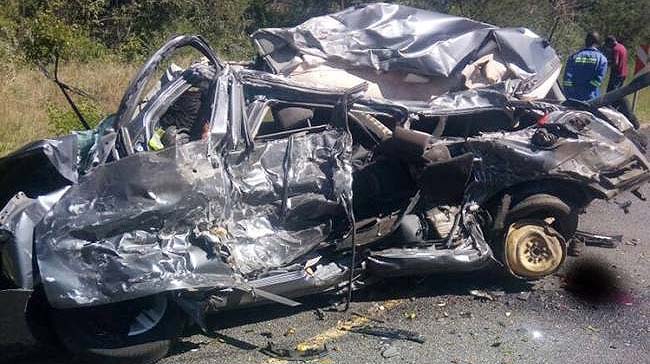
Six people died — four on the spot — while two others were seriously injured when a Hyundai Tucson collided head-on with a Mercedes Benz vehicle near Gutu turn off in Masvingo, police have confirmed.
File picture of an accident
National police spokesperson Senior Assistant Commissioner Charity Charamba said the accident occurred on Saturday at around 2PM at the 233km peg along the Harare-Masvingo Road.
She said the bodies of the deceased were taken to Driefontein Hospital mortuary in Mvuma for postmortem.
Snr Asst Comm Charamba said the Hyundai Tucson, which had four passengers on board, allegedly encroached onto the oncoming traffic lane and collided with the Mercedes Benz.
“Circumstances are that a Hyundai Tucson vehicle was travelling due north towards Harare with four passengers on board,” she said.
“On approaching the 233KM peg, the driver of the Hyundai Tucson encroached into the lane of an oncoming Mercedes Benz that had two passengers on board resulting in a head-on collision”.
Snr Asst Comm Charamba said four people died on the spot and the other two died on admission to Driefontein Hospital.
“Two other passengers who were seriously injured are still admitted to Driefontein Hospital where they are receiving treatment,” she said.
Snr Asst Comm Charamba said police were urging drivers to be observant on the roads and avoid straddling the centre line of the road.
“We express our deepest condolences to the families and relatives on the unfortunate road traffic accident which could have been avoided.
“The names of the deceased will be released once their next of kin have been advised.” The Chronicle
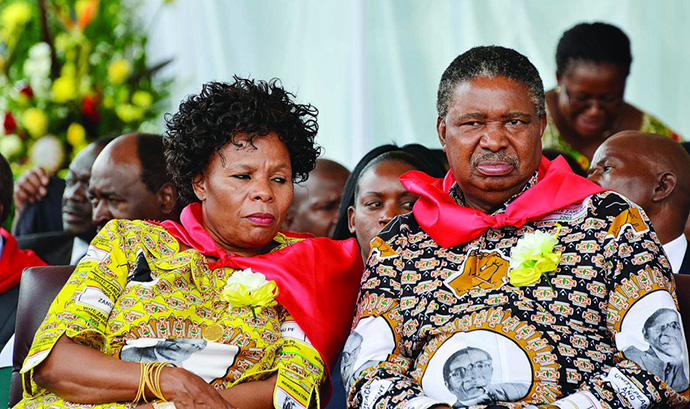
Former Vice President Phelekezela Mphoko’s daughter-in-law has been arrested for allegedly ordering 15 Choppies Supermarket managers in Bulawayo to unlawfully dispense more than $30 000 cash from their Point of Sale (POS) machines after threatening them with either deportation or dismissal.
Former Vice President Phelekezela Mphoko (right) seen here with his wife
Nomagugu Mphoko (36), who was initially jointly charged with her husband Siqokoqela, appeared before Bulawayo magistrate Ms Sithembiso Ndlovu yesterday facing 49 counts of extortion. She was remanded out of custody to September 3 on $200 bail.
As part of the bail conditions, Nomagugu was ordered not to interfere with State witnesses.
Prosecuting, Mr Nkathazo Dlodlo said sometime in June this year, Nanavac Investments trading as Choppies Zimbabwe issued a directive to all its supermarket managers against giving out cash realised from sales to individuals whose arrangement is to replace the equivalent through swiping at Point of Sale machines.
The court heard that between 13 and 29 June this year, Nomagugu went to the complainants, some of whom are Indian nationals, and demanded cash during which she also threatened to either get them fired or deported if they refused to comply.
She would then swipe the equivalent of the money received using different bank cards.
“Upon being advised of the directive against such transactions, the accused would threaten the shop managers with loss of employment and deportation from Zimbabwe. She would also tell the complainants that her husband is the owner of the company and that they were mere employees under his authority,” said Mr Dlodlo.
The court heard that as a result of the threats, the complainants acceded to Nomagugu’s demands and gave her the money.
“The accused person derived the advantage of easily accessing cash which is hard to come by. Her conduct resulted in loss for Nanavac Investments in that being a retail business, the company’s outlets rely heavily on cash to pay critical suppliers, including arranging for foreign payments with local banks,” said Mr Dlodlo.
The cash which was unlawfully collected by Nomagugu from the 15 shops amounts to $30 230. The money was looted on different occasions from Choppies shops in Bulawayo’s Central Business District, Luveve, Pumula East, Entumbane, Bellevue, Nkulumane and Lobengula suburbs.
Nomagugu is being represented by Professor Welshman Ncube of Mathonsi Law Chambers. The Chronicle
A female forex dealer lost more than $7 000 and had her lips cut off by four suspected robbers who allegedly kidnapped her in town. She was also reportedly raped by her assailants.
The gang, said to be fronted by a woman – Susan Fumukani (37) — allegedly called the victim aside and pretended to be clients who wanted to change a large sum of money.
Peace Mapfumo (24), Tinotenda Murondedza (20) and Tichana Tawanda (26) allegedly picked up the victim in the CBD and drove to Chitungwiza where the money was alleged to be.
They robbed and raped the woman before chopping off her lips. –The Herald
Flamboyant rapper Mudiwa, pictured here with Steward Bank Chief Executive Officer Dr Lance Mambondiani
By Tawanda Musarurwa
Steward Bank, a unit of Econet Waireless, has launched an innovative housing development scheme, which vertically integrates several of the telecoms giant’s business offerings.
Flamboyant rapper Mudiwa, pictured here with Steward Bank Chief Executive Officer Dr Lance Mambondiani
Econet Wireless is a key player in the data space through its internet services subsidiary, ZOL Zimbabwe and the group also operates a solar subsidiary — Distributed Power Africa (DPA).
Additionally, in 2015 Econet Wireless swooped on Redan Gas as it extended its footprint into the energy solutions business; the group also runs a subscription television network — Kwese TV, as well as a home surveillance system — Connected Home.
“In the past week, the bank unveiled its Diaspora Mortgage Scheme in London, having recently completed development of 200 housing units in Ruwa fully-equipped with services such as solar, gas facilities, wifi, Kwese satellite system and home surveillance system,” said Stewart Bank.
“The housing scheme, which is one of many under development by Steward Bank is targeted at addressing the rising demand for quality houses in the country as more investors angle to take opportunities in the property sector.”
The Diaspora Mortgage Scheme will be available at zero deposit, on a 25-year tenure at an interest rate of 2 percent per annum, which is the lowest rate in the local financial services sector.
The Diaspora Mortgage facility ranges from a minimum of $10 000 to a maximum of $400 000.
Steward Bank’s more flexible mortgage offering will contribute to reduce Zimbabwe’s national housing backlog, which has been ballooning in recent years, pushed by the increased rural to urban migration.
The country’s national housing backlog is currently estimated at 1,3 million with Harare alone requiring around 500 000 housing units.
Zimbabwe has been unable to resolve its housing issues due to the onerous terms of developers and the stringent conditions and high cost of mortgage finance among others. The Herald


 Connell Sibanda of Nkulumane suburb opened a gas cylinder and set his room alight while he was inside after his girlfriend Siboniso Dube (59) told him they should part ways.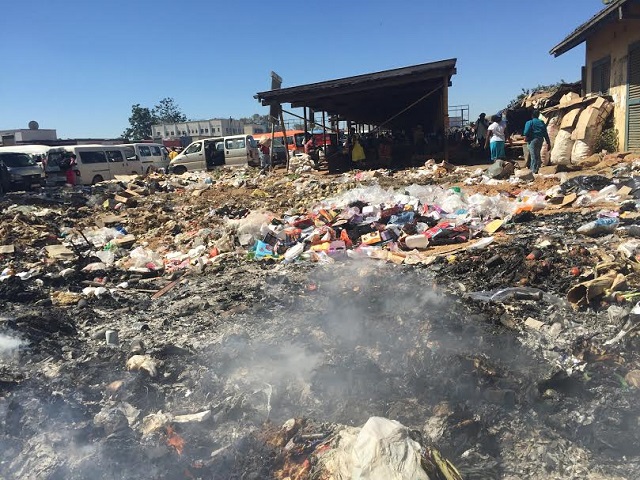


 The gang, said to be fronted by a woman – Susan Fumukani (37) — allegedly called the victim aside and pretended to be clients who wanted to change a large sum of money.
