WINDHOEK (AFP) — Zimbabwe has refused to comply with a regional tribunal’s order to allow 78 white farmers to keep their land, a judge said Friday, saying the court would refer the case to Southern African leaders.
The tribunal of the South African Development Community (SADC) last year ruled that the 78 farmers could remain on their land, which was targetted for resettlement by black farmers under President Robert Mugabe’s land reform scheme.
But Mugabe has openly dismissed the verdict, and the farmers’ lawyer returned to court Friday to seek further action to enforce the ruling.
“The applicants showed ample material of the state of Zimbabwe?s non-compliance (with the earlier ruling) and the tribunal will report its findings to the SADC summit,” Justice Ariranga Pillay said.
The lawyer for the farmers, Jeremy Gauntlett, urged the court to recommend sanctions or Zimbabwe’s expulsion from SADC.
“We urgently ask the SADC tribunal to put this matter before the next summit of the SADC heads of states next August for possibly imposing sanctions against Zimbabwe, laying down a timetable for compliance — otherwise expulsion from SADC,” Gauntlett said.
“Despite the tribunal ruling of last November… there have been forced and aggressive invasions on the farms of Mike Campbell and Richard Etheredge,” Gauntlett added.
The lawyer quoted Mugabe, who publicly said earlier this year that the ruling was “nonsense and of no consequence.”
“This defiance not only threatens the lives of the farmers who endured several invasions over the past few weeks and their crops rot on their land, but also the authority of this regional tribunal,” Gauntlett argued.
Zimbabwe’s deputy attorney general Prince Machaya declined to enter a defence.
“I have no instructions to make a submission,” he told the tribunal.
Although SADC members are bound by treaty to respect the court’s decisions, the judges have no independent power to enforce their rulings.
The land case was the first major ruling by the court since it first convened in April last year.
Eight years ago Zimbabwe began seizing white-owned farms to resettle them with landless blacks, but the chaotic programme was plagued by deadly violence and some farms ended up in the hands of Mugabe’s allies.
In Zimbabwe and many neighbouring countries, white settlers took most of the best farmland during colonial times. Now African nations face a dilemma in how to bring black farmers back onto the land without disrupting food production.
Zimbabwe gave much of its land to inexperienced farmers and provided them little support, causing an enormous drop in food production that has left the country dependent on foreign food aid.
VICTORIA FALLS, Zimbabwe (AFP) — Sudan’s President Omar al-Beshir, who faces international arrest for war crimes, arrived in Zimbabwe on Saturday for a two-day African trade summit.
Beshir will join heads of state from the 19-member Common Market for Eastern and Southern Africa (COMESA) who are set to approve a free customs union on Sunday.
Zimbabwe has no duty to arrest Beshir as it is not party to the treaty that set up the International Criminal Court (ICC), justice minister Patrick Chinamasa told AFP.
“We are aware that the President of Sudan is under an ICC warrant of arrest which he disputes. We are not a state party under the Rome Statute. We have no obligation under the Statute of Rome to execute that obligation,” he said.
The ICC issued an arrest warrant in March for Beshir to face five counts of crimes against humanity and two of war crimes over the conflict in Darfur.
Sudan is a member of COMESA, which will be chaired from Sunday by Zimbabwe President Robert Mugabe who takes over from Kenyan President Mwai Kibaki.
Under the free customs union deal, the 19 countries with a total population of 400 million people will impose the same tariffs on goods from outside the region.
Raw materials and capital goods will travel across borders without tariffs, while intermediate products will be taxed at 10 percent and finished goods at 25 percent.
Also in Victoria Falls is ousted Madagascan leader Marc Ravalomanana, who said Madagascar needs support and help from the trade bloc, following his ouster in March.
“It was a coup. I’m sure COMESA will make a commitment so that I get my country back,” he told reporters at Victoria Falls airport.
Ravalomanana this week dismissed a four-year jail term to which he was sentenced in absentia over his purchase of a 60-million-dollar presidential jet.
COMESA consists of Burundi, Comoros, the Democratic Republic of Congo, Djibouti, Egypt, Eritrea, Ethiopia, Kenya, Libya, Madagascar, Malawi, Mauritius, Rwanda, Seychelles, Sudan, Swaziland, Uganda, Zambia and Zimbabwe.
HARARE (Reuters) – Zimbabwean Prime Minister Morgan Tsvangirai left for Europe and the United States on Saturday to try to drum up financial aid for a unity government he formed with rival President Robert Mugabe.
Tsvangirai will visit the Netherlands, Britain, France, Sweden and Brussels, seat of the 27-nation European Union, to try to help Zimbabwe’s battered economy. He will meet U.S. President Barack Obama during a four-day trip to Washington.
“I am meeting all the heads of government of the countries I am visiting … I hope that we will be able to put our case across and for the rest of the world to give the inclusive government the benefit of doubt,” Tsvangirai told reporters.
Tsvangirai formed a unity government with rival Mugabe in February after an electoral standoff that worsened an economic crisis, which many critics blame on the veteran Zimbabwean president.
Many Western countries imposed sanctions on Mugabe’s ZANU-PF government over charges of human rights abuses, vote-rigging and its seizures of white-owned commercial farms for redistribution to blacks without paying compensation.
Mugabe, 85, and in power since independence from Britain in 1980, says Zimbabwe’s once-prosperous economy has been wrecked by sanctions and his land policy is aimed at correcting colonial injustices.
Western donors say they will not release substantial aid until Zimbabwe’s new administration undertakes political and other reforms. Harare says it needs about $10 billion for its short-term economic recovery program, but has so far secured credit lines worth about $1 billion from Africa.
Asked if he would be able to convince Western countries to release aid, Tsvangirai said: “I’m optimistic because Zimbabwe has gone through a very difficult period. The country has been in isolation in the last 10 years. It’s time we put our case across.”
Tsvangirai says he has a “workable relationship” with Mugabe although there are still disputes in the unity government over Mugabe’s appointment of his allies as heads of the central bank and the attorney-general’s office.
In a sign of the difficult relations in the new government, Zimbabwean state media on Saturday cast Tsvangirai’s trip to Western capitals as “an assignment given by the president to the prime minister to undo sanctions he invited on the country” while in opposition.
Tsvangirai’s spokesman James Maridadi said: “That is outright propaganda meant to cast the prime minister as a poodle and junior partner in the government.
“The prime minister’s program is not defined by President Mugabe but the whole unity government and he is working in the best interests of all Zimbabweans.”
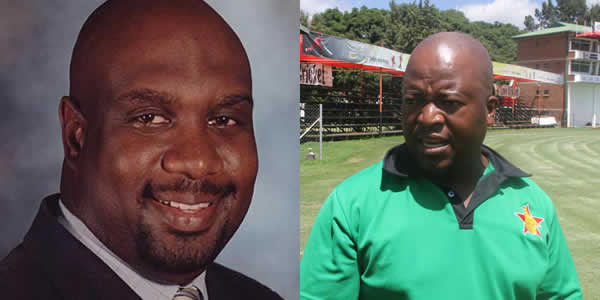
Zimbabwe Cricket Union director Ozias Bvute got into a fist fight with convenor of selectors Stephen Mangongo
The divisions and rifts in Zimbabwean cricket came to a head when Zimbabwe Cricket Union director Ozias Bvute got into a fist fight with convenor of selectors Stephen Mangongo, according to several witnesses.
Zimbabwe Cricket Union director Ozias Bvute got into a fist fight with convenor of selectors Stephen Mangongo
The alleged incidents happened last Thursday, when Zimbabwe were playing Sri Lanka in the last of five international matches.
Bvute had a fight with Mangongo after they disagreed over how many of the white players who have recently been on strike should be included in the Zimbabwe team for the first Test against Sri Lanka which begins in Harare on Thursday, according to several guests and security staff who reported the incident to ZCU officials.
Before that Bvute had stormed into the television commentary section of the media centre at Harare Sports Club and sacked Mpumulelo Mbangwa, a Zimbabwe commentator.
Bvute and Mangongo admitted later in a joint statement that they had had a “physical confrontation” but they denied it had extended to fisticuffs.
Witnesses to their row said Mangongo thought eight whites who have been in dispute with the ZCU but who have resumed training should be included, but Bvute said he was prepared to include three or four at most.
They said later they were discussing “pertinent issues” which led to shouting, then to the fracas.
Several administration and technical staff were present in the TV section when Bvute marched in and told Mbangwa, popularly known as “Pommie,” that he was fired for making observations about the Zimbabwe team’s performance, comments which apparently enraged Bvute.
A ZCU source who was informed about the incident said: “I am told that Pommie later went to see Bvute to discuss it and Bvute relented.”
One of the TV company’s managers, who asked not to be named, confirmed the incident, saying: “Yes, that is exactly what happened.”
Bvute has the authority to sack TV commentators according to the ZCU. He is chairman of the ZCU marketing committee which negotiates TV and other publicity contracts.
Bvute is also in charge of the Union’s integration policy to advance blacks into top levels of the sport, both on and off the field.
Mbangwa, a former Test cricketer with Zimbabwe, has been commentating for several years and is highly regarded by the TV company.
Neither ZCU chairman Peter Chingoka nor Bvute were available for comment. Mbangwa was said to be away.
The white players went on strike in protest at the sacking of former captain Heath Streak. He was replaced by 20-year-old Tatenda Taibu. AFP
By Lance Guma | Opinion | Written in October 2002 |
History is littered with events that clearly show Robert Mugabe was always a dictator, mind, body and soul. Since assuming the captaincy of the Zimbabwean ship in April 1980, he has never tolerated opposition to his rule in whatever form. Political scientists contend he set sail well but somehow lost the compass midway hence the current sinking ship. Events however, tell a different story.
Robert Mugabe, Emmerson Mnangagwa and Perence Shiri the three key figures in the Gukurahundi Genocide
That Mugabe was at one time the darling of the international community is not in doubt. A well pronounced reconciliation policy, advances in education, health and the provision of social services enabled him to mask his intolerance of internal opposition and deferred for sometime the
unmasking of his true colours.
Four months after democratically taking power in 1980, Robert Mugabe then Prime Minister, signed an agreement with the North Korean government led by President Kim II Sung, providing for the Koreans to train a brigade in the Zimbabwean army to in Mugabe’s words, “combat malcontents.”
While the rest of the world including the legendary Reggae musical prophet, Bob Marley, euphorically gloated over Zimbabwes’ hard won independence the incumbent ‘statesman’ was already planning how to crush the opposition.
Despite the existence of a police force and army that could easily contain any civil unrest, 106 Koreans arrived in August 1981 pursuant to the August 1980 agreement to train what would become an infamous 5 brigade.
Wearing red berrets to distinguish from the regular army the brigade drawn from 3500 ex-ZANLA troops butchered over 20 000 people living in the southern parts of Zimbabwe believed to be opposition supporters. Mugabe christened the new brigade, ‘Gukurahundi’ which, loosely translated, means ‘the rain which washes away the chaff before the spring rains’.
The opposition ZAPU led by the late nationalist Dr Joshua Nkomo had won a sizeable number of seats in the new parliament and clearly fitted the description of ‘chaff’ as it stood between him and total domination.
A state of emergency in place since 1965 way before independence was maintained by Mugabe for a decade until July 1990, an ominous sign that nothing was changing except the colour of the new ruler’s skin. The Gukurahundi era began to define the role of particular organisations in the
maintenance of Mugabe’s smartly disguised but brutal ‘life presidency’.
These were Youth Brigades, Central Intelligence Organisation (CIO), Police Internal Security Intelligence Unit (PISI), Police Support Unit (PSU), Zimbabwe Broadcasting Corporation (ZBC) and the army. Most if not all these organisations relied heavily on archaic and abhorent colonial legislation to
subvert justice.
Up to now these organisations continue to play an integral role in keeping Mugabe in power using the same legislation now spruced up by hired ‘Professors’ with seemingly dignified titles but rudely oppressive anyhow ie Access to Information and Protection of Privacy Act (AIPPA), Public Order and Security Act (POSA) and the Broadcasting Act which grants the state broadcaster an embarrassingly naked monopoly over the airwaves.
In the run up to the 1985 elections the ZANU PF Youth Brigades ideologically modelled on the Chinese Red Guard rampaged through the country meting out violence to mainly Ndebele speakers who were presumed to be supporters of Nkomo’s ZAPU.
They carried out mob beatings, burnt homes and murdered innocent civilians while responding to Mugabe’s chilling calling, ‘go and uproot the weeds from your gardens.’ Nothing has changed. Youth brigades now being officially produced from the Border Gezi training camps under the guise of a ‘national service drive’ are doing the same to MDC supporters across the country.
The Central Intelligence Organisation (CIO) was used to facilitate the ‘disappearance’ of people deemed a threat to ‘state security’. Sydney Malunga the opposition Chief Whip in parliament at the time, famous as an outspoken legislator was arrested in 1986 on charges of assisting the ‘dissidents’ before the treason charges were dropped.
He died in a suspicious accident when his car collided with a ‘black dog’ (underground jargon for army truck). Christopher Giwa a former University of Zimbabwe student leader who had embarrassed Mugabe during a Commonwealth Heads of Government Summit (CHOGM) in Harare by organising a demonstration died when his small Nissan Pulsar vehicle collided with another black dog.
The deaths of Rashiwe Guzha, Captain Nleya, Mthandazo Ndema Ngwenya, Samson Benard Paweni and many others remain shrouded in mystery and suspicion. Now that Zimbabwe has a vibrant, diligent and brave independent press this ‘disappearing’ function of the CIO has been whittled down and confined to sophisticated assignments.
The death of Insiza MDC member of parliament George Joe Ndlovu who is alleged to have eaten a poisoned apple at a function in Masvingo is another reminder snakes will always be snakes. He had a blackout while driving and had an accident. The job was finished off in hospital.
Evidence is mounting that Mugabe worried about retributions when he leaves the scene wants to fiddle the with the constitution but can only gain a two thirds majority by eliminating MDC parliamentarians and rigging the resulting by-elections.
Another tragic addition to this long list of examples is the suspicious death of Learnmore Jongwe the oppositions former spokesman and legislator in remand prison awaiting trial for allegedly stabbing his wife to death in a domestic dispute. At the time of his arrest government went out of its way to spread the falsehood that the former student leader and lawyer wanted to commit suicide soon after the incident as an advance pretext for denying him bail using a compromised judiciary.
Speculation is also rife they offered him an ‘information for freedom’ deal which he rudely turned down.It is now clear his being kept in custody was to fulfil the grand plan of reducing MDC legislators by hook or crook. This sad era in the history of Zimbabwe showed Mugabe’s penchant for rewarding evil.
The commander of the 5 brigade, Colonel Perence Shiri at the time, who presided over the atrocities later described as ‘a moment of madness’ by Mugabe himself is now Air Marshall Shiri, the supreme head of Zimbabwe’s Airforce. Mugabe’s other henchmen through this period, the current Speaker
of Parliament, Emmerson Mnangagwa and Defence Minister, Sydney Sekeramayi are his closest aides and have survived numerous reshuffles by Mugabe.
The two are currently being touted as the leading contenders to the Zimbabwean throne. ZANU PF’s current tactic of whimsically arresting opposition leaders on charges ranging from inciting violence, murder and treason without ever securing a conviction can also be traced to this period in history.
In 1982 Dumiso Dabengwa (ZIPRA’s Intelligence Supremo) , Lookout Masuku (Army General) and four others faced treason charges which were later quashed by the Supreme Court for lack of credible evidence. Mugabe accused Dabengwa of writing a letter to Mikhail Gorbachev (former USSR president) asking for assistance in toppling Mugabe. The Soviets however denied this.
Inspite of the Supreme Court order Dabengwa and Masuku were redetained and spent four years in custody without trial courtesy of Mugabe’s often abused ’emergency regulations’. Masuku died in suspicious circumstances a few weeks after his release and Dabengwa was rewarded with a cabinet post in a unified government much later.
Masuku was belatedly declared a national hero only after intense lobbying found a guilty Mugabe eager to appease the Matabeleland region he had abused for a long time. The late Dr Joshua Nkomo and Rev Ndabaningi Sithole, father figures in Zimbabwean nationalism both faced charges of trying to kill Mugabe despite evidence to the opposite. MDC President Morgan Tsvangirai faced similar charges before being acquitted.
ZANU PF has perfected the art of manufacturing events in order to justify any excesses they may commit. The discovery of arms caches in February of 1982 which soured the integration of ZIPRA and ZANLA forces into one army had all the makings of a manufactured event coming fresh after the Entumbane Uprising in which the two sides fought each other for two days. Evidence clearly showed government had planted the arms to gain a pretext for unleashing the 5 brigade.
The kidnapping and murder, in 1982 of 6 foreign tourists was also suspicious as it allowed the regime to effect past colonial immunity laws that protected members of the security forces from prosecution if they committed any crimes. Similarly the murder of Bulawayo War Veteran leader, Cain Nkala
had all the makings of an inside job as it allowed Mugabe the much needed chance and consequent mileage to brand the MDC a violent party, when his death was of no material benefit to the opposition at all.
If the world is surprised at Mugabe’s behaviour it is because it failed to understand his intolerance from the word go. Mugabe is as predictable as the rising sun and none know this more than those who have borne the brunt of his brute. The saying, history repeats itself because we are not paying attention the first time is given credence by the story of Mugabe more the leader of a band of crooks than of a country.