The photograph was a simple tableau of elite hospitality. At Precabe Farm in Kwekwe, South African President Cyril Ramaphosa stood with his host, President Emmerson Mnangagwa.
Yet, it was the third man – resplendent in the confidence only a government tender can buy – who transformed a routine diplomatic visit into a political crisis for Pretoria.
That man was Wicknell Chivayo, a flamboyant businessman whose reputation precedes him across the Limpopo not for industrial innovation, but for his uncanny proximity to ZANU PF power and his inconvenient entanglements with South African law enforcement.
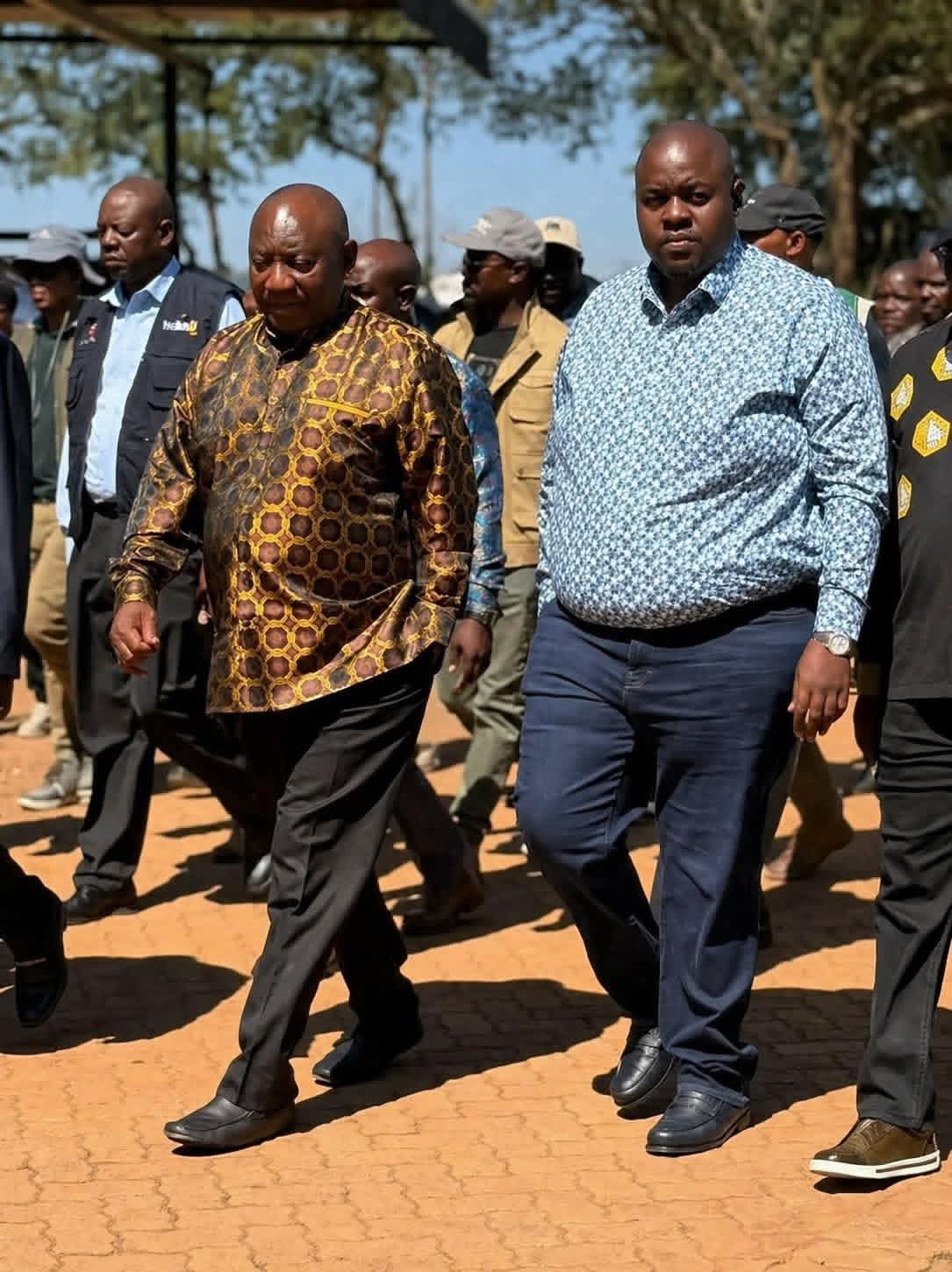
For Ramaphosa, the encounter was a public relations catastrophe, a shard of reality piercing the bubble of his “New Dawn.” For Mnangagwa, it was just another Tuesday. This divergence provides a profound autopsy of the two distinct political souls of Southern Africa.
The controversy exposes the structural chasm between a South Africa still tethered to institutional accountability and a Zimbabwe that has fully embraced a patronage-driven, oligarchic state model.
The Anatomy of a Scandal
The facts are stark. Ramaphosa travelled to Zimbabwe for a routine working visit. However, the optics shifted when images emerged of the president in the company of Chivayo at Mnangagwa’s private estate.
The timing was poisoned: Chivayo is currently under investigation by South Africa’s Hawks for alleged money laundering, with authorities reportedly freezing assets linked to him.
Pretoria’s reaction was immediate damage control. Presidential spokesperson Vincent Magwenya asserted that Ramaphosa had no prior knowledge of the guest list and was unfamiliar with Chivayo.
In South African politics, where “state capture” still haunts every corridor, such explanations are viewed with the same scepticism one reserves for a fox explaining its presence in a henhouse.
The opposition pounced, framing the encounter as a betrayal of the president’s anti-corruption mandate.
The Burden of the New Dawn
The story exploded in South Africa, while barely causing a ripple in Zimbabwe’s state media, because of Ramaphosa’s specific branding. He ascended on the promise of a “New Dawn” to purge the ANC of Zuma-era rot.
In South Africa, the relationship between power and “tenderpreneurs” is a raw nerve. The country possesses a robust judiciary, a fierce investigative press, and a parliamentary oversight mechanism that remains functional.
In this environment, optics are everything. Proximity to a man being investigated by your own police force is a delicious contradiction of the constitutional order the president is sworn to uphold.
The South African public, weary of Gupta-linked scandals, reacts with a visceral allergic response because they understand that in a democracy, the company a leader keeps is a proxy for the ethics they practice.
The New Protocol: Oligarchs Over Deputies
Perhaps the most sarcastic irony was the conspicuous absence of Zimbabwe’s constitutional heavyweights. Where were the vice presidents? In any standard setting, the arrival of a foreign head of state is a moment for formal hierarchy.
Yet, at Mnangagwa’s side, the traditional guard was replaced by Wicknell Chivayo and energy mogul Kudakwashe Tagwirei.

This is a masterclass in political trolling. In the Harare theatre of power, being a “gold benefactor” with an appetite for mining deals carries more weight than holding constitutional office.
One can imagine Vice Presidents Chiwenga and Mohadi relegated to the periphery while the men who finance the “Vision 2030” billboards take centre stage.
It sends a message of delightful clarity: why bother with the formalities of statehood when you can have the men who buy the cars standing in the light?
In Zimbabwe, the “alternative cabinet” does not meet in secret; it poses for the cameras, draped in the confidence of the untouchable.
Normalising the Exceptional in Harare
Under ZANU PF, proximity between the executive and controversial businessmen is the primary engine of governance. Chivayo and Tagwirei are not liabilities in Mnangagwa’s eyes; they are essential components of the patronage economy.
They function as informal extensions of the state, providing the liquidity and logistical support the ruling party requires to maintain its grip.
In exchange, they receive preferential access to contracts and a shield of political protection that makes a mockery of the rule of law.
Mnangagwa’s administration prioritises loyalty and financial agility over public perception because he operates in an environment where the consequences for scandal have been systematically neutered.
The Global Logic of Patronage
This model finds parallels in the “managed democracies” of the East. Much like the Russian oligarchs under Vladimir Putin, Zimbabwe’s elite businessmen exist in a symbiotic relationship with the presidency.
They are permitted to amass wealth provided that wealth serves the regime’s survival. There is something almost comedic about the brazen Ness – a system so confident in its lack of accountability that it treats national sovereignty as a boutique family business.
Contrast this with the Gupta family in South Africa. Their attempt to replicate the oligarchic model failed because South Africa’s investigative institutions were strong enough to expose the mechanics of capture.
In a Western democracy, a photograph with a high-profile criminal suspect would end a career. In Harare, it is viewed as being “within the tent,” preferably a tent with air conditioning and imported leather seating.
Two Systems, One Frame
The real scandal is not that Ramaphosa shook a hand, but that the encounter was possible. It illustrates how the “New Dawn” is constantly diluted by the “old guard” realities of its neighbours.
Ramaphosa operates in a system where he is held to account by law and a sceptical electorate. Mnangagwa operates in a system where power is its own justification, and the presence of Chivayo and Tagwirei serves as a reminder of who actually keeps the lights on.
Ultimately, the photograph is a Rorschach test for Southern African governance. To a South African, it represents a breach of the line between the state and the underworld.
To the Zimbabwean elite, it represents the seamless integration of political and commercial interests, where vice presidents are ceremonial ghosts in a machine run by the highest bidder.
The two presidents may have stood in the same field, but they were in different political universes. One is somewhat a world of rules; the other is a world of networks where the only rule is survival.
Until these cultures align, the Limpopo remains not just a geographic border, but a moral one too.
Gabriel Manyati is a Zimbabwean journalist and analyst delivering incisive commentary on politics, human interest stories, and current affairs.
Discover more from Nehanda Radio
Subscribe to get the latest posts sent to your email.