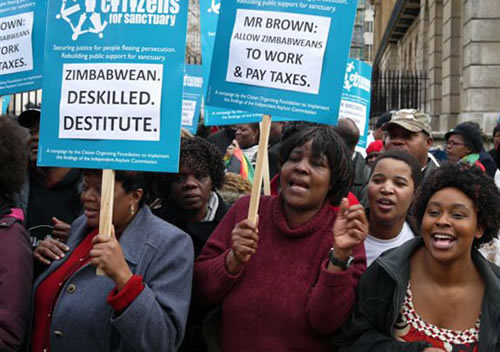
House of Commons, Westminster Hall, Wednesday 24 March 2010Â , ZimbabweÂ
Hugh Bayley (City of York) (Lab): Today’s debate gives us an opportunity to discuss the Africa all-party group’s latest report, “Land in Zimbabwe: Past Mistakes, Future Prospectsâ€. I begin by declaring an interest: the Royal African Society seconds a member of its staff, Alex O’Donoghue, to work three days a week for the all-party group, and I sponsor her parliamentary pass.Â
I thank colleagues from all parties and from both Houses of Parliament who have contributed to the report. I also thank Alex O’Donoghue for her work in collecting the evidence and setting up our oral evidence sessions.Â
Finally, I thank the Secretary of State for International Development for considering our report and its conclusions, and for responding, on behalf of his Department and the Foreign Office, to those conclusions.Â
Our all-party group chose to investigate this subject because it is a pivotal and emotive issue in Zimbabwe. The violence from farm invasions has destroyed the livelihoods of 200,000 farm workers and halved the commercial agricultural output of Zimbabwe. Zimbabwe’s current land reform policy is a barrier to both the county’s economic recovery and its longer term development.Â
We also decided to address this subject because of our concern that UK policy is misunderstood in Africa. Many Africans, particularly those from southern Africa, believe that the UK promised to fund land reform in Zimbabwe as part of the deal made 30 years ago at the Lancaster house talks, which brought to an end the illegal unilateral declaration of independence by the white settler regime in Zimbabwe.Â
Furthermore, many in Africa believe that we oppose farm invasions in Zimbabwe principally because it is white farmers whose land is being expropriated, and many believe that we support the European Union’s restrictive measures—often referred to as sanctions—because we have political differences with the President of Zimbabwe.Â
I do not believe that any of those views are right or true. For example, the EU’s restrictive measures ban arm sales to Zimbabwe because of the human rights violations that the armed forces in that country have committed against civilians. Those measures also freeze the assets of 203 individual members of ZANU-PF, which until recently was the sole ruling party in Zimbabwe, and of 40 parastatal companies. Those assets abroad have been frozen because of the real fear that Government or state property from Zimbabwe was being taken out of the country and used for personal benefit, rather than for the benefit of Zimbabwe’s people.Â
I must say, however, that sometimes the comments made by Members of this House about land invasions in Zimbabwe reinforce the belief that our concern is based principally on kith and kin. I do not believe that that is the case. Addressing that concern was one of the reasons why the all-party group decided to write our report.Â
Sir Nicholas Winterton (Macclesfield) (Con): The hon. Gentleman has quite rightly outlined the facts and gave the statistics about land invasions, saying that something like 220,000 farm workers have been robbed of their jobs, their accommodation and a good quality of life.Â
Does that statistic indicate that those of us who have stood up and opposed the farm invasions are seeking merely to support our kith and kin? We are concerned about Zimbabweans and the prosperity and future of their country. Is that not the position of the overwhelming majority of Members of this House who have taken an interest in Zimbabwe and land reform there?Â
Hugh Bayley: I believe that that is the case and I am glad to hear the hon. Gentleman, who has been vocal on this issue for as long as I have been a Member of Parliament, stating that as clearly and as forcefully as he just has.Â
The all-party group wanted to do two things in our report: to set the record straight and to look forwards, not backwards—to try to develop ideas about the types of policies that would provide the basis for a new and better relationship between our country and Zimbabwe.Â
The report set out three broad objectives: first, to establish what was actually agreed at Lancaster house; secondly, to document what development assistance has been provided by the UK to Zimbabwe, for land reform specifically and more generally; and thirdly, to examine what future land reform policies would re-establish a productive agriculture sector in Zimbabwe, which would support rural livelihoods and offer job opportunities once again for the many farm workers who have lost their jobs through the farm invasions.Â
We sought and obtained evidence from the widest possible range of people. They included representatives of the UK Government, and we are grateful to the Secretary of State for International Development for providing a detailed draft of written evidence. Through the Zimbabwean ambassador in London, we received evidence from ZANU-PF.Â
We also received evidence from various participants at the Lancaster house talks, including members of the ZANU and ZAPU teams who were legal advisers to their respective party presidents, Robert Mugabe and Joshua Nkomo. Furthermore, we received evidence from Lord Carrington, who gave oral evidence in a very sharp way. He remembered a huge amount of detail and it was important to capture that detail to understand what actually happened in those discussions at Lancaster house.Â
In addition, we sought and obtained evidence from academics, both in the UK and Zimbabwe; from Chester Crocker, the US Assistant Secretary of State who had special responsibility for Africa at the time of the Lancaster house talks, and from others.Â
In all the evidence that we obtained, we found no evidence that Britain had betrayed promises on land reform made at Lancaster house. In fact, the most interesting evidence of all came from ZANU-PF. The Zimbabwean embassy in London did not claim that there was a secret deal that the UK would provide funds to pay for land reform.Â
It is true that both Robert Mugabe and Joshua Nkomo sought commitments on land reform at Lancaster house—land reform was a very important issue for those who had been involved in the liberation struggle—but the UK had to broker a deal between Ian Smith and his regime’s military on the one hand and the liberation movements on the other hand, and there was no agreement on land.Â
At one stage in the talks, Robert Mugabe and Joshua Nkomo threatened to walk out of Lancaster house, but a great deal of pressure was put on them by the Presidents of the front-line states, particularly Zambia and Mozambique, which were used by the Zimbabwean liberation movement fighters for their training camps and supply lines. Pressure from those neighbouring countries was put on the Zimbabwean liberation movements to agree a deal so that the war might end. The leaders of those movements were urged to compromise, and they did.Â
There is nothing in the Lancaster house agreement promising to pay for land reform, and nothing in our conversations with the principal western Ministers involved at the time—Lord Carrington and Chester Crocker—suggested that there was any secret deal to do so. Nevertheless, Britain made aid available for land reform on a “willing seller, willing buyer†basis, and by 1986, 71,000 families had been resettled on land formerly owned by commercial farmers. The Economist described it at the time as “one of the most successful aid schemes in Africaâ€. However, by 1985, the scheme had slowed down, and in the 1990s it stopped altogether.
In 1997, Robert Mugabe was losing support within his party, ZANU-PF, and came under pressure from war veterans for pensions. He capitulated to those demands, seeking support from a constituency within his party, but his capitulation did not end the demands. The veterans came back with more demands, including demands for land, and in 2000 Robert Mugabe instituted a fast-track land reform process. From that time onwards, Zimbabwe’s relationship with the UK, the European Union and the United States deteriorated.Â
As a result of fast-track land reform, Zimbabwe’s agricultural output has fallen by 60 per cent. and the economy more generally has gone into freefall, with mounting inflation. I came back from Zimbabwe recently with a note for either 50 million or 50 billion Zimbabwean dollars—I cannot remember which. I should have looked at it again this weekend. At the end of the inflation spiral, prices were doubling every 24 hours.Â
Sir Robert Smith (West Aberdeenshire and Kincardine) (LD): I should declare an interest, as my nephew is a Zimbabwean who has been evicted from farmland.
The hon. Gentleman mentioned the change in process that led to the collapse in productive capacity. One of the biggest underlying problems it is that, because the process does not give legal title to the new owners and the transfer has no proper legal underpinning, the new owners have no means of investing in the farms. We therefore need to bring back legal stability and a proper legal process to land ownership in countries such as Zimbabwe, to enable investment for the future so that productive capacity can be restored.Â
Hugh Bayley: The only thing with which I disagree is the use of “weâ€. It is not for us but for the Government of Zimbabwe to bring that back. However, I know the hon. Gentleman well, and I am sure that that was a slip of the tongue. One matter that we examined in some detail in our report was Zimbabwe’s dual land ownership law.Â
Roughly 70 per cent. of land was originally commercially farmed, with a system of title, which brought with it the sort of benefit that the hon. Gentleman describes. Owners can use the equity in the land title to borrow for the purchase of inputs such as seeds and fertilisers and to pay for irrigation; when good legal title is lost, such benefits disappear.Â
However, on the remaining 30 per cent. of the land—the so-called communal lands used largely by African farmers—an individual farmer does not have legal title and is therefore unable to gain the credit necessary to raise farm productivity. I would like a system of title to be established for land across Zimbabwe as a whole, but that of course is a matter for the Zimbabweans, not us.Â
Mr. William Cash (Stone) (Con): I was an official observer in the Rhodesian elections back in 1982 and I remember meeting members of the then Government. Among the matters that came up that the hon. Gentleman has not yet mentioned was the question whether the money that came from land, if compensation were payable under reform, could be taken out of the country. Of course, a different regime altogether applied to mines. Did he discuss with Lord Carrington article 5 of the constitution—if I recall it correctly; it was a long time ago? That was a hot issue at the time. It locked people in and it has in many ways been a contributory factor in the conflict, violence and hatred that Robert Mugabe has tended to generate.Â
Hugh Bayley: We did not discuss with Lord Carrington the situation after the Lancaster house talks, other than in the most general terms. However, one pillar on which the agreement rested was the principle that the political arrangements—the constitution as agreed at Lancaster House—would remain in force for either 10 or 20 years.
Somebody will correct me—[HON. MEMBERS: “Ten years.â€] Yes, of course, because it was 10 years later that the constitution was changed to create a different political arrangement. One plank of the Lancaster house agreement was that until or unless the constitution was changed, land title would change only on the basis that a willing seller sold to a willing buyer. In fairness to Robert Mugabe, after a bloody war against an illegal settler regime, he honoured that agreement to the letter. The problems arose later.Â
Mr. Cash: “Willing seller, willing buyer†is one thing, but the fact that the seller could not repatriate the money to the United Kingdom or wherever else they wanted to send it created a lot of pressure on the practicalities of the reform system. As I recall, in the mining sector, Lonrho negotiated a deal enabling it to take mining money out of the country. The whole thing was a complete mess, which is what generated a lot of the pressure.Â
Hugh Bayley: We did not consider capital flows in detail in the report, but that is an important issue. Perhaps if the hon. Gentleman catches your eye, Mrs. Dean, he will be able to expand on it. It is crucial to the future as well as the past.Â
On finance and money, although the Lancaster house agreement did not require the UK to set up a land reform fund, the UK put up money for that purpose. The UK has always been one of the biggest aid donors to Zimbabwe: since 1998, it has been among the top three countries in the world giving aid to Zimbabwe, and for five of those 11 years, we have been the largest single bilateral donor to Zimbabwe.Â
Since 2000, when political relations between the UK and Zimbabwe became strained, far from penalising Zimbabwe for farm invasions, the UK has recognised the country’s growing humanitarian needs and has increased aid from $20 million in 2000 to $89 million in 2008, according to independent figures from the OECD’s development assistance committee. I totted up the figures last night: since independence, the UK has provided Zimbabwe with $1.128 billion in aid—a considerable sum.Â
In the early years, $50 million was set aside for land reform, which paid for the resettlement of 71,000 smallholders. That was the scheme described by The Economist as particularly successful. In fact, not quite all the $50 million was used; $2 million or so was not. The only reason why the scheme did not continue is that the rule of law broke down and land was redistributed not to the rural landless poor, but to rich and powerful members of the ruling elite. I regard it as perfectly proper that British aid is used to provide livelihoods for poor African peasant farmers, but it should not be used to provide large capital assets to members of a country’s elite.Â
Mr. Gregory Campbell (East Londonderry) (DUP): The hon. Gentleman is coming on to something that afflicts Zimbabwe and much of Africa: corruption. Does the all-party group’s report examine in detail the part played by corruption, particularly in the past five or six years?Â
Hugh Bayley: This report does not, but I remind the hon. Gentleman that the group’s last report entitled “The Other Side of the Coin†was on exactly that issue. It focused on corruption in Africa, and in particular on the corrupt relationships between people in this country and in Africa. The hon. Member for Stone (Mr. Cash) has taken a close interest in the matter and brought a Bill before the House. Similarly, I brought forward an International Bribery and Corruption Bill 12 years ago. We are both happy that the Government have brought forward the Bribery Bill, which is before the House and will hopefully be on the statute book before the election.Â
Sir Nicholas Winterton: The hon. Gentleman is right. I had the honour of chairing the Bribery Public Bill Committee, and the Committee stage was completed this week. I also hope that the Bill makes rapid progress, as it has all-party support in the House.Â
Hugh Bayley: With the hon. Gentleman’s support, I am damned sure that the Bill will go through. I believe it will make a real difference. In 2001, the law on bribery in the UK was changed to make explicit for the first time that transnational bribes made by British citizens or companies were contrary to law. That meant that the UK complied with the requirements of the OECD convention on bribery.Â
However, it was not an effective law in terms of bringing cases before the courts. A few cases have been brought recently by the Serious Fraud Office, with convictions being secured through the courts or civil penalties being paid by companies in breach of the law. If the Bribery Bill becomes law, it will significantly strengthen the powers of the Government and help to prevent bad apples from the UK fuelling corruption abroad.Â
Mr. Geoffrey Clifton-Brown (Cotswold) (Con): I am interested to find out what the situation in Zimbabwe is today and what the hon. Gentleman thinks about it. Does he agree with the provisions in the global political agreement that say that there should be a thorough land audit of the current situation in Zimbabwe, or does he think that that would enshrine the current situation? Does he think that those provisions would help in the production of a proper land title system that would allow farmers to borrow against the resulting collateral?Â
Hugh Bayley: I should make progress or I will be delivering my speech in bits. I agree strongly with the provisions. I am glad that the Government have been instrumental in persuading the World Bank to set up a multi-donor trust fund to pay for such an audit to be carried out. That will be an important basis on which to build a viable land policy for Zimbabwe. I am grateful to the hon. Gentleman for mentioning the matter.Â
The International Development Committee, whose Chair, the right hon. Member for Gordon (Malcolm Bruce), is here, has just completed an inquiry into Zimbabwe that is due to be published on Friday. Because of the rules of parliamentary privilege, I cannot reveal what it says, but I can refer to evidence submitted to the Committee; that is in the public domain.Â
The Department for International Development evidence said that in 2009–10, British aid to Zimbabwe will, for the first time, exceed $100 million. I know that British aid is making a real difference, not only from reading DFID papers, but because I visited Zimbabwe a few weeks ago as a member of the International Development Committee. The aid is being used to distribute seeds and fertiliser to 375,000 smallholder households in Zimbabwe, to compensate those who have lost land and create new livelihoods for them.Â
A great deal of British money goes towards fighting HIV/AIDS, for example through the distribution of tens of millions of male and female condoms. The UK is leading the multi-donor expanded support programme on HIV/AIDS, which is making antiretroviral drugs available to 58,000 people in Zimbabwe who would otherwise suffer from AIDS and die.Â
The UK is helping the World Food Programme to deliver food aid to 1.6 million people. We are supporting UNICEF to reduce the impact of cholera; in 2008, about 1,500 people died in a cholera epidemic. British money is being used to improve access to clean water and sanitation for 2 million people in Zimbabwe. We have a commitment to provide textbooks to 5,300 primary schools in Zimbabwe.Â
We are providing technical assistance to the office of the Prime Minister and the office of the Finance Minister. British money is being well spent and is channelled largely through multilateral agencies to ensure that it is not misused through corrupt practices within the Zimbabwe Government.Â
Malcolm Bruce (Gordon) (LD): I am grateful to the hon. Gentleman for alluding to the work of the International Development Committee. Our report will come out on Friday. Does he agree that we learned from our visit to Zimbabwe that there is a huge capacity for recovery if only all parties come together, and that, contrary to what one might think from the propaganda, the UK Government are playing a pivotal role in co-ordinating aid and development and facilitating further investment in Zimbabwe, should the political process allow it?Â
Hugh Bayley: I agree absolutely. I must tread cautiously so that I do not reveal what is in the report. However, I feel able to repeat what I said before we received evidence: I think that the global political agreement opens a new opportunity for the UK to advance the cause of development in Zimbabwe and build better relationships with the Zimbabwe Government. I believe that now is the time to engage, not to hold back.Â
Sir Nicholas Winterton: The hon. Gentleman has not yet mentioned the number of farms that Mr. Mugabe has handed over to members of the army, members of his family, members of ZANU-PF and individuals and companies involved with ZANU-PF. Will he highlight the problem that the country is not able to produce the food that its people need and is therefore reliant on overseas aid and food from other countries, even though it could be and has been the bread basket of central Africa?Â
Hugh Bayley: This is the central tragedy: a country that used not only to be self-sufficient, but to export food to Zambia, Malawi and other countries in the region now has a food deficit that cannot be made good through commercial trade. In years past, Zimbabwe had a larger commercial sector in its economy than most countries in central and southern Africa. The gap has to be filled by donors from abroad through food aid.Â
It is to the credit of the UK that we have never flinched from that task, despite our very strong differences with the Government of Zimbabwe. If it is a question of whether people live or starve, the only thing a rich country such as ours can do is provide the food. If we are not welcome in person in the country, we need to find an agency such as the World Food Programme to deliver the aid on our behalf. We have done that, and it is the right thing to do.Â
When the Committee was in Zimbabwe a couple of weeks ago, we met the Prime Minister, Morgan Tsvangirai. He urged the UK to think about what he called humanitarian aid-plus. He did not suggest that circumstances are yet appropriate for large-scale aid to be channelled through the Government, but he did say that we ought to be looking at longer-term development, not just immediate humanitarian relief.Â
To a considerable extent, that is what DFID is doing. It is looking at the issues of sewerage and water supplies and the provision of a basic formulary of drugs, rather than just responding to the health problems caused by food shortages. I would like us to do everything we can to move the aid relationship between this country and Zimbabwe on from one of humanitarian relief to one that builds economic and political capacity within the country.Â
The inclusive Government who grew out of the global political agreement incorporate members of the Movement for Democratic Change as well as of ZANU-PF, the long-term ruling party, but that Government are clearly fragile and under pressure. There have been some real achievements—most notably, of course, the stabilisation of the economy and the Finance Minister’s decision to dollarise the economy.Â
That led to two immediate advantages: first, it stopped inflation in its tracks, and secondly it stopped the Zimbabwean central bank from printing money to give to the party in power or senior people in the ruling regime; that was what had destroyed the value of the Zimbabwean dollar. The inclusive Government are rebuilding the capacity of the civil service to deliver basic services to the people, but they have a long way to go.Â
The Minister of State, Department for International Development (Mr. Gareth Thomas): My hon. Friend referred to the stabilisation of the economy. Would he at this point join me in noting the serious incident that took place yesterday? Last night, the Finance Minister, Tendai Biti, was involved in a serious car crash on a road just outside Harare.Â
We understand that he is currently under observation in hospital, that his condition is stable and that he is expected to make a full recovery. Will my hon. Friend take this opportunity to join me and I am sure other hon. Members in wishing him well for a speedy recovery, given how important he has been in helping to stabilise Zimbabwe’s economy?Â
Hugh Bayley: Yes, I will. I know that every hon. Member in this Chamber would also wish to join the Minister in sending those greetings. I hope that it is not just a rhetorical flourish; I hope that our ambassador in Harare will convey the greetings of this House and send our best wishes to Tendai Biti. He is an absolutely pivotal figure and is extremely bright. He is, of course, the architect of the finance reforms that stopped the runaway inflation, and he will play a vital—pivotal—part in Zimbabwe’s economic recovery.Â
His good health and speedy return to office is extremely important not only to the politics of Zimbabwe, but to the people of Zimbabwe. I worry when I hear about car crashes in Zimbabwe, because the Prime Minister there lost his wife in a car crash. Although we know that the roads are much more dangerous in Africa, that incident shows how fragile the inclusive Government are.Â
I shall briefly refer to the four recommendations in the report and say a word or two about the global political agreement. We came to four principal conclusions. First, when we in the UK consider land reform, we must recognise that it is a highly charged political issue.Â
At the time of independence, the settler farmers made up 1 per cent. of the population, but they owned 70 per cent. of the land. Most of the farmers in the 1980s had bought their land from earlier generations of white settlers, but the land title that the first settlers obtained at the end of the 19th and beginning of the 20th century was disputable to say the least.Â
When the Committee was in Zimbabwe, I talked to a white archivist who had just retired from the civil service. He was a fourth generation Rhodesian, as he called himself, and his family were farmers. He said that when his family arrived at the turn of the 19th century and staked out their claim to land, they told the local people that they had a choice: work for them or get off the land. One has to understand why there is an African sense of grievance.Â
That is not to say that the process of land invasions is a wise, sensible or justifiable response to that grievance, but to ignore the fact that there is a very real grievance is to put off finding a solution to the problem.Â
Our second recommendation was that the UK needs to combat more actively the “promises betrayed†myth in Africa and that we need to assert that we are one of Africa’s best development partners. Over the past decade, the United Kingdom has doubled—possibly even trebled—our aid to Africa. We have done more than that in Zimbabwe; we have increased it fivefold. We must continue to support Zimbabwe’s development both politically and economically.Â
Thirdly, we made comments about the dual land tenure system. I was pleased to note in the Government’s response that they share our view that real land title needs to be provided to all Zimbabweans who are farming. However, the Government point out rightly that the Zimbabwean people and their Parliament must make that decision—it is not a decision that we can make here.Â
Fourthly, we recommend that the UK should re-engage on the issue of land reform—including on making a financial commitment to land reform—once the quality of governance is such that we are assured that the money spent will go to provide land to the landless poor, not to elite groups.Â
We make the point that the UK cannot do that alone, partly because of a poisoned post-colonial relationship and partly because it is a responsibility for the wider donor community. That matter ought to be dealt with on a multilateral basis and is possibly something that could flow from the “Domesday Book†work on defining land title, which is being carried out—funded—by the World Bank’s multi-donor trust fund.Â
Finally, I want briefly to read some extracts from the global political agreement, which was made between ZANU-PF, the largest party in Government since independence, and the major Opposition parties—the two factions of the MDC. Article V of the global political agreement recognizes “that colonial racist, land ownership patterns, established during the colonial conquest of Zimbabwe…were not only unsustainable, but against the national interest, equity and justice†and accepts the desirability of comprehensive land reform in Zimbabwe.Â
The agreement states that there was a difference of opinion between the MDC and ZANU-PF. It says: “While differing on the methodology of acquisition and redistribution…under a land reform programme undertaken since 2000â€, the parties accept “the irreversibility of the said land acquisitions and redistribution.†The parties agree on a number of other issues, but I want to set out just four of the points that they agreed.Â
First, they agreed to “conduct a comprehensive, transparent and non-partisan land auditâ€. As I said, that is under way and it is being funded by donors, including this country. Secondly, they agreed to “work together to secure international support and finance for the land reform programmeâ€.Â
When the political conditions allow, I would want our Government to support that and to take a lead in constructing a multi-donor fund. Thirdly, they agreed to “work together for the restoration of full productivity on all agricultural landâ€. DFID is already working on that, and I mentioned the seed and fertiliser distribution programmes.Â
However, the parties to the global political agreement, which included the MDC, also “call upon the United Kingdom government to accept the primary responsibility to pay compensation for land acquired from former land owners for resettlementâ€, and I do not accept that. That statement was made in a political agreement between Zimbabweans. It is not for the UK to compensate those whose land was taken by force; the responsibility to pay compensation must lie with those who forcibly took the land.Â
After all, it is 45 years since Britain ruled what is now Zimbabwe, in which time we have seen 15 years of an illegal settler regime, which was in revolt against the British Crown, followed by 30 years of independence. It is those who have broken the law in Zimbabwe in recent years who have a responsibility.Â
The all-party group and I strongly make the case that the UK should be a generous aid donor and, in particular, that it should set up a fund to help pay for land reform. However, we should do that because we are good development partners, not because of an historical debt, particularly when actions have taken place decades after the colonial period. We should work with the Government of Zimbabwe not just to distribute seeds and fertiliser, but to put together a range of policies on land title and other matters to help Zimbabwe recover the agricultural productivity that it once had and to become the bread basket of Africa once again.Â
Several hon. Members rose—Â
Mrs. Janet Dean (in the Chair): Order. I advise Members that I intend to begin calling the Front-Bench spokesmen at 3.30 pm.Â
Kate Hoey (Vauxhall) (Lab): I congratulate my hon. Friend the Member for City of York (Hugh Bayley) on his debate. Today, I have spoken to members of Tendai Biti’s family, both here and in Zimbabwe, and he is recovering. He has met many of the Members here, including the members of the all-party group on Zimbabwe, and he will be very grateful and pleased that we are sending him our best wishes.Â
Land is an emotive issue in Zimbabwe; having travelled hundreds of miles through Zimbabwe over the past 10 years, and coming as I do from a farming background, I feel pretty emotional about it myself. My emotion arises, first, from seeing thousands and thousands of acres of good agricultural land revert to scrubland. It also arises from seeing thousands and thousands of skilled agricultural workers consigned to enforced idleness, joblessness and the prospect of having no future.Â
It is outrageous that that should be happening in a world short of food and on a continent where hunger is never far away. What makes me very angry indeed, however, is the thought that my constituents just down the road in Lambeth, Vauxhall and Brixton are paying their taxes so that food can be shipped halfway around the world to feed people in a country that, until very recently, exported food.
Indeed, it could still be exporting food but for the disastrous actions of Mugabe and his ruling clique, which has sacrificed the prosperity and well-being of an entire nation to their greed for power and plunder. It is really important to set the discussion of land in Zimbabwe in that context, because there is a tendency among many people and many of the relief agencies to tiptoe around the real issues.Â
Some people still often blame the food shortages on bad harvests and bad weather, when the truth is that the chaotic fast-track land reform process has resulted in whole swathes of land being taken out of production. Earlier this month, the Red Cross announced that more than 2 million Zimbabweans are urgently in need of food assistance, before going on to blame the shortages on drought in some areas and excessive rain in others.Â
That statement shows a real drought of honesty over the real reasons why Zimbabweans are hungry. While ZANU Ministers and the people at the top of the armed forces sit in the farm houses that they have grabbed, the land lies uncultivated and unproductive, and those who should be working it are displaced and destitute. That is shocking and scandalous. Whatever the weasel words from Mugabe and his apologists about righting the supposed wrongs of colonialism, the people of Zimbabwe are now far worse off than they were in the 1980s.Â
It would be helpful if the Minister could assure us that DFID and the Foreign and Commonwealth Office will do all they can to make sure that NGOs delivering programmes funded by British taxpayers become in no way complicit in promoting the politicised misrepresentation of facts favoured by ZANU-PF. I realise that it is sometimes difficult and that organisations do not want to jeopardise their operations in the country by becoming overtly political, but if we are providing their funding, it is important they should not, for the sake of a quiet life, play along with sometimes distorted versions of events that denigrate the UK and gloss over the appalling record of Mugabe’s Government.Â
Recently, the general secretary of the General Agricultural and Plantation Workers Union of Zimbabwe, Gertrude Hambira, came to speak to the all-party group on Zimbabwe about a report and a film produced by the union, which show the human rights violations suffered by farm workers as a result of the land reform process. She was in hiding until very recently because armed men forced their way into her home to abduct her.Â
Only last month, the Central Intelligence Organisation—Zimbabwe’s secret police, who are still operating in Zimbabwe despite the global political agreement—raided the union’s offices looking for Gertrude, and she had to flee to South Africa for safety. Such things are still happening day in, day out to trade union leaders who tell the truth about land reform in Zimbabwe and who try to defend the rights of workers.Â
Sir Nicholas Winterton: The hon. Lady mentions an important trade union leader who has fled to South Africa, but what about the hundreds of thousands—nay, millions—of Zimbabwe citizens, including those who have been driven off the land by the so-called war veterans, who were not even born when the war took place, who are causing unrest and social disorder in parts of South Africa, among other countries?Â
Kate Hoey: Of course. It is refreshing to see President Zuma engage much more with the issue. Indeed, shortly after he left this country—I am sure that his visit had something to do with this—he was literally followed by Zimbabweans wherever he went, and he has recently been in Zimbabwe. South Africa is suffering, too, because of the overspill from what is happening in Zimbabwe.Â
For 20 years, as we know, Mugabe was not interested in land reform, which was not a priority. When he did move it to the top of his agenda, it was not because he suddenly wanted to right an historical wrong; his real aim was to cripple the trade union movement because of the looming political threat. The Zimbabwe Congress of Trade Unions broke its alliance with ZANU-PF, and Morgan Tsvangirai, who was then the ZCTU general secretary, went on to found the MDC. Farm workers were an obvious target for retribution because they made up the largest sector of unionised labour.Â
What is even worse—this is often overlooked—is that there is a nasty whiff of xenophobia about taking things out on farm workers, many of whom are descended from Malawian migrants. That is a whole new issue, which needs to be looked at.
Some Members participating in the debate will have seen the moving film “Mugabe and the White Africanâ€, which was released recently. The all-party group had a screening of the film, which members of the International Development Committee saw before their visit to Zimbabwe.Â
The film follows the proceedings of the Southern African Development Community tribunal, leading up to its ruling in 2008 that the seizure of commercial farms was illegal. The tribunal decided that the amendment to the Zimbabwe constitution allowing the Government to seize white-owned farms without compensation violated international law.Â
It is particularly significant that the ruling should have been made by a tribunal set up by the SADC, the regional grouping of African nations. Needless to say, Mugabe promptly announced that he did not recognise the authority of the tribunal, even though his own Government had ratified the protocol establishing it. In February in South Africa the North Gauteng High Court ruled that the SADC decision could be enforced in South Africa and that certain assets of the Government of Zimbabwe could be seized, to provide compensation to dispossessed farmers.Â
The UK provides substantial support across the SADC region and DFID has helped with the strengthening of SADC institutions. It is futile to provide support for those much vaunted regional bodies if they can be disregarded as soon as they become inconvenient. Perhaps the Minister can tell us what discussions he has had with Governments in the region about making sure that ZANU-PF Ministers honour their international obligations, particularly those made to the country’s SADC partners.Â
That has a bearing on the cavalier way in which Mugabe still treats the global political agreement. He signed up to the agreement and was really only allowed to stay on in government because of it. The pressure came from South Africa. Yet SADC has seemed pretty impotent when it comes to exercising the guarantee that it gave to the MDC when it signed up—reluctantly, but in the interest of the country—that ZANU-PF would not be able to wriggle out of its obligations to observe the spirit and letter of the agreement.Â
If only Mugabe would reread what he said 30 years ago, in January 1980, when he arrived back from exile in Mozambique:
“We will not seize land from anyone who has a use for it. Farmers who are able to be productive and prove useful to society will find us co-operative.â€Â
He has actually seized farms from black farmers and white farmers who bought their land legally long after colonialism finished. We must not allow the colonial issue to override everything, because, as my hon. Friend the Member for City of York said, it is a long time since this country was directly running Zimbabwe in any way.Â
Land is the key; it should be productive and should be used to grow crops to feed the people and to export. It should be used to provide employment and to generate the wealth needed to pay for local schools and community hospitals. Now at long last there are encouraging signs that Zimbabwe might be moving towards proper democracy. As those signs materialise into reality, I hope that we can enter into productive partnerships with forward-looking MDC Ministers in the Government of Zimbabwe, such as Elton Mangoma. There are really good people around, who know what needs to be done to get Zimbabwe moving.Â
I hope that the Minister will tell us more about DFID plans to encourage investment in enterprises related to agriculture. What can be done that will help to re-establish enterprises that will generate employment and foreign earnings? One of the realities is that many of the methods of modern agribusiness are not labour-intensive. There is a need to find ways in which value can be added to agricultural produce before it leaves Zimbabwe.Â
That will not only boost employment; it will boost Zimbabwe’s export earnings. It will help land to become again what it was for so long: the mainstay of the Zimbabwean economy and the foundation of vibrant local communities. None of that can happen until Zimbabwe has genuinely free and fair elections, a new Government and a new President, elected on the basis of support for the rule of law and real democracy. That is what the House should work towards.Â
Mr. Richard Benyon (Newbury) (Con): It is always a pleasure to hear the hon. Member for Vauxhall (Kate Hoey) speak about Zimbabwe. Her courage on the issue is known to many of us in the all-party group on Zimbabwe. The anger that she feels at what has happened to that wonderful country burns in her rhetoric, and it is a privilege to follow her.Â
This is a poignant moment for me to speak on the issue, because I have today been given information about two constituents, Adele and Bruce Moffatt, who escaped after what happened to them on their farm and came to live with their children in my constituency. They went back to Zimbabwe and in the past day or so have had a really horrendous experience.Â
They were subjected to continuous beating for more than 90 minutes and were marched into the bush, where they were certain they were going to be murdered. They managed to talk their way out of it and escape. They are still trying to find out what has happened to others close to them, and it is a worrying time for many families in this country, and of course in Zimbabwe.Â
I pay tribute to the all-party group on Africa for the report. It was a very good piece of work. I played a very small part in it, because I attended one hearing, when Lord Carrington gave evidence. If I have half the marbles that he has at his age I shall be a very happy old man. He is a remarkable person and his recall of what must at times have been very confusing negotiations at Lancaster house was remarkable.Â
I have seen land reform from close to in Zimbabwe. I visited a farm where all the tractors were covered in signs saying “A gift from the people of the European Economic Communityâ€. The farm, near Karoi, was configured like an east European collective, and its productivity was plunging compared with some of the commercial farms, owned by all races, round about, which were very well farmed. I worried when I saw how aid from the EEC, as it was then, was being used. I have also visited farms that were invaded by so-called war veterans.Â
To be a war veteran someone must be more or less my age, in their late 40s, but there were people there considerably younger than that. It was not possible that they fought in the war, unless they were soldiers while they were toddlers.Â
The most important point that I want to make in the few minutes left to me is to respond to recommendations 2 and 4 in the report. What worries me and, I know, other Members of both Houses who meet from time to time, concerns what I should call the next generation of African leaders.Â
Many are very impressive people, and many have been involved in business. They are involved in politics in an entirely laudable way and they present themselves as a new hope for a continent that has suffered too long from poor governance. However, in many cases, it is apparent that they still have a hang-up about Lancaster house, saying that there was a betrayal there and that we are in part to blame for what happened in Zimbabwe.
The report has done much to debunk some of the wrong perceptions about that.Â
It is now up to some of the very clever people we meet in high commissions and the Foreign Office and other organisations to get out there to show those people that we stuck to our word; the problem started in Zimbabwe and can be solved in Zimbabwe. Until we do that an apologia will hang over the debate on land reform in the whole region. We desperately need the Minister to say that our high commissions will be charged with the job of selling that point, to lay to rest a perception that has been allowed to continue for too long.Â
Recommendation 4 is an excellent one—along with the rest of the report. The British Government, whatever form they take in the coming years, need to re-engage with governance issues in Zimbabwe, not in a colonial sense but in a supportive sense. Anything of that nature that one says at the moment is misconstrued in the Government-friendly Zimbabwe press, and we have to be careful about the language we use. All of us in this House have to do that. The problem is Zimbabwe’s. We must stand by as friends of the people of Zimbabwe to support them at the right time.Â
As for the taxpayers in our constituencies, and the giving of aid, I barely hold a surgery now at which a Zimbabwean does not come to see me. It might be about a visa issue, or a welfare issue. Too often it is about poverty, because people are living in straitened circumstances in this country. Many of them are intelligent, good people who want to go back to Zimbabwe and take it to its recovery.Â
We can get a massive bang for our buck in aid, because not only can we re-energise that potentially fantastically productive country, but—if we want to be thoroughly selfish about it—we can save our Exchequer the burden of supporting so many people who have escaped the regime. In pure cash terms, for regeneration, we can contribute sums of money that will have an enormous, over-arching effect, in the good that they can do.
We need to look forward in this debate. I noticed that Denis Norman, who was the Farm Minister, suggested a process of some form of land nationalisation. Perhaps there should be some form of sale and lease-back—some form of leasing arrangement.Â
The Commercial Farmers Union is suggesting a truth and reconciliation committee. Those are all good suggestions and I hope that they get a good hearing, but ultimately they are nothing to do with us. It is a question of a solution for Zimbabwe that we can support. On page 31 of the report, there is a map showing just how fertile the country is and how what was once the bread basket of Africa has become a basket case. However, it can revert to being that again—if I had the same rainfall over the same soil on my farm I would be a very happy farmer indeed. We must find every way we can to support the economy.Â
We have covered the question of tenure, and I have run out of time. I will finish by saying that we must take a mature approach to the future, recognising that for some people certain perceptions will remain realities, whatever efforts are made. If we tackle the wrongly-held beliefs in an open and clear way and assist civil society and the stabilising forces in Zimbabwe as they re-establish themselves in the years to come, we can make a huge difference to the future of that country. We must support the agriculture and food production infrastructure, if our aid funds allow, and work hard to make Governments in the region aware that unless they stabilise Zimbabwe they risk destabilising further the whole region.Â
Mr. Edward Davey (Kingston and Surbiton) (LD): I congratulate the hon. Member for City of York (Hugh Bayley) on securing the debate and he and his colleagues in the all-party group on Africa on their excellent report, the recommendations of which seem extremely sensible. I will show them to my parents-in-law, because they were both born in Bulawayo and came to this country rather depressed after the unilateral declaration of independence. They have relatives who have been farmers.
Indeed, my wife’s uncle was a farmer in Zimbabwe until he eventually decided to give up the ghost and go and farm in South Africa. Before he did so he had a crocodile farm, because he found that that helped the war veterans decide not to come and take the land.
I have learnt some of the background to the situation from my wife’s uncle and, in particular, from my father-in-law, who stood in the elections against Ian Smith.Â
My father-in-law was part of the Liberal white party there and selected his constituency in that election because he worked out that, if he were elected, the party would win the election and defeat Ian Smith. He was depressed by the political situation at the time because he predicted the war and how bad things would get.Â
He could not bear to watch that happen to his beloved country and so decided, having been rejected by the white population, to find work elsewhere. He ended up as the head of the Law Commission in this country. While he was a lawyer in Zimbabwe he defended some of the black tribes against seizures of their land by whites, so as a lawyer he was very much involved in that in the 1960s and has some interesting tales to tell.
Many of those tales relate to one of the report’s main points, which is that we must get over the narrative from history that so bedevils the debate even among black politicians, who in many other respects are extremely progressive and have an encouraging outlook, as the hon. Member for Newbury (Mr. Benyon) said, and that is quite correct.Â
My father-in-law explained to me that if one looks back far enough in the history of land ownership and land disputes in Zimbabwe one will see that there were disputes between the Shona and the Matabele. That is not to say that Britain’s record is good in that regard, because it is not at all, and he is critical of some of the things white settlers did, but his major point is that if we keep going back to history we will get nowhere.Â
We must take the view that it is the job of all the people of Zimbabwe to look after the land and ensure that they can grow the food that they all need. As other Members have said, if the people can work together there is no reason why Zimbabwe should not be able to feed its own population and children and even export food. That point is well made in the all-party group’s report.Â
The question is how land reform happens. Other Members have rightly said that that is ultimately a matter for the Zimbabweans. The fate of the unity Government, particularly the involvement of the MDC, is unfortunately still in question, and everyone is right to try to support them as much as possible. The news about Tendai Biti is shocking, and like others we send him our best wishes. The most frustrating thing is that the policies that could be pursued would be in everyone’s interests and could turn things around relatively quickly.Â
The report recommends, for example, that communal land ownership must have title and that sorting out the title of the land that has been seized would mean that people could borrow for the seeds, tools and implements they need. There are ways forward if there is the good governance that is so critical to such policies.Â
I am sure that our Government will play their part, although I think that recommendation 4 of the report is well put, stressing the need for British support to be on an increasingly multilateral basis so that we can get over some of the historical baggage that is so bizarre and unhelpful.Â
One matter that is not covered in the report, and which I would be interested to learn more about after the debate, is the role of China in Zimbabwe, particularly with regard to land. One reads reports of Chinese state corporations buying up land, which is adding a new and complicating factor. I am certainly not an expert on that, but I wonder how it is being factored into the recommendations and thoughts, not least because there is a danger that the deals that one hears are being made between some of those corporations and, no doubt, members of the ZANU-PF elite could create even more problems in due course.Â
I do not pretend to have expert knowledge, save for what I have heard from my father-in-law, but I think that Britain has much to contribute in the situation. We can help by dispelling the myths. I believe that the politicians in Zimbabwe need to know that we have a lot of cross-party support on the matter in the House. There is a great deal of unity, but above all there is much good will towards the people of Zimbabwe.Â
My final point, which was also made by the hon. Member for Newbury, and which backs up the point on good will, is about assisting Zimbabweans in this country. In many respects, that would be the quickest way of showing that good will and giving support, and it would mean that we would not necessarily have to get involved in the difficult and sensitive politics of Zimbabwe immediately.Â
Like the hon. Gentleman, I have many Zimbabweans, both black and white, who come to my surgery seeking support with visas and Home Office problems. It pains me to see some of them who are in an extremely difficult position, either because they are still waiting for their asylum case to be heard or because their case has failed, although, rightly, they are not being sent back.Â
The fact that they are not allowed to work and are given no support in training seems to me to be one of the biggest missed opportunities in development. I urge the Minister, as I have urged the Foreign Secretary and Ministers in the Foreign and Commonwealth Office, to talk again to the Home Office on that, because there must be a way around it. We have an opportunity to instil the skills, expertise, work experience and contacts in a whole generation of Zimbabweans who could then help to rebuild their country.Â
There is a broader point on the asylum seekers and refugees who come to our shores and whom we do not treat properly. We do not give them the opportunity to return to their countries with added value and extra skills. I think that there is a case for some kind of temporary development visa that tells those people that they can stay, get work and get trained because we want to put in their hands and minds the skills that would allow them to go back and rebuild their countries.Â
Would not that be Britain showing leadership in development? Would that not be one of the easiest ways to show that development money is better spent on the people who will ultimately deliver better futures for countries such as Zimbabwe?Â
Mr. Geoffrey Clifton-Brown (Cotswold) (Con): I pay tribute to the hon. Member for City of York (Hugh Bayley) for obtaining this debate. It is very timely, coming in the wake of the excellent report from his all-party Africa group and in the light of the fact that the International Development Committee is about to publish its report.
I agree with my hon. Friend the Member for Newbury (Mr. Benyon).Â
Many of our constituents have an instinctive empathy with the plight of the people of Zimbabwe. Like him, I have had tragic cases of people who fled from Zimbabwe, having lost close relatives in brutal circumstances. They have been well looked after by others in my constituency, and there are strong support groups in this country that are giving a great deal of help to the people of Zimbabwe.Â
I shall start where the hon. Member for Vauxhall (Kate Hoey) ended. We and the British Government need to do everything we can to make the global political agreement work and to ensure that there is a finite date for the next election, because the only sustainable way forward is for Zimbabwe to move from a transitional Government to a Government who are properly elected through free and fair elections, if that were ever possible.Â
In the short run, However, IHS Global Insight shares the International Monetary Fund’s concerns over the sustainability of Zimbabwe’s recovery. It says that for that country, which is starting from an extremely low base, rising output in the agricultural and mining sectors is the quickest way to growth. It is clear that this debate on land is extremely important, and that how land reform moves forward is also important.Â
An aspect of the conditions in Zimbabwe that has not been raised in this debate, although the hon. Member for Kingston and Surbiton (Mr. Davey) got very close to it just now, is that an estimated 3 million to 4 million people have fled Zimbabwe and are refugees and asylum seekers, many of them—probably 2 million to 3 million—in South Africa. That leaves an estimated residual population in Zimbabwe of about 8 million, of which about 6 million were in need of food aid in 2008.Â
According to the World Food Programme, perhaps 2.7 million are still in need of food and subsistence aid. The situation in Zimbabwe is dire. My hon. Friend the Member for Newbury is a great expert on farming, and I farm as well. There is no doubt about it: Zimbabwe used to be the bread basket of Africa. Not only could it feed its own people, but it was one of the major food exporters to the whole of the rest of Africa.Â
It is sad that the land reforms instituted by President Mugabe from 2000 onwards have resulted in a situation in which an estimated 4,000 farmers have been displaced from their land, and, just as important, as my hon. Friend the Member for Macclesfield (Sir Nicholas Winterton) said, almost 300,000 agricultural workers have been displaced from the farms where they worked—many were brutally killed—and their skills have disappeared. As my hon. Friend knows, what is important is not only the ownership of a farm, but the skills of the people who work on it and produce the crops.Â
The global political agreement that provides the mechanism for a land audit is a good way forward. Once we have established who owns the farms—whether they are the right people to own them is a different question—it will be possible develop some form of land registration system, and then people will be able to borrow against the collateral of the land and reinvest in some of the infrastructure that has been so run down. That is why farms are lying idle: infrastructure for grain storage, irrigation and so on has in many cases gone to rack and ruin because it has not been maintained properly.Â
There is a need not only for capital infrastructure for the farms, but for working capital to buy machinery to harvest and plant crops and for the sort of assistance that the Department for International Development is giving by supplying farmers with seeds to plant and fertilisers. Production can be cranked up, but many things needed for that are desperately lacking.Â
Mr. Cash: I am sorry, Mrs. Dean, that I had to nip out for a European Scrutiny Committee sitting. Does my hon. Friend agree that the action of the South African court in giving a right to seize Zimbabwean Government property in South Africa in pursuit of compensation claims by white farmers is a tremendous step forward in establishing their rights? What does he think about the attitude of the President of South Africa in that context? We have the sense that the South African Government are reluctant to take the right action against Mugabe.Â
Mr. Clifton-Brown: As he so often does, my hon. Friend reads my mind; I was coming on to that point. We need to make the global political agreement work. We need to make the judgments of the panel enforceable under the judicial system of Zimbabwe. My hon. Friend is a great constitutional lawyer, so he will know that unless one can obtain enforcement of a judgment, there is not much point—I will not say that there is not much point in getting the judgment, but the judgment itself is not the critical thing. Enforcement is critical, and that is why Zimbabwe needs a proper judicial system.
My hon. Friend the Member for Sutton Coldfield (Mr. Mitchell) stated in a report on his recent visit to Zimbabwe:Â
“A land audit that establishes exactly who is in possession of what, as a first step towards a conclusive settlement on this most sensitive of issues, is crucial yet shows no sign of getting off the ground. Nor has Mugabe released all political prisoners, or honoured his commitments to open up the media space. And all the while Zanu PF thugs and militia lurk in the background.â€Â
There is real fear in the back of Zimbabwean people’s mind that the law and order situation is still highly unpredictable and unsatisfactory. That is why the country needs a general election and a properly, constitutionally and democratically elected Government.Â
As a farmer, I would like to probe some of DFID’s policies—that is the information that I hope the Minister will be able to provide today. The hon. Member for City of York said two important things. First, he said that, having examined the matter in forensic detail, he does not think that this country has any further obligations under the Lancaster house agreement, and that, furthermore, the situation is entirely the fault of the ruling political party, which brought about contraventions of the law of that country through the land reforms conducted since 2000.Â
Secondly—on the opposite end of the scale—he said that this country has contributed almost $1 billion to Zimbabwe since independence. That is an important point that we need to keep stressing to the world. Far from abandoning Zimbabwe, we have been a huge supporter and a huge help to that country through its difficult times.Â
I want to probe the Minister about the almost £100 million-worth of aid that we will give Zimbabwe this year. A great deal of it—I have the programmes written down here—will go to shore up Government infrastructure. How effective does he think direct aid to the Zimbabwean Government has been? Is it bringing about a real improvement in the structure of government?Â
Would we do better by channelling more of the aid through non-governmental organisations, which are able to reach the kind of areas that the Zimbabwean Government, let alone the British Government, are not able to reach?Â
Only two programmes are to do with food assistance and farming reform, and I wonder whether more cannot be done to encourage the kind of things that I have been outlining—planting crops but doing it better—at least on community and community co-operative lands. The Minister will talk about the conservation farming system, and that is great, but we need to go beyond that and teach farmers how to plant crops properly and how to grow them, and how to get farms recapitalised so that food production starts to increase.Â
Marketing pathways need to be re-established so that farmers can get their food to market and, above all, people must have the wherewithal to be able to buy it. Although the economic situation in Zimbabwe is improving, most people in most situations are still unable to pay for ordinary food. They simply do not have the ability to pay for the food that is now in the shops. I would like to hear from the Minister how he envisages the situation developing, how effective our aid to Zimbabwe is, whether we are right to give aid directly to the Zimbabwean Government and how he envisages the global political agreement panning out.Â
Does the Minister think that we are able to put any pressure on President Zuma of South Africa? As the hon. Member for Kingston and Surbiton and others have said, President Zuma was pressurised hard during his recent visit. Were there any diplomatic signs that that pressure on the South African President had an effect? He is able to bring more pressure to bear on Zimbabwe than anybody else in the world.Â
What the Minister and everybody else will be able to glean from this debate is that the British people care deeply about what happens in Zimbabwe. We want to see an alleviation of the situation in which the former bread basket of Africa is not able even to feed itself and more than 2 million people are today dependent on food aid.Â
The Minister of State, Department for International Development (Mr. Gareth Thomas): I join others in congratulating my hon. Friend the Member for City of York (Hugh Bayley) on securing today’s debate. As chair of the all-party group on Africa and through his membership of the International Development Committee, he has demonstrated a long-standing interest in development in general and in the future of Zimbabwe in particular. The insightful report on land in Zimbabwe by the all-party group is a powerful testament to his interest.Â
I also acknowledge the many other thoughtful contributions made by Members on both sides of the House, including interventions by the hon. Members for Stone (Mr. Cash), for Macclesfield (Sir Nicholas Winterton) and for East Londonderry (Mr. Campbell), the right hon. Member for Gordon (Malcolm Bruce), who chairs the International Development Committee, and the hon. Member for West Aberdeenshire and Kincardine (Sir Robert Smith). I shall come in due course to the substantive speeches made by my hon. Friend the Member for City of York, my hon. Friend the Member for Vauxhall (Kate Hoey) and the hon. Member for Newbury (Mr. Benyon), along with the Opposition spokespeople’s comments.Â
A number of Members have referred to the reputation that Zimbabwe’s land has earned that country as the bread basket of southern Africa, and how rebuilding the productive capability of Zimbabwe’s land for commercial and smallholder farmers is critical to the country’s future. My hon. Friend the Member for Vauxhall and the hon. Member for Newbury in particular drew our attention to the continuing violence in Zimbabwe. My hon. Friend highlighted the case of Gertrude Hambira, secretary-general of the General Agricultural and Plantation Workers Union of Zimbabwe, who had to go into hiding following harassment and intimidation.Â
My hon. Friend is absolutely right to continue to highlight the harassment and arrests of human rights defenders and political activists, and the way in which farm invasions have continued and, in some respects, escalated. We continue to urge all sides of the Government to fully observe the spirit as well as the letter of the global political agreement. The hon. Member for Newbury mentioned two of his constituents, Adele and Bruce Moffatt. The experience that they have just endured is another powerful illustration of the problems that continue to scar Zimbabwe, not only in the experiences of those who work on and own farms, but in the human rights situation in the country more generally.Â
Some of today’s speakers are members of the International Development Committee. When the Select Committee recently visited Zimbabwe, it was able to witness some of the Department’s work, and I look forward to receiving that Committee’s report shortly.
As others have said, today’s discussion about land reform has to be set in the context of the challenging political situation in Zimbabwe. I believe that the inclusive Government remain the best opportunity for achieving the economic and political reform that Zimbabwe so desperately needs.Â
The establishment of an inclusive Government has led to progress: for example, the stabilisation of the economy has meant that goods are available in shops, inflation has been tamed and there is now a reasonable basis for discussion with institutions such as the International Monetary Fund. Huge improvements are still necessary, but there has been progress.Â
The humanitarian situation has also improved. My hon. Friend the Member for Vauxhall in particular, will remember that, at this time last year, more than 100,000 people had been affected by the worst cholera outbreak in Zimbabwe’s history and 7 million people were receiving aid. This year, fewer than 250 people have been affected by cholera and about 2 million are likely to need food aid.Â
Mr. Cash: Are the Government ensuring that the aid we give goes to sanitation measures?Â
Mr. Thomas: We are giving support for sanitation measures. The hon. Gentleman gives me the opportunity to point out, in response to one of the questions asked by the hon. Member for Cotswold (Mr. Clifton-Brown), that almost all our aid goes through the United Nations or international NGOs.Â
A very small proportion is spent as technical assistance to Ministries that are committed to reform. Our aid goes through organisations in the UN or through INGOs with whom we have long-standing working arrangements, and there is an extensive programme of audits and evaluations of the aid’s effectiveness.
That leads me to highlight the continuing challenge of delivering basic health and education services, which Members who have visited Zimbabwe and those who follow events there closely will recognise. I welcome the efforts by President Zuma and his team to address the blockages that impede implementation of the global political agreement. We have consistently called, and I do so again today, on all sides of the Government of Zimbabwe to push forward reform and do all they can to meet the needs of their people. We had a useful discussion with President Zuma when he came to London.Â
He joined the Prime Minister in calling on the inclusive Government of Zimbabwe to complete as soon as possible the implementation of the global political agreement. Both countries called for an immediate end to harassment, the repeal of repressive legislation and the establishment of the principles of free speech and free association. They also made it clear that the inclusive Government have to put in place the conditions for free and fair elections.
Many Members know that President Zuma recently visited Harare. I understand that the visit resulted in real progress and agreement in principle on a range of the outstanding issues that impede progress in Zimbabwe. President Zuma said that the package agreed during his visit would take the process forward substantially. Given the sensitivity of the discussions, he has obviously not disclosed the details of the agreements that were reached, but we are hopeful that the details will become public.Â
The Zimbabwe negotiating teams from all three political parties and the three South African facilitators will meet from 26 to 29 March to discuss the issues further and develop implementation plans. They intend to report back to President Zuma by 31 March.Â
Mr. Clifton-Brown: Is the Minister able to enlighten us on any discussions that the Government have had with President Zuma about how he, or the Southern African Development Community, as the guarantor of the global political agreement, will take the agenda forward? It is all very well reporting and reporting, but how will it be taken forward?Â
Mr. Thomas: As I have said, one the key ways for SADC and South Africa to take forward the process is to meet with the players in the inclusive Government. President Zuma’s recent visit to Harare is an important sign of his commitment to take forward the global political agreement and to try to broker further progress. We welcome the President’s visit, and the fact that his negotiating teams are following up on it.
As the all-party group reports, donors have to approach the complex issue of land reform with great sensitivity. I welcome the fact that the report clearly states that the UK did not make promises at Lancaster house that were subsequently betrayed—Â
Mrs. Janet Dean (in the Chair): Order. We must now move on to the next debate.
[newsletter]