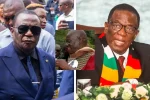
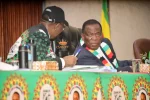
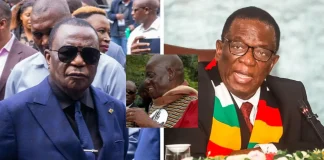
HARARE – A damning exchange between President Emmerson Mnangagwa’s and Vice-President Constantino Chiwenga’s camps has blown the lid off deep-seated divisions within Zanu-PF, exposing not only the bitter succession feud rocking the ruling party ahead of its Mutare conference, but also revealing the secret financiers and power dynamics behind the 2017 military coup that toppled the late Robert Mugabe.
At the heart of the conflict is the contentious “ED2030” proposal, a resolution by Mnangagwa’s supporters to extend his rule beyond the constitutional two-term limit ending in 2028.
The move, first raised at the 2024 party conference, is now the central issue dividing the party, with loyalists portraying it as a popular resolution, and Chiwenga’s faction denouncing it as unconstitutional and corrupt.
On 17 September 2025, Chiwenga presented a seven-page confidential document to the Zanu-PF presidium and Politburo, accusing Mnangagwa’s allies of manipulating party structures and looting public funds to finance a campaign to extend his presidency.
In the document, Chiwenga slammed the “2030 Agenda”, describing it as a betrayal of the ideals that led to the 2017 military coup.
He accused businessmen Kudakwashe Tagwirei, Wicknell Chivayo and Scott Sakupwanya of “corrupting and bribing party structures” using funds allegedly stolen from the state, estimating the losses at more than US$3.2 billion.
Chiwenga called for their arrest and for the party to “reclaim the state and the party from capture.”
However, in a scathing 25-page rebuttal that leaked to the media on Wednesday afternoon, Zanu-PF Secretary for Legal Affairs Ziyambi Ziyambi, writing at the direction of Mnangagwa, dismissed Chiwenga’s accusations as “reckless, malicious and treasonous.”
Ziyambi’s document, titled “Response to an Untitled Document Presented to His Excellency the President on 17 September 2025”, accused Chiwenga of ignorance of party procedures and of trying to “destabilise a constitutionally elected government.”
“The document is fundamentally flawed… and at its core, it advocates for the unlawful removal of a constitutionally elected President, which is palpably treasonous,” Ziyambi wrote.
He defended the ED2030 plan as a legitimate outcome of the 2024 party conference, arguing that under Article 6, Section 34 of the Zanu PF Constitution, resolutions passed at the conference “must be implemented as the will of the people.”
Ziyambi went further, alleging that Operation Restore Legacy in 2017, which Chiwenga led, was supported by businessmen like Tagwirei, who contributed five million litres of fuel and US$1.6 million to the cause.
“The success of Operation Restore Legacy cannot be attributed to a few individuals,” he said, suggesting Chiwenga was distorting history for “personal and political gain.”
The so-called ED2030 proposal seeks to delay the next general elections from 2028 to 2030, giving Mnangagwa an effective third term. Supporters argue that the extension would enable him to complete infrastructure and economic programmes under his Vision 2030 agenda.
Opponents, including Chiwenga, view it as a constitutional manipulation reminiscent of Mugabe’s later years in power. In his memo, Chiwenga compared the move to Mugabe’s alleged excesses and warned that corruption was now “the cornerstone of the campaign.”
Ziyambi countered that the allegations of theft and bribery were unsubstantiated. He insisted that the businessmen named were legitimate party benefactors and defended government contracts, including the controversial Geo Pomona waste deal, gold incentive scheme, and Kuvimba Mining House transactions, as lawful and Cabinet-approved.
“To label anyone a criminal before they are tried and convicted is defamatory,” Ziyambi said.
“There is nothing criminal about receiving funding for our revolutionary party from the business community.”
The explosive exchange between Mnangagwa and Chiwenga’s camps has intensified long-simmering tensions over succession.
Chiwenga, the former military commander who orchestrated Mugabe’s ouster in 2017, was widely seen as Mnangagwa’s heir apparent. However, Mnangagwa’s loyalists have systematically consolidated control of the party and the state, sidelining many of Chiwenga’s allies in the process.
Political analysts like Jealousy Mawarire say the Mutare conference, taking place amid the unfolding feud, is likely to determine the political future of both men.
Zanu-PF insiders suggest that the Mnangagwa faction is seeking to formalise the ED2030 resolution, while Chiwenga’s allies are mobilising resistance within the military and war veterans’ ranks.
Meanwhile, Tagwirei is now a Zanu-PF Central Committee member after the ratification of his co-option which was recommended by Harare Province.
The decision was made during the 128th session of the Central Committee at the party headquarters on Wednesday. The businessman recently spent US$23 million to buy 300 vehicles for use by Central Committee members.