spot_img

Chamisa calls for change in strategy to avoid “blood in the streets”

Must Try

Trending

Nehanda Radio
Zimbabwe News and Internet Radio

By MacDonald Dzirutwe | Reuters |

Zimbabwe’s main opposition party called off planned anti-government demonstrations on Friday, saying it aimed to avert bloodshed after police rounded up its followers and dispersed them with batons and water cannon.
- Advertisement -
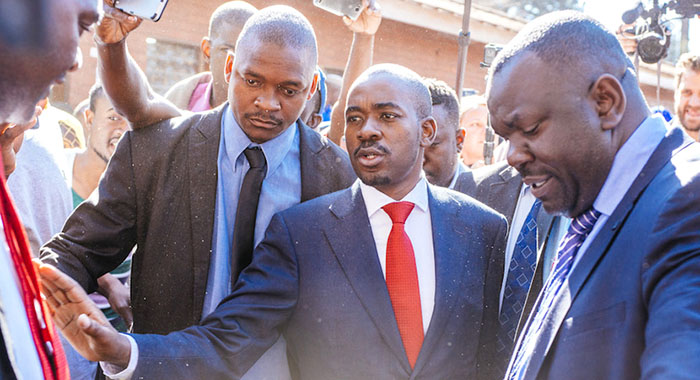
Opposition MDC Alliance leader Nelson Chamisa
Opposition MDC leader Nelson Chamisa

The Movement for Democratic Change (MDC), which accuses President Emmerson Mnangagwa’s government of repression and economic mismanagement, had called a demonstration for Friday as the start of a nationwide protest movement.

But police announced on Thursday that the protest would be banned, and an MDC court appeal to have the ban lifted failed. Police patrolled the usually bustling city centre in lorries and on foot, firing tear gas to disperse any groups that attempted to gather as most shops and business shut.

Around 100 MDC supporters who gathered early were chased by baton-wielding officers from a city square. Armed police barred access to the MDC’s Harare offices.

- Advertisement -

“Today we didn’t want to risk people’s lives by continuing to be confrontational because if we had chosen to be confrontational there will be blood in the streets,” Nelson Chamisa, the MDC leader, told reporters in Harare.

Riot police arrest and forcibly apprehend protestors during protests in Harare, Friday, Aug, 16, 2019. The main opposition Movement For Democratic Change party is holding protests over deteriorating economic conditions in the country as well as to try and force Zimbabwean President Emmerson Mnangagwa to set up a transitional authority to address the crisis and organize credible elections. (AP Photo/Tsvangirayi Mukwazhi)

“We will continue to mobilise but what you are going to see is a mutation of our strategy because when you are facing a confrontational regime you must also use tactics that are going to be above them,” he said, without elaborating.

Police said in a statement that 91 people were arrested for various offences. “The police is firm on the ground to ensure that law and order is maintained,” the statement read.

Outside the court that rejected the appeal to lift the ban on protesting, MDC Vice President Tendai Biti said: “The constitution guarantees the right to demonstration … yet this fascist regime has denied and proscribed this right.”

- Advertisement -

“We have jumped from the frying pan into the fire after the (anti-Mugabe) coup of November 2017… We don’t accept the conduct of this regime, the conduct of Mr Mnangagwa.”

A riot police man kicks out at a man during protests in Harare, Friday, Aug. 16, 2019. The main opposition Movement For Democratic Change party is holding protests over deteriorating economic conditions in the country as well as to try and force Zimbabwean President Emmerson Mnangagwa to set up a transitional authority to address the crisis and organize credible elections. (AP Photo/Tsvangirayi Mukwazhi)

U.S. Assistant Secretary of State for Africa Tibor Nagy condemned the “excessive force the police used today against Zimbabweans who were seeking to demonstrate peacefully.”

“We call on Zimbabwe’s security forces to respect human rights and to exercise restraint,” Nagy said on Twitter.

ECONOMIC CRISIS

Anger is mounting over triple-digit inflation, rolling power cuts and shortages of U.S. dollars, fuel and bread – bringing back memories of the hyperinflation of a decade ago that forced Zimbabwe to ditch its currency.

In a letter to church leaders published on Friday in the state-owned Herald newspaper, Mnangagwa said the economic hardship had its roots in sanctions imposed by the West more than a decade ago as well as a drought this year.

He also said Chamisa had rejected his invitation to talks. The MDC leader has said he sit down only if there is a neutral arbiter.

“The doors of national dialogue are still open to all political leaders,” Mnangagwa said.

In Geneva, a spokesman for the U.N. human rights commissioner urged the government to engage with citizens on legitimate economic grievances and “stop cracking down on peaceful protesters.”

Protestors gather on the streets in Harare, Friday, Aug. 16, 2019. The main opposition Movement For Democratic Change party is holding protests over deteriorating economic conditions in the country as well as to try and force Zimbabwean President Emmerson Mnangagwa to set up a transitional authority to address the crisis and organize credible elections.(AP Photo/Tsvangirayi Mukwazhi)

The demonstrations are viewed as a test of Mnangagwa’s willingness to tolerate dissent in a country tainted by a long history of repression under Mugabe, its ruler for nearly 40 years. Opponents say Mnangagwa has failed to make good on promises of political and economic reform.

The economy is mired in its worst crisis in a decade, and Mnangagwa is struggling to convince the growing ranks of poor that austerity measures and reforms can trigger a recovery.

Zimbabweans had also expected an election last year to help usher in a new dawn of expanded rights and an end to the country’s international pariah status, but so far society has only become more polarised.

In January, more than a dozen people were killed during a crackdown in Harare against fuel demonstrations.

In the days before Friday’s planned demonstration, six political activists were abducted from their homes at night and beaten by armed men, rights groups said.

On Friday, police and soldiers searched buses, taxis and private vehicles at checkpoints and demanded identity documents.

One woman was taken to hospital with a deep gash on her head after police charged at MDC supporters.

“We are tired, enough is enough,” MDC member Patience Gurure said moments before police dispersed her group.

- Advertisement -

Related Articles

Former allies Nelson Chamisa (centre) and Chalton Hwende (right) during an MDC-T press conference in Harare (Picture via MDC-T)

How Zimbabwe’s opposition lost its way from ideological struggle to survival politics

0
An analysis of how Zimbabwe’s opposition evolved from MDC roots to CCC fragmentation, highlighting internal struggles, leadership battles and shifting political values.
Opposition Citizens Coalition for Change (CCC) legislator Susan Matsunga (Picture via Facebook - Susan Matsunga)

CCC MP Susan Matsunga faces backlash after praising Mnangagwa at Budiriro borehole event

0
Opposition Citizens Coalition for Change (CCC) legislator Susan Matsunga is facing accusations of “selling out” after she publicly praised President Emmerson Mnangagwa and his adviser Paul Tungwarara during the commissioning of a borehole project in Budiriro North.
Opposition leader Nelson Chamisa (Picture via Chamisa News Network)

Now that “Chapwati” is here, what should Nelson Chamisa and change champions do differently?...

0
In this second and final part, I focus on what the new opposition must do, specifically the structures it should establish, to succeed in its pursuit of democratic change in Zimbabwe. I propose that the new opposition establish the following departments or units.
Former allies Nelson Chamisa (centre) and Chalton Hwende (right) during an MDC-T press conference in Harare (Picture via MDC-T)

Chamisa lashes out at “drunk” Hwende after Zanu PF 2030 bribe accusation

0
Under fire opposition leader Nelson Chamisa has hit back at former ally, Chalton Hwende, insinuating the Kuwadzana East MP was drunk when he accused him of accepting bribes from Zanu PF to ignore attempts by President Emmerson Mnangagwa to extend his term in office from 2028 to 2030.
Zimbabwean opposition leader Nelson Chamisa with a "God is in it T-Shirt" (Picture via Facebook - Nelson Chamisa)

Zimbabwe’s opposition illusion: Charisma, collapse, and the ZANU-PF machine

0
Zimbabwe’s opposition democratic struggle today is defined less by institutions than by the illusion of opposition, a spectacle choreographed around the charisma of Nelson Chamisa.

Don't miss a story

Breaking News straight to your inbox.

No spam just news !

- Advertisement -spot_img

Latest Recipes

Latest

More Recipes Like This