spot_img

Banks scrap tax on transactions below $10

Must Try

Trending

By Livingstone Marufu

Government has, with immediate effect, directed banks not to levy 5 percent tax on all transactions below $10 as a way of promoting financial inclusion. This comes as Government moves to provide safety nets to cushion vulnerable people and allow them to transact freely.
- Advertisement -
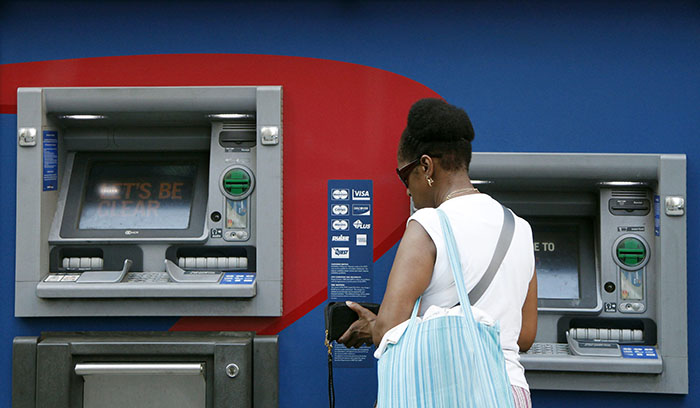
File picture of customer using an ATM

Banks heeded Government’s call to remove the $0, 05 tax on transactions below $10. In a gazette last week, the Government said: “The Amendment of section 22B of Chap 23:04, ‘automated financial transactions tax’ of the Finance Act [Chapter 23: 04] is amended by the deletion of “for each transaction on which the tax is payable” and the substitution of “for each transaction exceeding Ten United States dollars on which the tax is payable.”

“Section 22G (Intermediated money transfer tax) of the Finance Act [Chapter 23:04] is amended by the deletion of “for each transaction on which the tax is payable and the transaction is exceeding Ten United States dollars on which the tax is payable.”

Steward Bank CEO, Dr Lance Mambondiani, told The Herald that the removal of the 5 cents tax will go a long way in promoting financial inclusion. “For a long time, we have been in negotiations with the Government to scrap that 5 cents tax for any amount less than $10 and finally the authorities had paid heed to our appeals. This will certainly make waves in promoting financial inclusion as banking products are becoming more and cheaper to our people.

- Advertisement -

“This may be the other way of encouraging the unbanked public to start banking as this beat all mobile payments platforms, which charge a certain fee for every transaction made. As time goes on, this will make those who do not want bank accounts to have one.”

Meanwhile, the Reserve Bank of Zimbabwe (RBZ) has since slashed bank cash withdrawal charges following an outcry from members of the public. The new charges were put at 1 percent of an amount withdrawn at an Automated Teller Machine (ATM) and 1.25 percent for withdrawals over the counter.

Against this background and as part of ongoing efforts to promote financial inclusion and to ensure that banking products and services are affordable to the banking public, RBZ reviewed cash withdrawal charges downwards. RBZ continued to monitor the cost of bank charges to ensure access to affordable banking services and at the same time promoting the use of plastic money. The Herald


Related Articles

John Mushayavanhu, the new governor or the Reserve Bank of Zimbabwe, displays new banknotes of the country's currency to reporters, in Harare, April 5, 2024. (Columbus Mavhunga/VOA)

RBZ abandons 2030 multi-currency deadline, unveils new ZiG banknotes

0
HARARE - The Reserve Bank of Zimbabwe (RBZ) has abandoned its fixed 2030 deadline for ending the multi-currency system, shifting its focus instead to achieving key economic conditions, while also preparing to roll out new ZiG banknotes aimed at improving transaction efficiency and strengthening the local currency.
Steve Hanke, a Professor of Applied Economics at The Johns Hopkins University in Baltimore (Picture via Macroguy7979, CC BY-SA 4.0 , via Wikimedia Commons)

Zimbabwe’s ZiG ranked as one of the world’s worst-performing currencies

0
At a time when Zimbabwe is planning a phased transition to a mono-currency system, with the goal of making the Zimbabwe Gold (ZiG) its sole legal tender by 2030, the ZiG has been ranked as one of the world’s worst-performing currencies, according to United States economist Professor Steve Hanke, who placed it sixth on his latest Hanke’s Currency Watchlist.
John Mushayavanhu, the new governor or the Reserve Bank of Zimbabwe, displays new banknotes of the country's currency to reporters, in Harare, April 5, 2024. (Columbus Mavhunga/VOA)

Zimbabweans are not embracing the ZiG, Mr. Mushayavanhu — they’re simply disposing of it!

10
It’s astonishing how easy it is to convince oneself to see what simply isn’t there. The Reserve Bank of Zimbabwe (RBZ) wants us to believe that the growing number of transactions conducted in the Zimbabwe Gold (ZiG) is a sign of renewed public confidence in the local currency. But let us not be deceived. The truth is far less flattering.
Reserve Bank of Zimbabwe (RBZ) governor John announcing the introduction of the new gold-backed currency known as ZiG (Picture via Ministry of Information)

Zimbabwe “imposes” backdoor price controls amid currency confusion

1
HARARE - The Reserve Bank of Zimbabwe (RBZ) is facing criticism from economists and market analysts who accuse it of implementing de facto price controls through its recent directives on exchange rate determination.
John Mushayavanhu, the new governor or the Reserve Bank of Zimbabwe, displays new banknotes of the country's currency to reporters, in Harare, April 5, 2024. (Columbus Mavhunga/VOA)

Reserve Bank of Zimbabwe admits poor design and quality of ZiG currency

0
HARARE - The Reserve Bank of Zimbabwe (RBZ) has acknowledged the poor quality of its recently introduced currency, the Zimbabwe Gold (ZiG), and says it is taking steps to address the issue.

Don't miss a story

Breaking News straight to your inbox.

No spam just news !

0 0 votes
Article Rating
Subscribe
Notify of
0 Comments
Oldest
Newest Most Voted
Inline Feedbacks
View all comments
- Advertisement -spot_img

Latest Recipes

Latest

More Recipes Like This