Home Blog Page 4

The gospel according to the herdsman: When the mooing stops, the clay cow is exposed

0
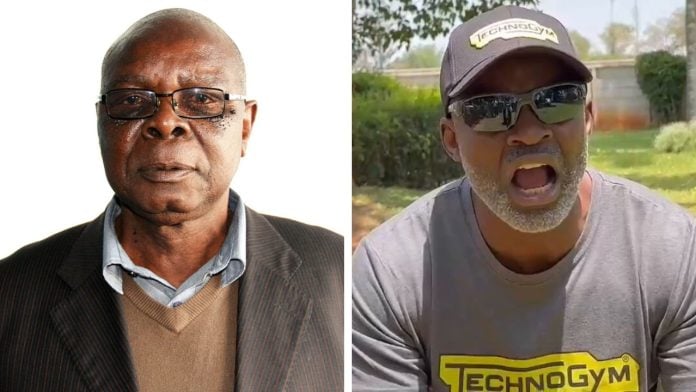
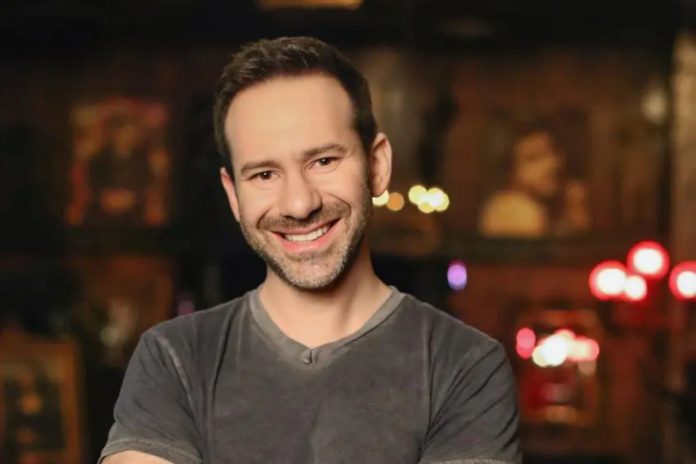
Political activist Rutendo Benson Matinyarare (Picture via Facebook)

There is something profoundly poetic about a man who has spent years perfecting the art of ventriloquism suddenly pausing mid-performance to question the voice coming out of the puppet.

Rutendo Benson Matinyarare, long celebrated as the chief acoustics engineer of Zimbabwe’s most delicate economic sculpture, the ZiG—now appears to have discovered an inconvenient truth: even the most beautifully crafted clay cow cannot moo indefinitely without cracking.

For years, he has stood in the village square, assuring us that the cow was not only alive, but thriving—its silence merely a sign of “monetary discipline,” its stillness evidence of “stability,” and its fragility a misunderstood feature of “precision engineering.”

Those who questioned why the cow required such relentless narration to confirm its vitality were dismissed as heretics, regime-change agents, or, worse, economically illiterate.

After all, real cows do not need spokespersons. They announce themselves.

But clay cows? Clay cows require devotion. They require amplification. They require belief.

And above all, they require a man willing to moo on their behalf.

Now comes the twist.

The same voice that once filled in the silence of ZiG’s “strength” has turned its attention to CAB3—and suddenly, the tone has changed. The certainty has softened. The choreography is off-beat. The herdsman is no longer entirely convinced the pasture is safe.

What we are witnessing is not a change of ideology. It is something far more interesting: a moment of cognitive dissonance within propaganda itself.

Because CAB3 is not a currency. It cannot be narrated into stability. It cannot be defended through metaphor alone. It demands legal coherence, constitutional fidelity, and—most dangerously—public consent.

And here, the script becomes harder to follow.

Matinyarare’s argument, stripped of its rhetorical embroidery, is devastatingly simple:

The electorate has developed a dual-vote language—supporting MPs while qualifying or restraining presidential authority.

This is not confusion. It is communication.

It is a built-in pressure valve.

And tampering with that valve may not consolidate power—it may detonate it.

This is not the language of a propagandist. It is the language of a reluctant diagnostician.

He is, perhaps unknowingly, describing a system that has survived not because it is perfect, but because it allows controlled dissent within the act of loyalty.

Vote for the party. Restrain the President. Signal dissatisfaction without rebellion.

A quiet rebellion, harmonised.

And then comes the real heresy: the legal argument.

Here, the mooing stops entirely.

Because once you accept that a “term” is both duration and limit, the entire intellectual scaffolding around CAB3 collapses. The semantic gymnastics—“length versus term”—begin to look less like legal innovation and more like linguistic desperation.

You cannot stretch a term without admitting it was limited.

And if it was limited, you cannot extend it without asking the people.

And if you must ask the people, then the outcome is no longer guaranteed.

This is the point at which propaganda meets probability—and grows uneasy.

But perhaps the most revealing moment is not the legal reasoning, nor the electoral analysis.

It is the tone of disappointment.

There is something almost personal in the frustration:

How do you propose a law and then suppress the very debate required to legitimise it?

This is not opposition rhetoric. This is insider bewilderment.

It is the sound of a man who has spent years defending the system suddenly confronting its contradictions in real time.

And so we return to the clay cow.

For years, it stood in the centre of the kraal, polished, praised, and loudly interpreted. Its silence was never allowed to speak for itself.

Now, however, the herdsman has paused.

Not entirely. Not decisively. But noticeably.

And in that pause, something dangerous happens:

People start listening for the cow.

Because if the cow were real, it would not need narration.

If the system were coherent, it would not fear debate.

If the mandate were overwhelming, it would not avoid a referendum.

And if the unity were intact, it would not leak dissent from its most loyal voices.

Matinyarare has not crossed over.

He has done something far more unsettling.

He has remained in place—and started asking the wrong questions.

And in systems built on controlled messaging, there are no more dangerous people than those who continue to believe, but begin to think.

Because once the mooing stops, even briefly, the entire village hears what was always there: Silence.
Air Marshal Henry Muchena is right to stand with Zimbabweans

0
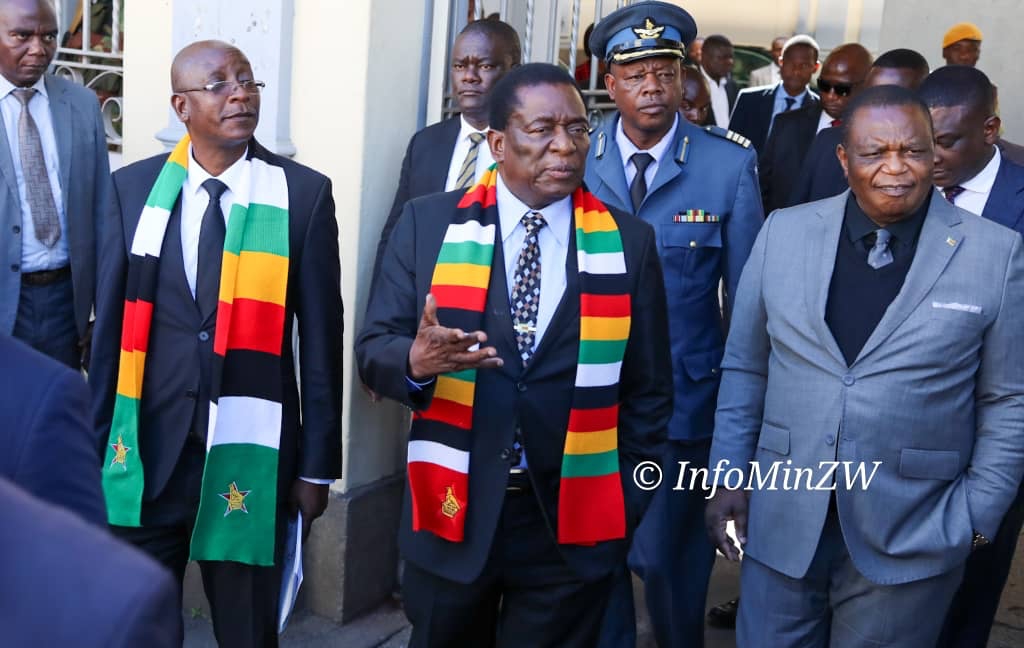
Justice Minister Ziyambi Ziyambi, President Emmerson Mnangagwa and Vice President Constantino Chiwenga at the High Court in Harare, June 2023 (Picture via Ministry of Information)

At a time when silence would be easier, Air Marshal (Retired) Henry Muchena has chosen principle over comfort and he is right to do so.

The attacks directed at retired generals by sections within ZANU PF and its sympathisers are not only misplaced but deeply insulting.

These men and women, who played a role in shaping the nation’s history, are now being vilified simply for exercising a right guaranteed to every citizen: the right to speak out.

Muchena’s intervention is necessary. As a citizen of Zimbabwe, he carries the same constitutional entitlement as any Zimbabwean to question leadership and raise alarm where governance appears to be failing.

To dismiss his voice and those he represents is to undermine the very democratic principles the nation claims to uphold.

What distinguishes Muchena’s stance is that it resonates with the growing frustration among ordinary Zimbabweans. He is not speaking in isolation, rather, he is echoing the concerns of a population burdened by economic hardship and uncertain about the country’s direction.

In this sense, he is not merely defending generals he is standing with the people.

It is increasingly evident that the message, though carefully delivered, is clear. There is a call for accountability at the highest level.

Many interpret this as a direct appeal to President Emmerson Mnangagwa to reflect on his leadership and if necessary, to do the honourable thing in the national interest even if that means stepping aside.

Zimbabwe has been here before. The final years of Robert Mugabe were marked by growing public discontent that was ignored until it could no longer be contained. Today, there is a clear determination among citizens not to repeat that history.

Those who seek to insult or silence Muchena and his colleagues risk misreading the moment. This is not about bitterness or personal grievance, as some have suggested. It is about principle, accountability, and the future of a nation.

Air Marshal Muchena is right not because he is a former military leader, but because he has chosen to align himself with truth as many Zimbabweans see it. In times like these, such voices should not be attacked; they should be heard.

Engineer Jacob Kudzayi Mutisi

Rejoice Ngwenya’s comparative lens on Zimbabwe’s constitutional amendments

0
Wellington Muzengeza and Rejoice Ngwenya in discussion (Picture Supplied)

Rejoice Ngwenya is not merely a commentator on Zimbabwe’s constitutional debates; he is a seasoned economist, political analyst, and policy thinker whose liberal democratic convictions have been forged through decades of engagement with governance processes across Africa.

As rapporteur and convenor in Zimbabwe’s 1998 and 2009 constitution-making exercises, and later as a governance consultant for the GNU, Ngwenya has witnessed first-hand the promises and betrayals of constitutionalism in our polity.

His voice matters because it is anchored in comparative experience, liberal clarity, and an unflinching commitment to democratic accountability.

In his analysis of Constitutional Amendment Bill No. 3, Ngwenya delivers a masterclass in exposing the hollow pretences of ZANU-PF’s constitutional engineering.

He reminds us that constitutions are not ornamental texts to be bent at the whim of incumbents; instead, they are covenants between the people and the state, yet ZANU-PF’s latest manoeuvre is nothing less than a mutilation of that covenant, a calculated regression masquerading as reform.

Ngwenya’s arguments cut through the propaganda and the empty claim that these amendments “strengthen democratic structures” is mere political banter.

For three decades, Zimbabweans have demanded genuine political reforms, independent media, impartial courts, and freedom of assembly. None of these demands requires constitutional amendments, only political will, yet they have been ignored consistently.

Instead, ZANU PF seeks to extend presidential terms, strip the judiciary of independence, and hand electoral rolls to partisan appointees. This is not reform, it is regression.

Ngwenya’s comparative lens is devastating in its precision. South Africa, the example ZANU PF flaunts recklessly, anchors its parliamentary election of the president in the bedrock of free and fair elections, genuinely independent institutions, and transparent, accessible voters’ rolls.

Zimbabwe, by contrast, has offered none of these safeguards for at least three decades. To invoke South Africa’s model while denying Zimbabweans the very conditions that make it legitimate is intellectual dishonesty of the highest order.

What ZANU PF proposes is not constitutional reform but constitutional mimicry, a hollow transplantation of form without substance. It is fraud masquerading as progress, a cynical attempt to cloak authoritarian consolidation in the language of comparative governance.

Ngwenya exposes this charade for what it is: the deliberate entrenchment of power under the guise of constitutionalism, a betrayal of the people’s covenant dressed up as democratic innovation.

The Futility of ZANU PF’s Constitutional Project

Ngwenya poses the piercing question that shatters ZANU PF’s pretences: what, in truth, will two additional years of presidential tenure achieve?

Zimbabwe remains a nation importing its own survival, food, cars, and basic commodities, while public transport lies in ruins, health systems collapse, and millions of citizens flee in search of dignity elsewhere and rightfully points out that to imagine that an elongated term could resolve these structural crises is not only delusional, but it is also deceitful.

The extension is not about governance but about entrenching privilege and perpetuating looting under the veneer of constitutionalism.

More damning still is Ngwenya’s reminder that fear of a referendum is fear of the people themselves. ZANU PF’s refusal to submit these amendments to a plebiscite is not a technical omission but a brazen act of contempt.

It is a repudiation of the very sovereignty the constitution enshrines, a calculated insult to the citizens whose voice should be the ultimate arbiter of legitimacy.

In this refusal, the regime reveals its deepest insecurity that cannot withstand the judgment of the people, and so it mutilates the covenant to silence them.

Ngwenya is unsparing in his indictment of the opposition’s silence. In the wake of Tshabangu’s orchestrated recalls, the opposition benches stand hollow, stripped of legitimacy, incapable of defending the people’s covenant. This muteness is not neutral; it is complicity.

It is the abdication of duty at the very moment when vigilance is most required. In the vacuum left by their silence, authoritarianism does not merely survive; it thrives, metastasising into every crevice of the political order.

Ngwenya’s critique reminds us that when opposition voices retreat, tyranny advances unchallenged, and the constitution itself becomes hostage to the ambitions of one party.

Gen Z as Attitude, Not Age

Ngwenya’s liberal clarity converges with my own conviction that the locus of hope lies in Generation Z, not as a mere demographic category, but as a radical attitude. It is an ethos defined by an uncompromising insistence on transparency, accountability, and the refusal to normalise authoritarian mediocrity.

Gen Z embodies a politics of defiance, a generational consciousness that refuses to inherit silence as tradition. Across Africa, this spirit has already become the pulse of resistance, from Nigeria’s #EndSARS movement to Sudan’s street uprisings, where young people have redefined citizenship as active vigilance rather than passive endurance.

In Zimbabwe, this attitude must crystallise into a civic force that refuses to sanctify betrayal as inevitability. It must be the generation that dismantles the myth of permanence surrounding liberation parties, the generation that insists that constitutions are covenants, not conveniences.

Gen Z, as Ngwenya’s critique implicitly affirms, is not bound by age but by audacity, the audacity to imagine a Zimbabwe beyond survival scripts, beyond the suffocating binaries of loyalty and fear, beyond the authoritarian normalcy that ZANU PF seeks to entrench.

It is this attitude, not the hollow promises of extended presidential terms, that carries the possibility of national renewal.

Zimbabwe’s Future: Beyond Survival Scripts

As I have consistently argued in my previous writings, The Autocrats’ Playbook, Can Africa Tame Its Strongman Problem?, and The 2030 Agenda: ZANU PF’s Survival Script, Not Zimbabwe’s Future, constitutional manipulation is the quintessential tactic of African autocrats.

It is not a project of progress but a strategy of survival, a cynical recalibration of law to shield incumbents from accountability and to perpetuate their grip on power.

In Zimbabwe, this pathology is laid bare: the constitution is treated not as the people’s covenant but as the ruling party’s instrument of convenience.

The future of Zimbabwe cannot be tethered to ZANU PF’s survival script, a script that extends terms, erodes judicial independence, and mutilates electoral credibility. To acquiesce is to normalise betrayal.

The task before citizens is to reclaim the constitution as non-negotiable, to insist that sovereignty resides not in the whims of Parliament but in the will of the people. This reclamation is not optional; it is the very condition for national renewal.

The Constitution as Covenant, Not Convenience

Rejoice Ngwenya concludes with a clarity that pierces through the fog of propaganda: “Fear of referendum is akin to fear of the people. In November 2017, President Mnangagwa said, ‘The voice of the people is the voice of God.’

He should prove his statesmanship by listening to what the referendum voice of five million Zimbabweans says. If this Bill is passed without a referendum, Zimbabwe’s parliamentary credibility will be permanently damaged.”

This is not merely a warning; it is an indictment. ZANU PF’s amendments are not reforms but betrayals, cynical manoeuvres designed to extend incumbency and hollow out the democratic promise of 2013.

The silence of the opposition is complicity, a retreat that leaves the constitution hostage to authoritarian ambition.

The hope lies in Generation Z, not as an age cohort but as an attitude. It is the audacity to imagine a Zimbabwe beyond authoritarian normalcy, the insistence that sovereignty belongs to the people, and the refusal to sanctify silence. Gen Z must embody the civic defiance that dismantles the myth of permanence surrounding liberation parties and demands accountability as the cornerstone of renewal.

The constitution is the people’s covenant. It is not ZANU PF’s property, nor Parliament’s convenience. It is the supreme law, and it must be defended, relentlessly, uncompromisingly, now.

Wellington Muzengeza is an Independent Journalist, Political Risk Analyst and Urban Strategist offering incisive insight on urban planning, infrastructure, leadership succession, and governance reform across Africa’s evolving post-liberation and urban landscapes.

How can people who rejected a president in two elections now want him to extend his term?

0
President Emmerson Mnangagwa officially opening the 22nd ZANU PF National People’s Conference in Mutare, 17 October 2025 (Picture via X - @edmnangagwa)

There are stories that can be believed, and there are those that even five-year-olds know to be fairy tales.

The political narrative currently being spun by loyalists of President Emmerson Mnangagwa is as audacious as it is intellectually dishonest.

We are told that “the people” are so enamored with the President’s performance and his “national development” agenda that they are practically begging for a constitutional amendment to extend his time in office.

This supposed groundswell of public pressure has culminated in the so-called “Resolution No. 1” and the subsequent Constitutional Amendment (No. 3) Bill, which seeks to push his tenure beyond the current 2028 deadline.

But if we move past the choreographed chants and the state-sponsored sycophancy, a glaring question remains.

At what point exactly did the people of Zimbabwe, who have twice rejected this president at the ballot box, suddenly decide they cannot live without him?

Numbers do not lie, and in the case of the 2018 and 2023 harmonized elections, the raw popular vote numbers tell a story of profound rejection.

It is crucial to look at these specific figures rather than obscured percentages or seat counts.

In 2018, according to official ZEC data, ZANU PF Members of Parliament secured a commanding victory, yet Mnangagwa himself lagged significantly behind the party’s collective performance.

While ZANU PF candidates for the National Assembly secured a convincing majority with a massive popular vote, Mnangagwa narrowly avoided a run-off with 2,461,745 votes.

In comparison, the total votes cast for ZANU PF MPs across the country reached approximately 2,477,708, meaning tens of thousands of ZANU PF supporters chose their local MP but explicitly refused to endorse the man at the top.

Fast forward to 2023, and the trend solidified into a permanent feature of our political landscape.

Despite the intense “ED Pfee” campaigning, the President once again trailed behind his own party.

In the 2023 harmonized elections, Mnangagwa officially received 2,350,711 votes.

However, the collective vote for ZANU PF parliamentary candidates was notably higher, with the party pulling approximately 2,501,475 votes in the National Assembly race.

This means that even after five years in power, over 160,000 people who voted for ZANU PF candidates for Parliament pointedly refused to tick the box for the presidential candidate.

This “split-voting” phenomenon is not a statistical fluke; it is a deliberate political statement repeated across two consecutive elections.

This data is the most authentic set we have on public sentiment.

It proves that even within the ruling party’s own support base, there is a significant portion of the electorate that trusts the party’s local representatives but fundamentally distrusts the man at the top.

How can a president who repeatedly receives far fewer votes than his own party’s MPs be said to be “doing a good job”?

If “the people” were truly clamoring for him to “finish his programs,” surely that enthusiasm would have reflected in a popular vote that at least matched, if not exceeded, that of his subordinates.

Instead, the opposite is true.

The people of Zimbabwe loudly and audibly spoke twice on how they truly felt about the president, and the verdict was far from flattering.

When ZANU PF MPs were awarded convincing victories, the president barely scraped through.

That should be clear enough evidence of what the public genuinely feels.

The claim by loyalists that the push for a term extension is “from the people” is a fallacy of the highest order.

It suggests a magical, overnight conversion of the Zimbabwean soul.

We are expected to believe that the same citizens who walked into polling booths in August 2023 and rejected Mnangagwa have now, less than three years later, decided that the supreme law of the land—a sacred document they voted for in 2013—should be mutilated just to keep him in power.

Isn’t it quite curious that the same people who twice rejected the president now allegedly want him to stay in power longer?

At what point did these “people” decide that they not only wanted him as president but actually wanted the supreme law changed to facilitate his continued stay?

This is not public pressure; it is elite persistence.

It is the work of a few who mistake their own proximity to power for the will of the nation.

If those pushing for these constitutional amendments truly believe “the people” have changed their minds, then they should ask the people again in a national referendum.

This would not be a favor or an act of benevolence from the state; it is something the Constitution itself demands.

The Constitution is particularly clear when the effect of an amendment extends the length of time that a person may hold or occupy any public office.

Such an amendment should not benefit any person who held or occupied that office at any time before the amendment.

The only legal and democratic way this can be changed is through a national referendum.

If the proponents of this amendment are so confident that the public is behind them, why are they not rushing toward a referendum to validate their claims?

The reality is that any claims that “the people” are the ones who want the president to continue in office are unfounded and without merit.

The track record of the last two elections serves as a standing rebuttal to the “Resolution No. 1” narrative.

You cannot claim to lead by the will of the people while simultaneously avoiding the very mechanism—the direct popular vote—that allows them to choose their leader.

The people have already spoken, and they did not ask for him to remain.

If the loyalists truly believe they have the mandate of the masses, give the people a national referendum to prove me wrong.

Until then, these constitutional maneuvers remain an affront to the democratic will of Zimbabwe.

● Tendai Ruben Mbofana is a social justice advocate and writer. To directly receive his articles please join his WhatsApp Channel on: https://whatsapp.com/channel/0029VaqprWCIyPtRnKpkHe08

If you value my social justice advocacy and writing, please consider a financial contribution to keep it going. Contact me on WhatsApp: +263 715 667 700 or Email: [email protected]

The opposition in all but name: How Reform UK is governing by proxy on immigration

0
Nigel Farage member of Parliament arrives ahead of Cheltenham Festival 2025 Gold Cup Day at Cheltenham Racecourse, Cheltenham, United Kingdom, 14th March 2025 (Photo by Gareth Evans/News Images via DepositPhotos.com)

There is an old adage in politics: one need not win office to win power. In contemporary Britain, that observation feels less like theory and more like lived reality.

On immigration, the United Kingdom appears to be witnessing a peculiar inversion of democratic norms—an opposition party shaping the substance of government policy so thoroughly that it is, in effect, “governing in all but name.”

The rise of Reform as a disruptive force in British politics was initially dismissed as peripheral agitation—loud, certainly, but electorally marginal. Yet such dismissals misunderstood the nature of political influence.

Power does not reside solely in parliamentary majorities; it also lies in the ability to set the terms of debate, to define what is thinkable, sayable, and ultimately doable. On immigration, Reform has not merely influenced the conversation—it has redrawn its boundaries.

What is most striking is not simply that the Labour government has adopted elements of Reform’s rhetoric or posture. Political parties, after all, frequently borrow from their opponents in an effort to neutralise electoral threats.

Rather, it is the extent to which Labour has gone further—embracing policies that, until recently, would have been characterised as politically extreme. This is not policy convergence; it is policy acceleration in a direction set by others.

To describe this as capitulation would, in fact, be too generous. Capitulation implies reluctant concession under pressure.

Nigel Farage addresses the media during the Brexit Party's first press conference of the European election campaign on May 07, 2019 in London, England. — Photo by Fred Duval via DepositPhotos.com
Nigel Farage addresses the media during the Brexit Party’s first press conference of the European election campaign on May 07, 2019 in London, England. — Photo by Fred Duval via DepositPhotos.com

What we are witnessing instead is something closer to overcompensation: a governing party not only accepting the framing of its challengers but seeking to outflank them on their own terrain.

In doing so, Labour risks legitimising and entrenching a policy paradigm that it neither originated nor, historically, endorsed.

The implications are profound. When a government governs on opposition terms, democratic accountability becomes blurred. Voters may reasonably ask: if the policies of Reform are being implemented irrespective of who holds office, what meaningful choice remains?

Elections risk becoming contests of branding rather than substance, with policy trajectories continuing unchanged beneath the surface of partisan turnover.

Moreover, the hardening of immigration policy under Labour raises pressing ethical and social questions. The United Kingdom has long wrestled with how to balance border control with humanitarian obligation.

Yet the current trajectory suggests a narrowing of that balance, with enforcement and deterrence increasingly eclipsing compassion and international responsibility.

That such a shift is being driven not by a traditionally right-wing government but by a party that once positioned itself as a defender of social justice is particularly telling.

This dynamic also reveals a deeper anxiety within the political establishment. Reform’s success has not been measured in seats won but in fear generated—the fear of losing voters, of appearing “soft”, of being out of step with a perceived public mood.

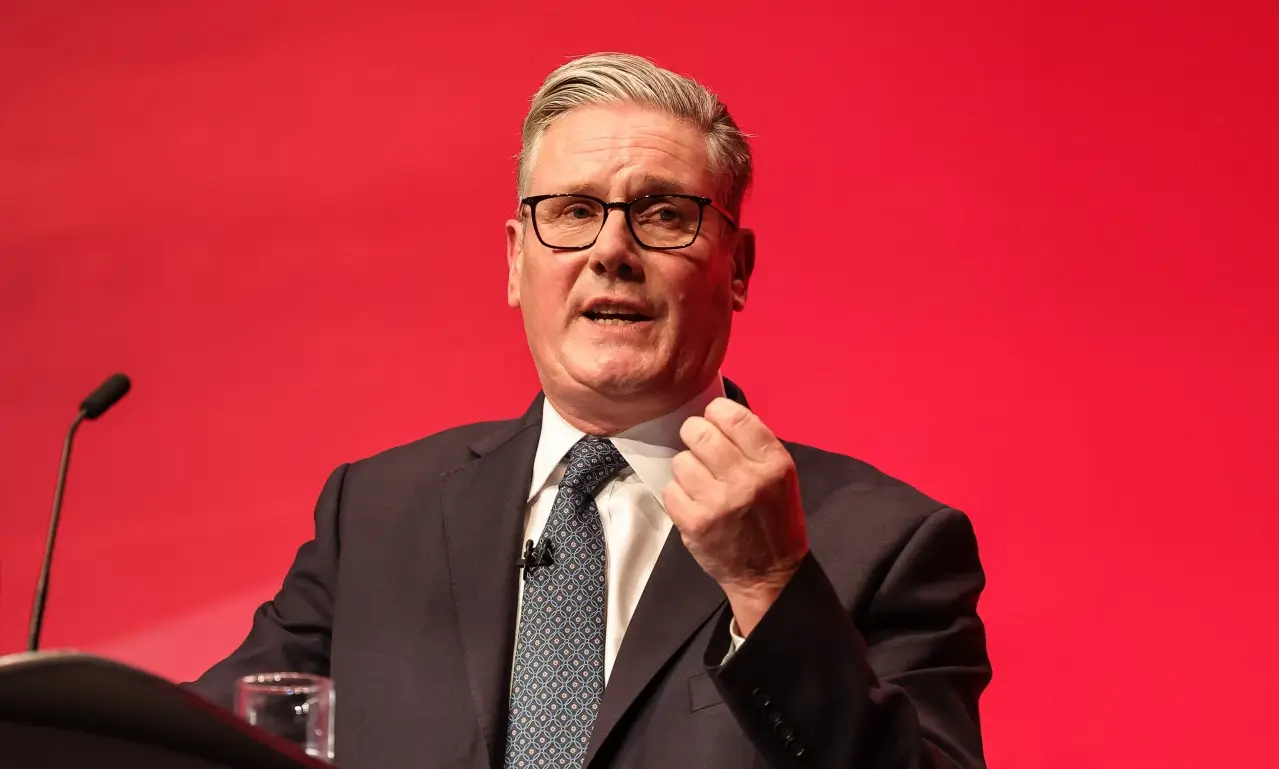
Sir Keir Starmer, Prime Minister of the United Kingdom of Great Britain and Northern Ireland addresses the conference during the Labour Party Annual Conference 2025 Day 3 at The ACC, Liverpool, United Kingdom, 30th September 2025 (Photo by Mark Cosgrove/News Images via DepositPhotos.com)
Sir Keir Starmer, Prime Minister of the United Kingdom of Great Britain and Northern Ireland addresses the conference during the Labour Party Annual Conference 2025 Day 3 at The ACC, Liverpool, United Kingdom, 30th September 2025
(Photo by Mark Cosgrove/News Images via DepositPhotos.com)

In response, Labour has chosen not to challenge that mood but to mirror and amplify it. The result is a feedback loop in which the boundaries of acceptable policy move ever further in one direction, unchecked by meaningful opposition.

It is worth pausing to consider what is lost in this process. A healthy democracy depends not only on competition but on contrast—on the presence of genuinely different visions for society.

When one party effectively dictates the terms of policy across the spectrum, that contrast diminishes. Debate narrows. Alternatives disappear. And with them, the possibility of a more nuanced and humane approach to complex issues like immigration.

To say that Reform is “governing by proxy” is not rhetorical flourish; it is an analytical description of a political reality.

The party has achieved what many insurgent movements aspire to but seldom realise: it has shifted the centre of gravity so decisively that even its opponents now orbit around it.

Then Britain's Justice Secretary Shabana Mahmood leaves 10 Downing Street after attending a cabinet meeting on March 26, 2025 in London, England. — Photo by Fred Duval via DepositPhotos.com
Then Britain’s Justice Secretary Shabana Mahmood leaves 10 Downing Street after attending a cabinet meeting on March 26, 2025 in London, England. — Photo by Fred Duval via DepositPhotos.com

For Labour, the immediate political calculus may appear rational. By adopting—and indeed exceeding—Reform’s stance, it seeks to neutralise a threat and consolidate its position.

Yet, in the longer term, this strategy carries significant risks. It may erode the party’s ideological coherence, alienate segments of its traditional base, and, paradoxically, further legitimise the very force it seeks to contain.

In the end, the question is not whether Reform will enter government in the conventional sense. On immigration, at least, it already has. The more pressing question is whether any political actor remains willing—or able—to chart a different course.

Dr Sibangilizwe Moyo writes on Church and Governance, politics, legal and social issues. He can be reached at [email protected]

Temba Mliswa outburst displays selective memory and outrage on 2008 violence

0
Air Marshal (Retired) Henry Muchena has warned former Norton legislator Temba Mliswa (Picture by Tayananiswa via Pindula and X - Temba Mliswa)

Outrage is seldom random in Zimbabwe’s political soap opera. It is cultivated, sharpened and unleashed with deliberate intent. The ongoing war of words between Temba Mliswa and retired Air Marshal Henry Muchena is not merely a clash of personalities.

It is a revealing moment, one that exposes the selective deployment of memory and the moral evasions that continue to define Zimbabwe’s unresolved past.

Mliswa has chosen to resurrect the ghosts of 2008, directing his fury at Muchena and a cohort of retired generals. In a series of posts on X, he did not mince his words.

“These individuals carry the baggage of a checkered past, marked by violence inflicted upon countless innocents,” he wrote, before adding, “the same military leaders… orchestrated a brutal campaign to secure Robert Mugabe’s hold on power.”

In another pointed barb, Mliswa declared, “You cannot preside over bloodshed and later posture as custodians of constitutionalism.”

It is language designed to sting, to indict and to morally disqualify. Yet it is also language that reveals more by omission than by expression.

For 2008 was not the handiwork of a few rogue generals acting in isolation. It was a systemic operation, executed through the machinery of the state.

At the centre of that machinery was the Joint Operations Command, the nerve centre of Zimbabwe’s security establishment during moments of political crisis.

Its influence during the post-election violence is well-documented, its reach extending into rural communities where fear became a political instrument.

To speak of that period, therefore, is to speak of power in its most organised form. And within that structure, one name cannot be ignored: President Emmerson Mnangagwa.

At the time, Mnangagwa was not merely adjacent to power. He was embedded within it. As a senior cabinet minister, Mugabe’s chief election agent, and subsequently the head of the Joint Operations Command, he occupied a position of immense influence over the state’s response to electoral defeat. His role has long been the subject of scrutiny, both within Zimbabwe and beyond its borders.

Yet in Mliswa’s forceful condemnation of Muchena, Mnangagwa is conspicuously absent. Not a mention. Not even a passing acknowledgement.

This silence is not accidental. It is political. The selective framing becomes even more apparent when placed alongside Muchena’s own response.

In his rebuttal, the retired Air Marshal dismissed Mliswa’s accusations as reckless and dangerous, warning that “irresponsible statements that seek to inflame the nation without regard for unity must be condemned.”

He went further, suggesting that Mliswa’s intervention was less about truth and more about provocation: “We will not be lectured on constitutionalism by those who thrive on sensationalism.”

The exchange, though heated, is illuminating. Mliswa positions himself as a moral crusader, invoking the suffering of 2008 to challenge the legitimacy of the retired generals’ current stance on Constitutional Amendment Bill No. 3.

Muchena, in turn, frames Mliswa as an opportunist, exploiting national trauma for political gain.

Between these competing narratives lies a deeper truth: both men are engaged in a struggle not just over policy, but over the ownership of history itself. And history, in Zimbabwe, is rarely neutral terrain.

The violence of 2008 was not simply an episode of electoral misconduct. It was a defining moment that exposed the fragility of Zimbabwe’s democratic institutions and the extent to which state power could be mobilised to suppress dissent.

More than 200 lives were lost. Thousands were displaced. Entire communities were traumatised. The scars of that period remain etched into the national consciousness.

To invoke that history, therefore, is to enter sacred ground. It demands honesty. It demands completeness. It demands courage.

Mliswa offers none of these in full measure.

Instead, he presents a curated version of the past, one that isolates certain actors while shielding others.

By focusing his attack exclusively on Muchena and his colleagues, he constructs a narrative in which culpability is narrowly defined and conveniently located outside the current centres of power.

It is a narrative that allows him to appear principled without incurring the political cost of confronting those who still wield authority.

This is the essence of selective outrage. It is not the absence of truth, but its partial application.

The implications are profound. For if the standard Mliswa advances is that those implicated in the violence of 2008 are unfit to speak on matters of constitutional reform, then that standard must be applied universally.

It cannot be wielded as a partisan weapon, deployed against retired figures while sparing those in office. To do so is to transform accountability into an instrument of factional struggle rather than a foundation of democratic renewal.

The current debate over Constitutional Amendment Bill No. 3 only heightens the stakes. The proposed extension of presidential terms and the life of Parliament has already generated significant controversy, exposing fractures within the ruling party itself.

The intervention of retired generals, calling for a referendum, has added an unexpected dimension to the discourse.

Mliswa’s response must be understood within this context. His attack on Muchena is not merely retrospective. It is strategic.

By invoking the alleged sins of the past, he seeks to delegitimise the retired generals’ present intervention. Yet in doing so, he inadvertently undermines his own argument.

For the question inevitably arises: if historical complicity disqualifies one from participating in constitutional debates, then what of those who remain at the helm of the state?

It is a question Mliswa studiously avoids. And this avoidance speaks to a broader malaise within Zimbabwe’s political culture. Accountability is seldom pursued as an end in itself.

It is pursued selectively, often in service of immediate political objectives. The result is a fragmented moral landscape in which justice is unevenly applied and historical truth is perpetually contested.

The absence of a comprehensive truth and reconciliation process has only deepened this crisis.

Without a formal mechanism to interrogate the past, political actors are free to interpret it as they see fit, amplifying certain narratives while suppressing others. Memory becomes malleable, shaped by the exigencies of the moment.

Mliswa’s intervention is emblematic of this condition. It is not a genuine attempt to reckon with 2008, but a self-serving tactical deployment of its memory.

It seeks to expose, but only partially. It condemns, but selectively. It remembers, but incompletely. Zimbabwe deserves better.

A nation cannot move forward on the basis of half-truths. It cannot build a democratic future while its past remains selectively acknowledged.

The events of 2008 demand a full accounting, one that encompasses all those who wielded power, regardless of their current position or political alignment.

This requires a different kind of courage. Not the courage to speak loudly against convenient targets, but the courage to speak consistently, even when it is uncomfortable, even when it carries political risk.

Until that standard is embraced, the country will remain trapped in a cycle of selective memory and selective morality, where outrage is abundant but justice remains elusive.

Mliswa has, perhaps unintentionally, provided a mirror to this reality. In his words, we hear not only an indictment of others, but an echo of the very contradictions that continue to undermine Zimbabwe’s search for truth.

Bobi Wine slams arrest of Tendai Biti as “cowardly attack” on democracy in Zimbabwe

0
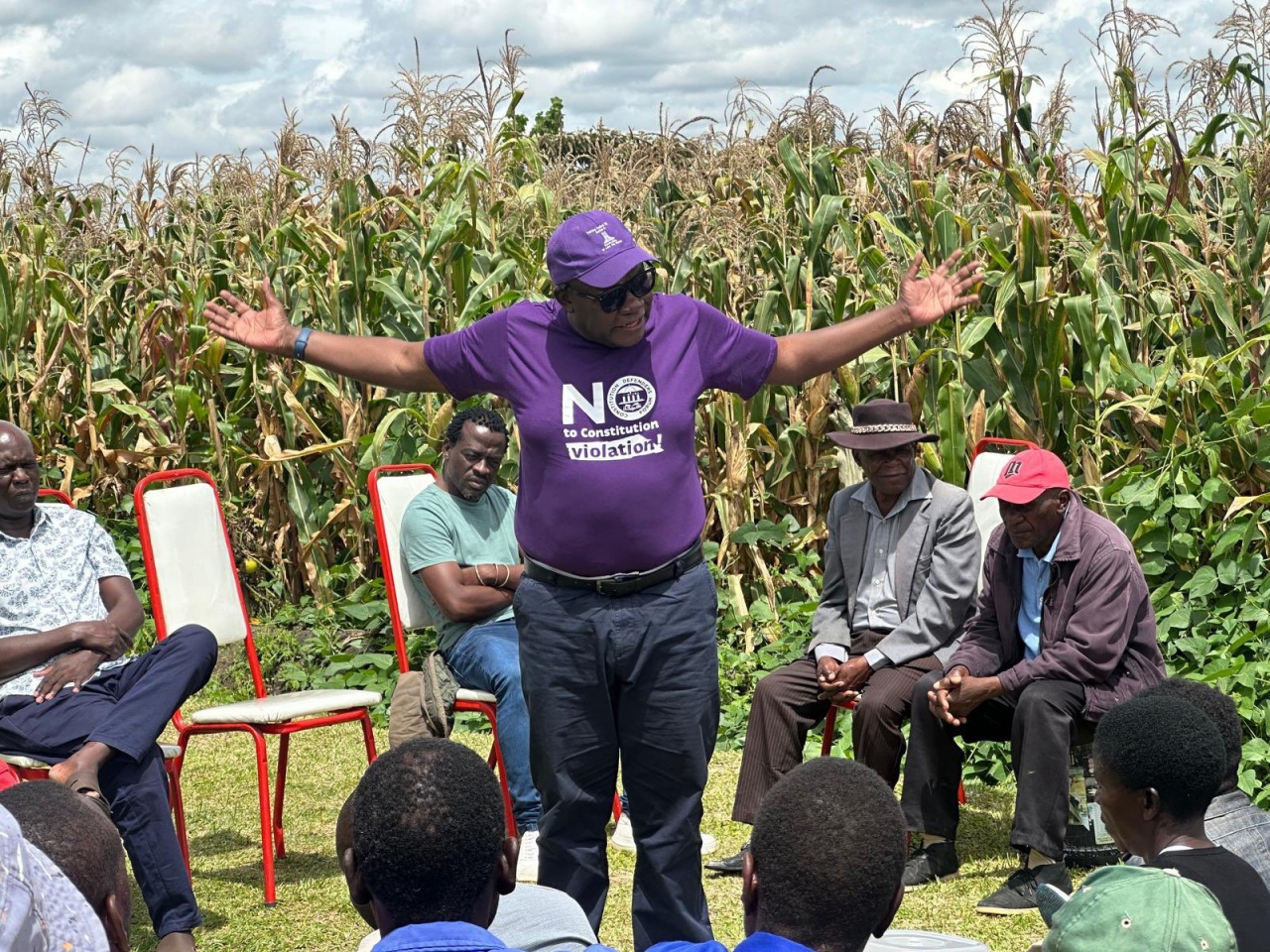
Ugandan opposition leader Bobi Wine and former finance minister and convener of the Constitution Defenders Forum (CDF) Tendai Biti (Picture via Facebook - Bobi Wine and ZimLive.com)

Ugandan opposition leader Robert Kyagulanyi Ssentamu, popularly known as Bobi Wine, has condemned the arrest of Zimbabwean politician Tendai Biti, describing it as a “cowardly attack” on citizens and democratic freedoms.

In a statement issued on Monday, Kyagulanyi, who leads the National Unity Platform (NUP), said Biti’s detention reflects a broader pattern of repression against dissenting voices across Africa.

“Biti’s arrest is a cowardly attack on all citizens of Zimbabwe by a regime that cannot sustain open debate about their future without resorting to brute force,” he said.

He called for the “immediate, unconditional release” of Biti and others detained alongside him.

Kyagulanyi said Biti had recently expressed solidarity with Ugandan activists following what he described as a crackdown after the country’s January 2026 elections under President Yoweri Museveni, drawing parallels between the political climates of the two countries.

Former Finance Minister Tendai Biti, journalist Fanuel Chinowaita, lawyer Nyasha Gerald and Morgan Ncube were arrested in Mutare while mobilising support for the Constitutional Defenders Forum (CDF) that he leads (Picture via ZimLive)

Biti, a former finance minister and convener of the Constitution Defenders Forum (CDF), was arrested on March 21 in Mutare together with the organisation’s national organiser, Morgan Ncube, and others.

He is accused of holding a public meeting without notifying police.

His detention comes amid growing tensions over proposed constitutional amendments that could extend the rule of President Emmerson Mnangagwa beyond his current term, which is set to end in 2028.

The proposed changes would extend presidential and parliamentary terms from five to seven years, delay elections to 2030, and allow the president to be elected by Parliament rather than through a popular vote.

In recent months, police have reportedly banned opposition gatherings and arrested activists protesting against the proposed reforms.

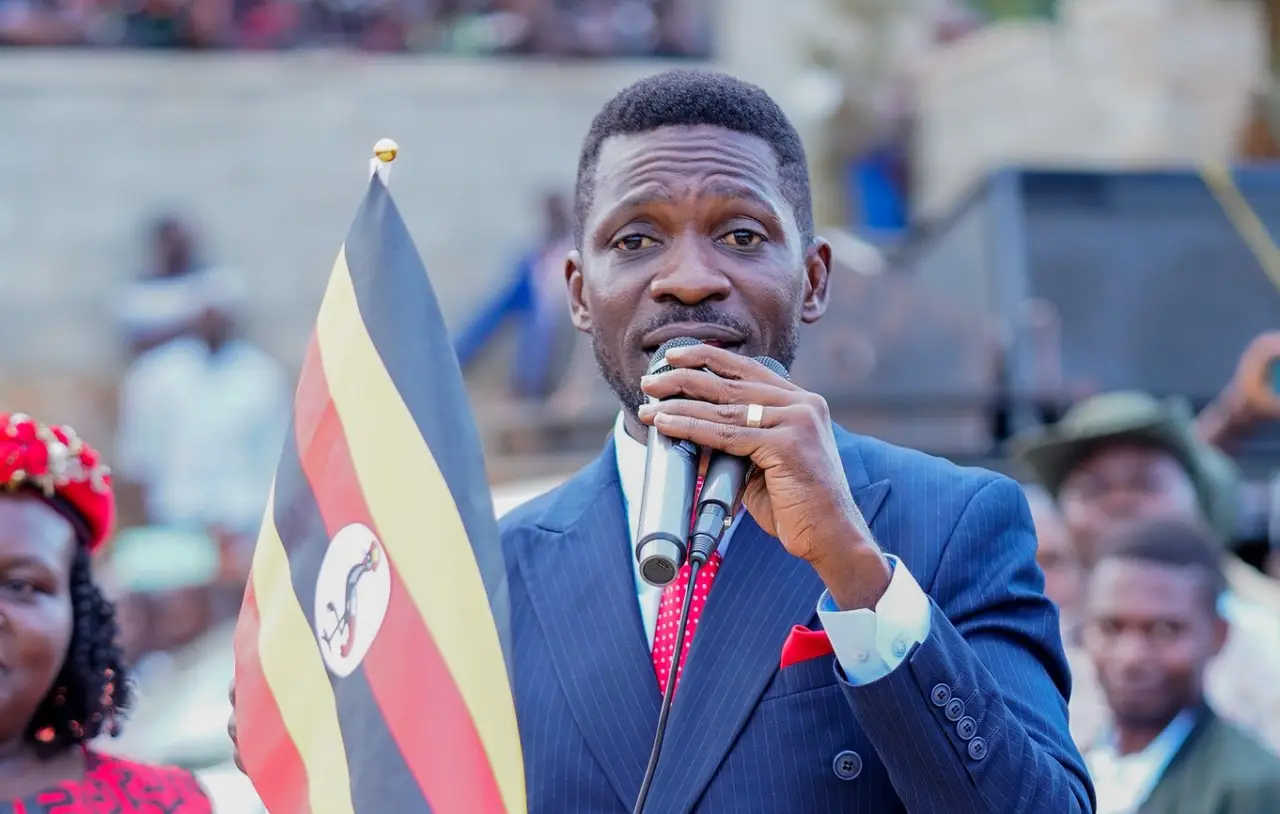
Ugandan opposition leader Bobi Wine (Picture by National Unity Platform via Facebook - Bobi Wine)
Ugandan opposition leader Bobi Wine (Picture by National Unity Platform via Facebook – Bobi Wine)

Kyagulanyi said the developments in Zimbabwe mirror tactics used elsewhere on the continent to suppress political opposition.

“It is disturbing to see this script, which Ugandans are already familiar with, being deployed in Zimbabwe as well,” he said.

Meanwhile, South Africa’s opposition Democratic Alliance (DA) also condemned Biti’s arrest, calling it an act of “state brutality” and urging President Cyril Ramaphosa to intervene diplomatically.

The DA warned that Zimbabwe’s political situation could have wider regional implications, including increased migration and instability, and called on South African authorities to uphold a foreign policy grounded in human rights and constitutionalism.

“We call on President Cyril Ramaphosa and Minister Ronald Lamola to condemn Tendai Biti’s arrest and urgently engage with Zimbabwean authorities through diplomatic channels to reconsider this draconian legislative proposal,” the DA stated.

“South Africa cannot continue to prop up its fraternity of leaders who continue to trample on democracy and the rights of citizens across the Southern African region.

“This recent act of state oppression follows a worrying trend seen in countries such as Uganda and Tanzania which have arrested opposition leaders on trumped up charges of treason to silence opposing voices and sideline democracy.”

OnlyFans billionaire owner Leonid Radvinsky dies at 43 after cancer battle

0
The billionaire owner of OnlyFans, Leonid Radvinsky (Picture by Leonid Radvinsky via LinkedIn)

The billionaire owner of OnlyFans, Leonid Radvinsky, has died at the age of 43 following a prolonged battle with cancer.

A company representative confirmed his death, saying: “Leo passed away peacefully after several years of illness. His loved ones have asked for privacy during this difficult time.”

Radvinsky, a Ukrainian-American entrepreneur, built a multibillion-dollar business through his controlling stake in Fenix International Limited, the parent company of OnlyFans.

Riga, Latvia - February 24, 2023: OnlyFans logo on laptop computer. OnlyFans is an internet paid content subscription service. — Photo by hawkmedialv via DepositPhotos.com
Riga, Latvia – February 24, 2023: OnlyFans logo on laptop computer. OnlyFans is an internet paid content subscription service. — Photo by hawkmedialv via DepositPhotos.com

As the company’s principal owner and director, he oversaw a period of rapid growth and helped transform the platform into a global subscription powerhouse. He was also known as an active investor and donor in the tech sector.

Radvinsky acquired OnlyFans from its original owners, the Stokely family, in 2018. Under his leadership, the platform’s user base and revenues expanded significantly.

According to Bloomberg, users spent approximately $7.2 billion on subscriptions last year, while Radvinsky received an estimated $1.8 billion in payouts between 2021 and 2025.

Trump holds fire on Iran as tensions ease, but defiant Tehran pushes back

0
Washington, DC, USA: January 30, 2025 - President of USA Donald Trump speaks at presidential news conference on mid-air collision between a US Army helicopter and American Airlines regional jet that left no survivors (Photo by Kyle Mazza - TheNews2.com via DepositPhotos.com)

WASHINGTON — President Donald Trump said he has postponed planned strikes on Iran’s electricity grid after what he described as productive negotiations aimed at de-escalating tensions in the Middle East.

In a post on Truth Social, Trump said two days of “strong and effective” exchanges with Tehran prompted him to delay attacks on key energy infrastructure for five days while talks continue.

Financial markets reacted swiftly. Brent crude fell 13% to $96 a barrel, natural gas prices also dropped sharply, and London’s FTSE 100 reversed earlier losses to close up 0.5%. UK government bond yields eased to 4.78%.

The development came just hours before the expiration of Trump’s 48-hour ultimatum over the Strait of Hormuz, a critical passage that carries roughly 20% of global oil supplies. Iran had previously moved to block the route, disrupting international trade.

Tehran, however, disputed Trump’s account. A source cited by the IRGC-linked Fars News Agency denied that any negotiations had taken place, claiming instead that the U.S. stepped back following warnings of retaliatory strikes across the region.

UK Prime Minister Keir Starmer welcomed the apparent breakthrough during a call with Trump, urging that the Strait of Hormuz be reopened to shipping.

Downing Street said a rapid de-escalation would benefit all sides. Officials discussed the situation during a COBRA emergency meeting, focusing on rising energy prices, mortgage pressures and agricultural costs.

Starmer added there was no indication the UK was a direct target of Iranian action.

Meanwhile, Israel intensified its military campaign. The Israel Defense Forces said its aircraft struck targets in central Tehran and warned the conflict with Iran and allied militants in Lebanon could continue for several more weeks.

New York listed Caledonia reports revenue surge to US$267.7 million in Zimbabwe

0
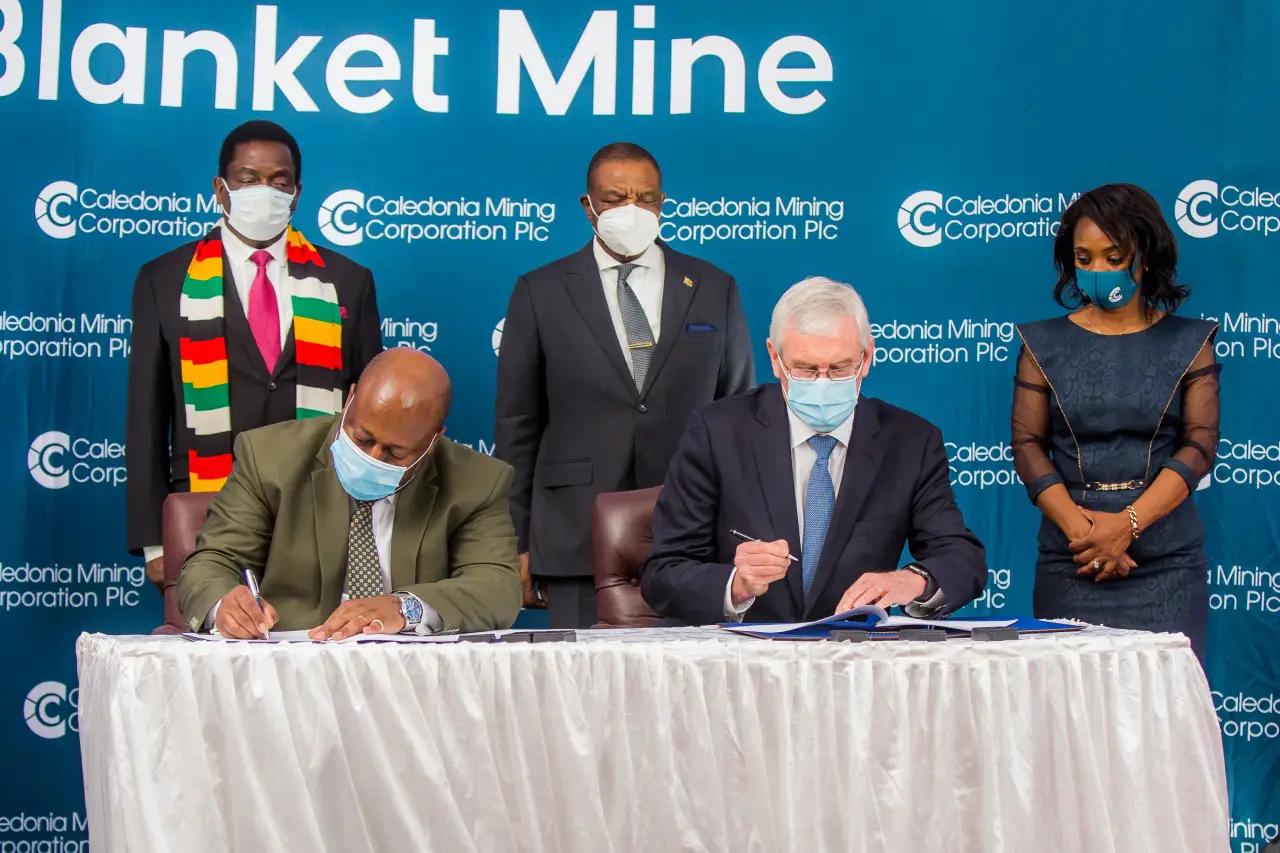
President Emmerson Mnangagwa, Vice President Constantino Chiwenga, Mines Minister Winston Chitando with then Caledonia Mining Corporation CEO Steve Curtis in October 2020 (Picture via X - Caledonia Mining Plc)

New York Stock Exchange listed Zimbabwe-focused gold producer Caledonia Mining Corporation Plc has reported a 46% increase in revenue to US$267.7 million for the financial year ended December 31, 2025, driven by higher gold prices and stable production levels.

According to the company’s preliminary unaudited results released on Monday, revenue rose from US$183.0 million recorded in 2024, marking a year of strong financial performance, improved profitability and robust cash generation.

Total gold sales increased slightly to 79,075 ounces, up from 77,917 ounces in the prior year, while the average realised gold price surged to US$3,383 per ounce from US$2,347 per ounce, underpinning the revenue growth.

The group’s gross profit nearly doubled to US$137.1 million from US$77.0 million, reflecting improved margins, while earnings before interest, tax, depreciation and amortisation (EBITDA) rose sharply to US$125.3 million, compared to US$59.7 million in 2024.

Profit after tax climbed by 193% to US$67.5 million, up from US$23.1 million, with basic earnings per share increasing to US$2.83 from US$0.91.

Net cash generated from operating activities rose by 82% to US$76.2 million, while free cash flow increased significantly to US$62.1 million from US$10.6 million in the prior year.

Operationally, Blanket Mine produced 76,213 ounces of gold during the year, broadly in line with previous performance, while the Bilboes oxide operation contributed 1,683 ounces.

Despite inflationary pressures, consolidated on-mine cash costs averaged US$1,263 per ounce sold, with all-in sustaining costs (AISC) at US$1,952 per ounce.

The company’s balance sheet strengthened considerably, with cash and cash equivalents rising to US$35.7 million at year-end from US$4.3 million in 2024. This resulted in a net cash position of US$23.8 million, compared to a net debt position of US$8.7 million previously.

During the period, Caledonia completed a feasibility study for the Bilboes sulphide project, confirming robust economics and a clear development pathway.

The project is expected to produce approximately 200,000 ounces of gold annually at peak, with first production targeted for 2028.

The group also continued exploration work at the Motapa project, positioning it as part of a broader strategy to develop a multi-asset gold production hub in Zimbabwe.

In line with its capital allocation strategy, the board declared a quarterly dividend of 14 US cents per share, payable on April 17, 2026.

Looking ahead, Caledonia expects Blanket Mine production to range between 72,000 and 76,500 ounces in 2026, with further investment planned to enhance operational reliability and support long-term growth.

Caledonia’s Chief Executive Officer, Mark Learmonth hailed the company’s relationship with the government of Zimbabwe.

He added that progress at the Bilboes project and ongoing exploration at Motapa position the company for future growth, with the group aiming to evolve into a multi-mine producer while maintaining operational stability and financial flexibility.

“We continue to receive strong and constructive support from the Government of Zimbabwe in implementing our strategy. Looking ahead to 2026, our focus is on execution and the strategic objective of becoming a multi-mine producer,” Learmonth stated.

“Our commitment is unwavering to safety and our people while maintaining consistent operations at Blanket, advancing Bilboes in line with the financing and development timetable, continuing targeted exploration at Motapa, and delivering sustainable value for shareholders, employees and the communities in which we operate.

“We intend to use the current strong gold price to invest in projects at Blanket to improve operating resilience and contain further upward pressure on input prices.”

Caledonia is also listed on the London Stock Exchange and Victoria Falls Stock Exchange in Zimbabwe.