The late MDC president Morgan Tsvangirai’s estate has been hauled before the High Court over the late founding leader’s alleged failure to pay a man who claims to have helped the opposition leader stitch a coalition deal for the 2013 general elections.
The late Morgan Tsvangirai seen here with his wife Elizabeth
Initially, Moreprecision Muzadzi, had cited the late Tsvangirai, as one of the respondents.
But in his latest application, Muzadzi has sought to amend the names of the respondents, to cite Tsvangirai’s estate executor Charles Maunga as the first respondent, while his brother Manasa and Morgen Komichi are the second and third respondents respectively.
The defendants reportedly owe Muzadzi and his partner $7 800 each, a Nissan NP200 worth $22 412 and $50 000 for physical violence, threats and intimidation.
In his founding affidavit, Muzadzi alleged that in January 2013, Tsvangirai agreed to engage him and his partner, Kisinoti Mukwazhe, to negotiate with opposition party
leaders not to contest the 2013 Zimbabwe general elections, but support his presidential candidature.
“Plaintiff and partner successfully negotiated with Simba Makoni, Dumiso Dabengwa, Margret Dongo and 15 others to support Tsvangirai’s presidential candidature,” the High Court heard.
“Plaintiff and his partner gave Komichi the bill which was $7 800 each and two vehicles, for services rendered to … Tsvangirai,” the court was told.
Despite demand, Muzadzi revealed that the defendants, have refused to pay the said amount to him.
He told the high court that when he asked for the payment he was physically abused and now demands $50 000 as compensation. DailyNews
Lawyers representing Village Inn, a hotel in Nyanga, and judicial manager Shepherd Chimutanda have denied allegations of a forceful take-over of the hotel by Tatipano Properties, a firm linked to Nyanga South member of the National Assembly Supa Mandiwanzira.
Former Information Communication Technology, Postal and Courier Services Minister Supa Mandiwanzira
The lawyers say the acquisition was done above board.
In papers filed with the High Court responding to allegations by Edward and Fanuel Buwu, the first and second respondents in the matter, alleging the company forcefully grabbed the hotel lawyers representing Chimutanda and Village Inn argued that “the sale of the assets of the 1st defendant was in accordance with a lawfully sanctioned scheme of arrangement.”
Edward and Fanuel Buwu had approached the High Court seeking the cancellation of the agreement between Tatipano Properties and Chimutanda, arguing the judicial manager acted unilaterally without the consent of the hotel’s shareholders.
However, the lawyers, Scanlen and Holderness said the first and second plaintiffs have no locus standi as shareholders to bring this action.
“The contractual nature of the relationship between the company and its creditors cannot be altered by shareholders.
“The shareholders have no capacity to challenge a contract between a company and a third party,” the papers read in part.
“First defendant is a company which is under a scheme of arrangement. The scheme was sanctioned by the court on January 17, 2018 and the court order was delivered to the registrar of companies in March 2018.”
“This action has been brought without leave of the court being sought and obtained. The action is accordingly incompetent and it must be dismissed with costs,” the lawyers said.
The lawyers denied allegations raised by the first and second plaintiffs on the matter saying there was no legal basis for citing the 2nd defendant in his personal capacity.
“The sale of the assets of the 1st defendant was in accordance with a lawfully sanctioned scheme of arrangement.
“The court order sanctioning the scheme of arrangement and the scheme documents were delivered to the registrar of companies as required by the law,” the papers further stated.
The lawyers said the defendant was not required to involve nor consult the 1st and 2nd plaintiffs as he derived his authority from the scheme of arrangement, “in particular the scheme document and the court order sanctioning the scheme.”
“The law does not require the 2nd defendant to obtain any resolution from the members to implement the schemes for the sale of the assets.”
Lawyers denied allegations of alleged irregularity in the transaction saying: “… There was no irregularity with regards the implementation of the scheme.
“The plaintiffs are put to strict proof thereof.”
The defendants want the claims to be dismissed with costs. DailyNews
Night Tawona Shadaya, 25, initially pleaded guilty after he was charged with criminal insult charge for retweeting a message besmirching Chigumba in the aftermath of the hotly-contested July 30 elections.
By Shamiso Dzingire
A Harare magistrate has ordered the retrial of a former Midlands State University student accused of retweeting a message denigrating Zimbabwe Electoral Commission (Zec) chairperson Priscilla Chigumba.
Night Tawona Shadaya, 25, initially pleaded guilty after he was charged with criminal insult charge for retweeting a message besmirching Chigumba in the aftermath of the hotly-contested July 30 elections.
Night Tawona Shadaya, 25, initially pleaded guilty after he was charged with criminal insult charge for retweeting a message besmirching Chigumba in the aftermath of the hotly-contested July 30 elections.
Attorneys for Shadaya filed a request at the Harare Magistrates’ Courts to change his guilty plea, which has been granted.
Shadaya will now appear before the same court on November 5 for trial on the charges of criminal insult as defined in section 95 of the Criminal Law (Codification and Reform Act).
In passing her ruling, Mugwagwa said: “It is clear from the State case that the essential elements were not canvassed. It is fundamental that the trial must commence.”
The 25-year-old had initially been convicted on his own plea of guilty but later changed his plea after Zimbabwe Lawyers for Human Rights (ZLHR) assumed his legal representation.
When ZLHR took over legal representation, they filed an application advising the court that Shadaya will be changing his plea, with the State opposing the application.
Through his lawyer Noble Chinhanu, Shadaya argued that when the matter was first heard, he had no understanding of the essential elements of the charges he is facing and had therefore mistakenly pleaded guilty.
Chinhanu said his client had clearly stated before the court that he was not aware that the Twitter account was bogus and assumed he was merely repeating what Chigumba had said.
“The offence against the accused person is that of intention. He never had any intention of raising the offence but was never afforded a chance to raise his defence since the crucial elements which form the basis of the case were not explained to him and were missing from the charge sheet,” Chinhanu submitted.
“My client genuinely believed that the account belonged to Chigumba at the time of retweeting and therefore did not impair the reputation of the complainant. She did that herself.”
However, prosecutor Fransisca Mukumbiri said ignorance of the law was not an excuse and cannot be used as an excuse to change the plea. The bogus tweet which was circulated by Shadaya purported to be from Chigumba’s account read: “I can’t wait for the election fiasco to come to an end. I could do with a holiday and some good sex. My body needs a break.”
Shadaya popularly known for Whatsapp memes got arrested following a report to the police by Chigumba. DailyNews
Diesel demand has been strikingly increasing over the last few months, a leading financial research firm has said.
The government has said the gain is due to regional truckers taking advantage of the lower cost of fuel in Zimbabwe relative to the region when the RTGS to USD parallel exchange rate is factored.
Equity Axis, however, said it is important to note that crude prices have almost doubled on the international markets and this could have had a significant impact on the imports value of both diesel and petrol.
“Energy demand broadly remains high,” the financial research firm said. “Our view is that the import structure is largely in shape with minimal excesses and should cautiously be managed rather than aggressively suppressed. Suppression through substitution should be systematic and should follow market principles with little inclination to controls where necessary.
“The only sustainable way of managing Zimbabwe’s external trade position in our view is through increased local production and exports. However, to spur production, companies need competitive and affordable capital to retool as well as viable utility costs.” DailyNews
Zanu PF mediocrity, lack of care for the people of Zimbabwe and their nauseating pursuit of patronage and self-preservation are the reasons of economic collapse in Zimbabwe.
Cllr Jacob Mafume, MDC National Spokesperson
An attempt to control prices is therefore tinkering with the deck while the titanic is sinking.
Several statements in successive press conferences by government officials including Kembo Mohadi are to the effect that Zanu PF has gone back to its default of price controls among other reactive and barbaric measures typical of a bunch with no proper understanding of elementary economics.
The people of Zimbabwe deserve better than a group of self-imposed leaders who are quick to make reckless announcements only good enough for the symptoms.
We in the MDC are aware that Zanu PF led by Mnangagwa does not want to take responsibility for its corruption and failure which has now resulted in economic meltdown and the suffering of the masses.
They play the blame game, blaming everyone except the trees and the stones. They blame the opposition for sabotage; blame shops for profiteering and blame the citizen for panic buying, surprisingly shortages include drugs in pharmacies.
Now productive time is being lost in fuel queues, food stalls and the search of now scarce basics like cooking oil. Electricity blackouts are also increasing by the day yet the business as usual approach seems not to go away.
Zanu PF has lost it.
With the above characterizing economic activity in Zimbabwe, the underlying assumptions for recovery are therefore non-existent. In this kind of situation a government which regulates consumer spending and control prices is a wrong government. It is a government which only worsens the situation.
It creates shortages, encourages the alternative market and subsequently exacerbates prices they are trying to control. The government must attend to its expenditure irregularities and provide supply side solutions.
We have also argued that the centre piece of any government policy must be restoration of production. Zanu PF’s failure to create conditions in respect of which the economy is grown and jobs are created will always harm this economy.
We further made the point consistently that the cash crisis, multiple exchange rates and the bullish trend in respect of the prices of the US dollar is a direct result of fiscal mismanagement.
The cost of the dollar is therefore the major driver of inflation. This cannot be corrected through institution of barbaric price controls and threats of revoking retail licenses.
We therefore propose the following solutions.
1. The government must design an Emergency Recovery Economic Plan supported by an Emergency Recovery Fund.(Creating such a fund will not be possible under a Zanu PF government)
2. Inject funds into traditional funds like DIMAF and ZETREF to revive distressed companies as part of supply side solutions.
3. The government must leave within its means, maintaining a primary balance is a hallmark of successful fiscal cycles.
4. Deal with the liquidity crisis including paying back the money stolen by the government at the RBZ which was kept in RTGS balances.
5. The government must construct itself out of the current crisis, by dealing with the infrastructure gap employment will be created and aggregate demand will also increase.
6. Initiate a sustainable debt clearance strategy and end isolation of the country by sincere re-engagement of the international community.
7. Combat corruption which has put a huge premium on the economy, the strategy must include regular life style audits for all top public officials.
8. Scrap the bond note, attend to fiscal hygiene and join the rand monetary union.
The landmark Constitutional Court (Con-Court) ruling declaring unconstitutional the draconian Public Order and Security Act (Posa) is likely to open floodgates of protests, as agitated Zimbabweans are itching to get into the streets to express their discontent over the increasingly failing economy, analysts, unions and opposition groups have said.
Anger: Supporters of the opposition Movement for Democratic Change party (MDC) of Nelson Chamisa burn an election banner with the face of Zimbabwe’s President Emmerson Mnangagwa in Harare
Under Posa, public gatherings and protests had to be first cleared by the police and thousands of Zimbabweans were victims of this provision, which was instrumental during former president Robert Mugabe’s era to foil dissent and peaceful demonstrations.
The piece of legislation introduced in Zimbabwe in 2002, gave police power to sanction or ban public gatherings and peaceful demonstrations and they often used excessive force in dealing with members of the public who “crossed the line”.
The MDC Alliance, whose members suffered the most from the law, which effectively replaced the equally detested Law and Order Maintenance Act (Loma) enacted by the Rhodesians before the country’s independence in 1980, welcomed the court ruling.
Through its spokesperson Jacob Mafume, MDC Alliance told the Daily News yesterday that the government no longer has excuses to stop public gatherings, even though it recently proscribed public gatherings citing the cholera health emergency that has claimed over 50 lives.
“We have always maintained that Posa is illegal, we have always maintained that what the government is doing is wrong,” Mafume told the Daily News. “We have always maintained that we have rights in our Constitution, which we were born with and one of those rights is to demonstrate when the government is failing to live up to its tasks.
“We hope that the police and the security agencies will obey the law. We have a problem currently with a government that operates outside the law, a government that does not like the law, a government that has gotten into power by breaking the law and continued to ignore and continue as if the law does not exist, so we are happy that it has come that way and we have been the victims, whereby cholera has been used to deny us from meeting.”
The MDC has been previously denied authority to conduct public gatherings together with other pressure groups.
The Zimbabwe Congress of Trade Unions (ZCTU) members were recently arrested after organising a protest against government’s two percent tax regime for every dollar used in electronic transactions.
Government claimed that ZCTU, which is the country’s largest labour group, could not hold its protest because of the cholera epidemic, even though other programmes went ahead, including a graduation ceremony at the University of Zimbabwe.
ZCTU president Peter Mutasa yesterday said the court ruling enabled people to demonstrate freely and has since said more demonstrations are going to be witnessed as pressure piles on government to improve the economic situation.
“We are now free to demonstrate considering the ruling that was handed down by the Constitutional Court,” Mutasa said.
Top Harare lawyer Tendai Biti, who argued the case at the Con-Court said people now have the right to freely move and express themselves, owing to the ruling.
“We were in court because the police were banning public processions for a month, for three months, so we went to court to say the police can’t do that in a democracy.
The court agreed with us and said we can’t ban.
“So the question is not what we can do, it’s what the authorities can do, the authorities can no longer ban public processions as if they are gods at all. That’s the essence of the judgment. The people went to assert their right of freedom of movement and freedom of expression which is proscribed when there is a ban. So, in that regard it’s a very very important judgment,” he said. DailyNews
Zimbabwe’s main labour union has appealed to the International Labour Organisation (ILO) to probe President Emmerson Mnangagwa’s administration for violating freedom of association and workers’ rights to organise.
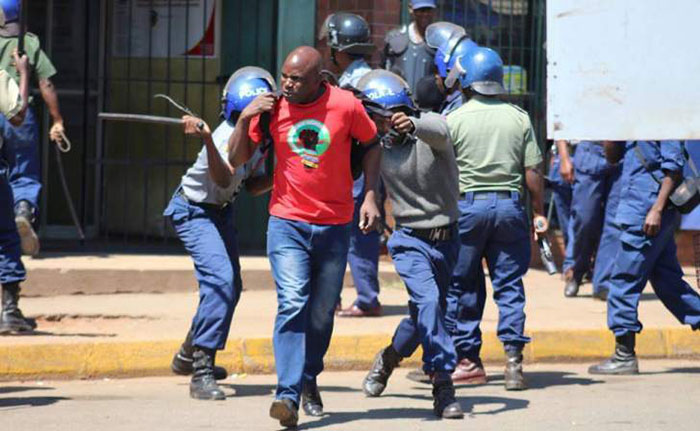
ZCTU leaders arrested by riot police
This comes after police arrested several members of the Zimbabwe Congress of Trade Unions (ZCTU) a fortnight ago to crush protests against an extortionate tax regime introduced last week by Finance minister Mthuli Ncube.
Despite the prior notification and peaceful character of the trade union activity, police violently cracked down on the ZCTU to prevent the protest from proceeding.
The union is aligned to Nelson Chamisa’s MDC.
More than 150 police officers with trucks and water cannons surrounded ZCTU offices to stop what the ZCTU said was the legitimate exercise of the constitutionally-guaranteed right of peaceful protest.
ZCTU president Peter Mutasa and secretary-general Japhet Moyo were beaten up and arrested, and 39 people were arrested in Mutare, Masvingo and Harare.
Mutasa said they will inform ILO about the excessive use of violence and harassment against trade union members in retaliation for legitimate demands made as part of a peaceful protest that was met with violent reprisals.
“Our legal team is approaching the courts and we will definitely formally file our complaint with ILO,” Mutasa told the Daily News.
“As long as the Constitution exists, we are going to exercise our rights. They authored the Constitution, we are not the ones who authored it.
“Nothing will deter us. We were battered, brutalised, but they have given us more energy to continue with our struggle you are going to see more action including demonstrations.”
Mutasa also said the tax issue is now adversely affecting workers, who are left with no option but to fight the government so that it can remove that tax.
“We are consulting our structures. We are going to come up with clear position but what we know is that workers mandated us to protect them against economic dictatorship. Workers are saying let’s go out and confront this government. The tax issue is now negatively impacting workers.”
Mutasa said there is no change between former president Robert Mugabe and Mnangagwa in their rules of engagement with workers.
“There is no change anywhere. There are no two different regimes. We have the same system. They are trying to seek legitimacy but whenever they are under pressure they revert back to what they know best. We are going back in the streets,” he warned.
This comes as Zimbabwe is in the throes of a crippling economic crisis also shown in shortages of foreign currency, fuel and food.
The shortages have widened after the government gazetted a controversial tax.
This comes at a time the Reserve Bank of Zimbabwe reintroduced foreign currency accounts, throwing the bond note into turmoil, hence sky-rocketing of prices as fears of 2008 when hyperinflation reached 500 billion percent grip the public.
The other resultant effects of the tax regime have been shortages of fuel and the increase in prices of basic commodities, burdening ordinary consumers in the process.
Some retailers have started limiting goods in a bid to avoid hoarding, as people have been buying items in large quantities for speculative purposes.
Products like sugar, rice and cooking oil are being limited to two items per customer. DailyNews
Apostolic Faith Mission in Zimbabwe (AFM) church president Aspher Madziyire, has filed an urgent chamber application at the High Court seeking permission to be allowed to file papers in response to an application in which some church members are contesting his presidency.
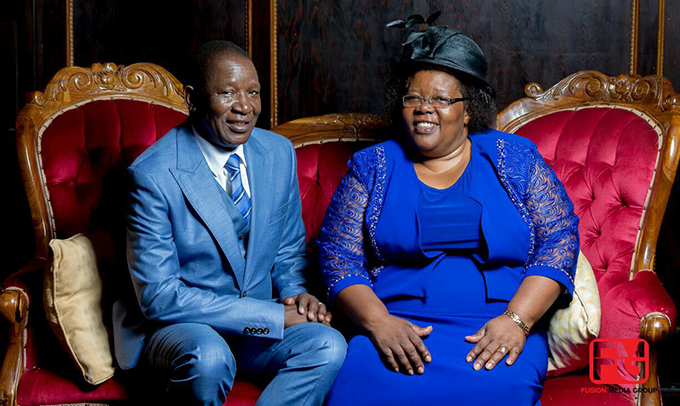
Aspher Madziyire and wife
Madziyire and four others had been barred from filing their papers, after they came with their responses out of the stipulated time.
This comes after pastor Never Pavari opened a case against Madziyire’s leadership and his alleged plot to change the church’s constitution.
However, Madziyire, Amon Madawo, Munyaradzi Shumba, Tawanda Nyambirai and the AFM failed to file their response on time, forcing the High Court to bar them from filing their papers.
Representing Madziyire and his team, Taona Nyamakura said his clients are appealing to the court for the lifting of the bar as they have valid explanations as to why the response was not filed on time.
In the application filed on Tuesday, Nyamakura noted that the delay in filing the application was due to the fact that he was overwhelmed as he had another similar court application filed at Masvingo High Court to attend to.
“This is an application for the upliftment of the bar operating on the applicants by virtue of rule 233 (3) of the High Court rules, 1971. I am aware that the applicants were served with the application to which they ought to have responded by October 12, 2018,” Nyamakura said.
“The application in the main matter was served together with the application for interim on September 28. This was also simultaneous with another urgent chamber application and court application in the name of Arthur Nhamburo and others.”
He said he intended to attend to the case but got entangled in the Masvingo matter which also required urgent attention. Madziyire reportedly suspended his vice Cossum Chiangwa and his allies without salary and benefits alleging that they staged a coup to oust him at the AFM annual conference at Rufaro.
This move angered some members of the AFM church, leading to the application of a case against Madziyire’s presidency.
Madawo told the court that the case raised against the church’s leadership was a waste of the court’s time, accusing some of the church’s congregants of harbouring hidden agendas.
He said the new constitution had been accepted but there were those that wanted to delay the progress of the church.
“I wish to emphasise that the new constitution had been accepted and that the only provisions relating to the conduct of elections would be effected with the remaining provisions being incorporated after elections by the new leadership,” Madawo said.
“The reality, however, is that this application has nothing to do with ensuring the elections are conducted in terms of the new constitution and everything to do with an elaborate plot to sanitise a coup and derail efforts to bring sanity and stability to the church.”
He said Madziyire’s leadership was legitimate.
Madziyire has led the AFM church for over a decade and was supposed to stand for re-election last year but brought constitutional changes allegedly meant to delay the election till 2019. DailyNews
There is confusion in the market over the two percent tax introduced by Finance minister Mthuli Ncube.
Zimbabwean Finance Minister Mthuli Ncube (File: AFP)
Part of the confusion emanated from an EcoCash message sent to customers stating that whilst their mobile tariffs remain unchanged, all applicable EcoCash transactions now attract two cents government tax per every dollar effective on Friday evening.
It is also reported that some fuel attendants are now taking advantage of the confusion emanating from the two percent tax and are defrauding motorists.
Some attendants are reportedly pumping fuel into vehicles that is 98 percent of the purchase price, and claiming the remaining 2 percent was going to government. Yet the tax does not apply to petroleum products.
This confusion emanated after a general notice published in the government gazette under statutory Instrument 205 of 2018 that gave legal effect to the new tax which is part of Ncube’s fiscal measures aimed at reversing imbalances in the country’s economy.
Financial institutions, the Zimbabwe Revenue Authority and the telecommunication companies have been directed to extend the collection on all electronic transactions.
The notice also indicated that the two cents per dollar tax will not apply on transactions which are below $10.
According to the notice, the tax will not apply to a range of other transactions that include transfer of money for procurement of fuel by a petroleum company licensed in terms of the petroleum act.
Econet spokesperson Fungayi Mandiveyi said customers should know there is no two cents government tax charge for EcoCash transactions that are below $10.
“For those between a dollar to $10, there is only the existing EcoCash transition fee.
“For transactions above $10, the two cents government tax applies.
“The tax is two percent of the value transacted, and it is over and above the existing normal EcoCash transaction fees,” he said.
In an interview with the Daily News, Ncube said the tax is exempt on transactions below $10.
“Those charging customers the two cents per dollar transaction on transactions below $10 will be dealt with accordingly,” he said.
President of the Motor Industry Association of Zimbabwe, Simplisio Shamba said it is wrong for any fuel retailer to charge the two percent tax because fuel prices are
regulated.
“Anyone who adds the two percent charge will be arrested by the Zimbabwe Energy Regulatory Authority,” he said. DailyNews
Prices have suddenly shot up in Zimbabwe following a slowdown in annual inflation during the first half of the year, a leading financial research firm has said.
Reserve Bank of Zimbabwe Governor Dr John Mangudya (left) makes an address during the mid-term monetary policy presentation in Harare as Minister of Finance and Economic Development, Professor Mthuli Ncube listens
The latest data from the Zimbabwe National Statistics Agency (ZimStat) shows that annual consumer price index (CPI) inflation continued to accelerate in September to +5,4 percent year-on-year after jumping to 4,8percent year-on-year in August — still remaining within the Sadc’s convergence benchmark range of 3 percent to 7 percent — not that official figures are much to go by.
NKC African Economics said September’s inflation print marks the highest levels since 2010, as a severe shortage of foreign exchange restricts supplies of basic commodities.
According to ZimStat, the main catalyst for the rise in prices was the food and non-alcoholic beverages sub-index that rose by 7,9 percent y-o-y in September.
Considering the major items within the food basket, the prices of bread and cereals rose by 6,3 percent on an annual basis, with the price of meat increasing by 11,8 percent y-o-y in September.
Looking at some of the other largest sub-indices comprising the overall consumer price index (CPI), the housing, water, electricity, gas and other fuels sub-index decreased at a slower pace (-0,5 percent y-o-y) in September, but the transportation sub-index recorded a 1,5 percent y-o-y upsurge in the same month.
That said, NKC said there continues to be growing consensus that Zimbabwe’s inflation figures are understated because they do not accurately reflect the change in consumers’ consumption patterns.
“The big reason for this is due to the large informal economy — which officials recently tried to account for when they rebased the country’s GDP, resulting in a GDP increase of more than 40 percent — that has manifested itself as a result of the currency shortage,” NKC analyst Jee-A Van Der Linde said.
“Essentially, the inflation print fails to account for the widening ‘black-market premium’ and therefore does not show the actual rate at which prices are rising in the informal market.”
Local economic commentators believe inflation is far higher than currently stated, while proponents of the purchasing power parity (PPP) index feel it can be used to paint a clearer picture of the actual inflation environment.
It has become increasingly difficult to accurately measure Zimbabwe’s CPI inflation, partly due to the view that monetary officials have not been able to consistently release reliable data since the days of hyperinflation.
Furthermore, Zimbabwe has been significantly underestimating the level of inflation — something Chris Mugaga, the chief executive of the Zimbabwe National Chamber of Commerce, has acknowledged.
To make matters worse, key inputs such as food, fuel and electricity are in short supply again, supermarkets in the capital are running out of stock and some local fast-food outlets have closed their doors citing difficult times.
That said, a bumper maize harvest in 2017 should offset price pressures somewhat this year.
Panic buying and hoarding has become the new normal, while increased demand for forex will likely lead to higher prices.
The impact of Zimbabwe’s precarious inflation environment is also visible on the stock market, with share prices skyrocketing as investors seek out equity investments to preserve value in the face of the depreciating bond notes — akin to the period late last year, when investors hedged against currency devaluation by investing heavily in local equities.
In response, Central Bank governor John Mangudya said Zimbabwe has enough foreign exchange to pay for imports of fuel, wheat and other items, and that the crash in bond notes is caused by “opportunists” trying to sow “unnecessary panic and despondency.”
According to the most recent Treasury report, annual broad money increased by 40,8 percent y-o-y in June, signalling added pressures on inflation.
Linde said it is just about impossible to keep up with the myriad of economic setbacks, with the currency issue remaining at the forefront.
On the one hand you have a severe shortage of foreign exchange, which means there is not enough money for wheat, maize, fuel, essential medicines, or electricity imports, and on the other you have a liquidity shortage which results in US dollar hoarding and precipitates panic buying, thus creating an enormous imbalance in the economy, hence the growing informal market, which in turn makes it impossible to accurately measure business activity.
Linde said: “Delving into the dynamics of Zimbabwe’s actual inflation opens up a Pandora’s box of considerations.
“While we closely follow Zimbabwe’s CPI, we do not regularly unpack official CPI releases due to the fact that current official figures simply do not reflect current buying power.
“What makes this even more concerning is the fact that policies are supposed to be formed around these figures, which in turn raises questions on the appropriateness of government policies.” DailyNews