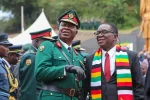
HARARE – “Tirikuda kuti zvinhu zvifambe. Ko modirei kuti hurumende irambe ichitukwa nezvinhu zvatinogona kugadzira isu?” asked Retired Lieutenant General Anselem Sanyatwe, as he grilled one of the contractors responsible for renovating the water reticulation and drainage system at the giant National Sports Stadium (NSS).
This happened during Wednesday’s tour of the stadium by the Special Adviser to the President who is responsible for Monitoring and Implementation of Government Programs, Dr. Jorum Gumbo.
Even though it was soft spoken Gumbo’s tour, Sanyatwe took over the reins, going contractor by contractor, asking each for clear timelines with most indicating they will complete their tasks by end of July.
If talking about a candid person, one is talking about Sanyatwe.
The former army general’s approach is to question every detail.
He asks about almost everything, only to ensure that contractors who were awarded tenders for NSS renovations are working with integrity and urgency.
His mission is clear; stop the delays and spare the nation from embarrassment being caused by prolonged renovations of the NSS, preventing the stadium from hosting international matches.

Sanyatwe who is less than two months old in office since replacing Kirsty Coventry, prefers to see things for himself rather than hearsay, and that approach could yield results for the NSS progress.
He demanded to see some of the equipment said to have been bought by contractors for the renovations.
Ironically, some of it was not in place even though he was initially lied to that the said equipment was already there when he took the reigns at the Sports Ministry recently.
This was evident during his interaction with the contractor responsible for installing a backup generator.

Sanyatwe asked, “Where is the generator that is supposed to be installed here?”
The contractor replied that it is currently in transit from South Africa.
Visibly surprised, Sanyatwe told Gumbo he was hearing that for the first time, as he was previously informed the generator was in Bulawayo when he got into office.
He then instructed the contractor to bring the generator on the ground sooner than later, to ensure mechanical testing is done.
As a result, from the visit, it became clear that the much anticipated progress at the NSS has been hampered by a lack of effective ground-level monitoring and slow processing of contractor payments.
 Observations from the visit showed that previous officials seemed to turn a blind eye to proper checks and verification.
These include confirming the presence of equipment on site.
However, the case seems different with Sanyatwe, who looks skeptical and prefers to physically see the said equipment.
Meanwhile, after inspecting the water and power systems, Sanyatwe turned his attention to contractors responsible for the stadium’s pitch and installation of electronic turnstiles required by CAF.
Some sample turnstiles have already been installed, with full installation to follow after receiving guidance from CAF.
The contract for the installation and standardisation of the bucket seats at the stadium is being managed by NC and Banat, a company owned by Zimbabwe Football Association (ZIFA) president Nqobile Magwizi.
As for the pitch, the contractor was expected to arrive Wednesday evening, with work set to begin immediately.
A representative from the Sports and Recreation Commission, said the new pitch should be ready within 10 weeks.
Sanyatwe seemed to be impressed in those areas, although he kept on insisting he prefers everything done in time to save government from humiliation
He wants the Warriors to play on home soil in their next World Cup qualifier against Rwanda on 8 September.
Encouragingly, there is visible momentum at the NSS and if the current pace is maintained, Zimbabwe could host its next international games at the stadium.
The country has been operating without a single stadium that meets CAF’s minimum requirements to host international matches
The main stadium, the NSS was banned in 2020 after failing to meet CAF standards.
The humiliating situation has forced the Warriors to use foreign stadiums as their home grounds, particularly in South Africa and other venues deemed logistically suitable and cost-effective by the country’s football governing body, ZIFA.