spot_img

Land reform irreversible: Mnangagwa

Must Try

Trending

By Helen Kadirire

President-elect Emmerson Mnangagwa yesterday said the country will not return land seized from former white commercial farmers almost two decades ago.

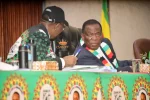
President Emmerson Mnangagwa addresses people during a Heroes’ Day event to commemorate the lives of those who died in the southern African country’s 1970s war against white minority rule, in Harare, Monday, Aug. 13, 2018. Zimbabwe’s president has called on the troubled country to unite and “put the election period behind us and embrace the future” in his first public address since winning disputed elections. (AP Photo/Tsvangirayi Mukwazhi)

“It is now behind us, it is irreversible,” Mnangagwa said in a speech to mark Heroes Day commemorations at the National Heroes Acre in central Zimbabwe, broadcast on television.

He said “the land reform programme was one of the fruits of the liberation struggle” and since it is “now behind us, it is irreversible.” He said “the task ahead is to fully utilise the land to increase agricultural production.”

Zimbabwe embarked on a violent land reform programme in 2000, taking over white-owned farms to resettle landless blacks.

Thousands of white farmers were forced off their land by mobs or evicted, with Mugabe saying the reforms would help black people marginalised under British colonial rule.

Critics blame the land redistribution for the collapse in agricultural production that saw the former regional breadbasket become a perennial food importer.

The government has indicated it will issue 99-year bankable leases to beneficiaries of land reform and Mnangagwa on Saturday said land owners must be more productive.

“Our land must be productive. We must mechanise and modernise our agriculture,” he said, adding that the land reforms were “irreversible”.

He said: “Let us move forward with the same determination and single mind, after all we share the same dream for the country.”

He said his government’s top priority was to revive the ailing economy.

It was the first Heroes commemorations since independence in 1980 that did not feature the former 94-year-old ruler, Robert Mugabe, who was forced to step down after the military seized power last November in a soft coup.

The new leader of the ruling Zanu PF party, who secured a marginal victory in the July 30 presidential elections, polling 2,46 million votes against 2,15 million for 40-year-old opposition leader Nelson Chamisa, presided over yesterday’s celebrations, also attended by his two deputies Constantino Chiwenga and Kembo Mohadi, who was walking with the aid of crutches.

The minister of Home Affairs and Cultural Heritage, Obert Mpofu, was the director of Ceremonies.

The second Monday of August is reserved for National Heroes’ Day, to remember those who fought and perished in the struggle for independence from British colonial rule. The heroes of the nation are honoured every year at the national shrine, where some of the soldiers from the revolution are buried.

People laid down wreaths on their grave sites, and Mnangagwa also paid his respects.

“This day gives us an opportunity to reflect on the role played by our national heroes of the liberation struggle. We remember the sacrifice of the sons and daughters of Zimbabwe who died for the country, we remember their great sacrifice for our freedom and independence,” Mnangagwa said. DailyNews

Related Articles

Former First Lady Grace Mugabe and President Emmerson Mnangagwa, March 2026 (Picture via Ministry of Information)

The uneasy peace: Grace Mugabe, Mnangagwa and the politics of controlled memory

0
At a recent public function, the opening of The Sprout Restaurant in Harare, we saw former First Lady Grace Mugabe moving within the same orbit as senior ZANU PF figures, her presence neither resisted nor theatrically embraced.
Vice President Constantino Chiwenga and President Emmerson Mnangagwa during a Zanu PF Central Committee meeting (Picture via X - @SokoCindy - Zanu PF Celebs)

Who will drive the bus: Mamvura, General Chiwenga, or someone else? Will President Mnangagwa...

0
In this second and final part of the article, I continue to examine the potential outcomes of ZANU-PF’s succession politics, focusing on whether Kudakwashe Tagwirei (whom I metaphorically refer to as “Mamvura”) will succeed in his presumed bid for the presidency, whether General Constantino Chiwenga will recover his political standing and take over, whether someone else will ascend to the throne, and whether President Mnangagwa will ultimately retire in peace.
President Emmerson Mnangagwa officially opening the 22nd ZANU PF National People’s Conference in Mutare, 17 October 2025 (Picture via X - @edmnangagwa)

How can people who rejected a president in two elections now want him to...

0
The political narrative currently being spun by loyalists of President Emmerson Mnangagwa is as audacious as it is intellectually dishonest.
Moses Tofa is a Research Leader, political analyst, and self-critical Pan-Africanist. He holds a PhD in Politics from the University of Johannesburg and a PhD in Conflict Studies from the University of KwaZulu Natal. (Picture via Facebook - Moses Tofa)

Who will drive the bus: Mamvura or General Chiwenga? Will President Mnangagwa retire peacefully?...

0
Zimbabwe is at a crossroads where critical and cruel decisions are being made in the corridors of power. These decisions will determine the country’s direction for many years to come.
Chatunga Mugabe (28) and his co-accused, Tobias Mugabe Matonhodze (33), appeared before the Alexandra Magistrate’s Court in Johannesburg (Picture via SABC News)

Trauma, power and the unfinished healing of Zimbabwe: The case study of Mugabe and...

0
Zimbabwe’s modern political history is often narrated through elections, constitutional changes, economic collapse, land reform, sanctions, liberation-war heroism, tribalism, authoritarian rule and the emerging culture of a cargo cult.

Don't miss a story

Breaking News straight to your inbox.

No spam just news !

0 0 votes
Article Rating
Subscribe
Notify of
0 Comments
Oldest
Newest Most Voted
Inline Feedbacks
View all comments
- Advertisement -spot_img

Latest Recipes

Latest

More Recipes Like This