By Masimba Kuchera
HARARE – People living with disabilities have blasted the government of Zimbabwe for neglecting their welfare with most of them turning to street vending and begging to make ends meet.
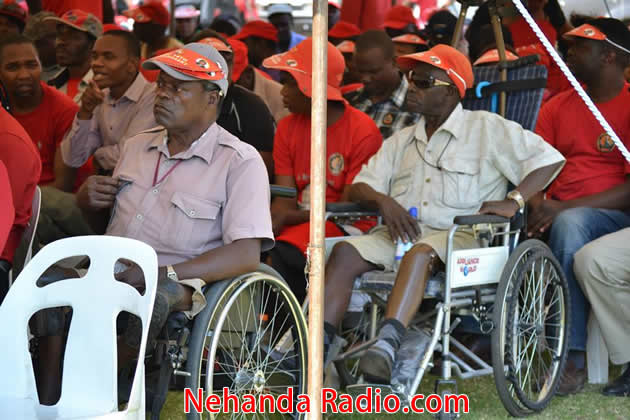
A snap survey in the streets of Harare proved that people with disabilities have flooded the capital either begging for alms selling airtime and sweets at street corners and pavements for the few lucky ones.
Of late, the rush to Harare in anticipation of better economic fortunes has not spared the disabled who are coming from as far as Chivhu, Marondera, Murewa and Chitungwiza to either trade their wares or beg for alms.
“I come to Harare every morning to sell airtime and sweets. It is better here because sometimes I go back home with between 5-10 dollars profit,” said Tendai Nyati who resides in Murewa.
She said that most of the visually impaired people use buses to come to Harare because they do not pay.
“Buses are our usual mode of transport because they do not ask for money unlike the smaller commuters who always demand something from us,” she added.
Asked if she was aware of the government intervention programmes, Nyati said bureaucracy at government offices was the problem as they are constantly referred to office after office.
Celani Tshuma who is an alms seeker at corner Lomagundi and King George Roads in Harare said she had lost faith in ever receiving government support and is focusing on soliciting for alms from members of the public.
“At the Department of social welfare offices they do not treat us well, they always say that resources are limited,” she said.
She indicated that there is poor or no communication from government social protection programs. “I always listen to news on radio hoping to get some updates but it is rare to hear anything on people with disabilities,” Tshuma added.
Climate Muzeziwa, a visually impaired father of three based at Harare’s Copacabana bus terminus has also lost hope of ever getting government support.
Muzeziwa said the government had all their names but took long to disburse funds to them despite knowing the glaring problems faced by people with disabilities.
Hlalani Sibanda said he tried without success to apply for a grant to start a small business. He got frustrated resulting in him turning to alms for survival though he said people no longer give as they did in the past.
“We don’t make much but what can you do.? It seems like everyone is struggling to survive,” Sibanda said.
He added that on a normal day he collects around $8 from alms with good days bringing up to $15. Bus termini have proved to be popular spots for people with disabilities who solicit for alms due to the high turnout of people who rely on commuter omnibuses for transport.
People with disabilities have on some cases clashed over territorial claims with some defining certain lucrative sections of bus termini no go areas for others.
National Association of Societies for the care of the Handicapped (NASCOH) Executive Director, Farai Mukuta said the government of Zimbabwe had dropped social protection for people with disabilities as the government was not doing anything else besides the $20 monthly support.
“Absence of social protection seriously compromises the well being of the people with disability. When the economy hard hits the able bodied it is worse for people with disabilities because where you need to buy a pair of shoe which cost $20 the disabled needs a wheelchair which costs $350,” Mukuta said.
He added that the government is giving people with disabilities $20 per household per month adding that snubbing of people with disabilities in the awarding of marketing stalls at flea markets such as Mupedzanhamo in Mbare, Harare further plunged people with disabilities into poverty hence the decision to turn to begging.
“The government just gives a blanket figure to social services, yet social services is not for people with disabilities only, it is also for war veterans, street kids and orphans.
So within that figure, that is where they lump people with disabilities, so the cake is too small for the 2 million people with disabilities in Zimbabwe” said Mukuta.
He added that Department of Social Welfare offices were poorly manned despite an overwhelming turnout of people with disabilities seeking help and support resulting in them being temperamental.
“If you are talking of poorly paid and resourced social welfare officers and then they have a crowd of people with disabilities they in turn become temperamental treating people with disabilities as a nuisance yet they are demanding what should obviously be theirs,” he said.
Mukuta called for the government of Zimbabwe to improve its support for people with disabilities and extricate them from running battles with police in the streets of Harare as they battle to survive for another day.