By William Muchayi
Dictators the world over, thrive on their manipulation of the pillars of state. In a viable democracy, for which Zimbabwe is far from, the Executive, Legislature and the Judiciary operate independently, although, at times, their functions overlap.
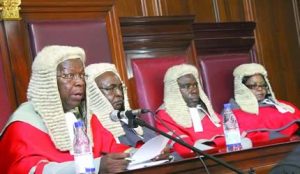
The judiciary and the legislature exist to curb the powers of the executive. Judges in a democracy base their decisions on points of law and not on political considerations.
These basic principles are what Robert Mugabe and his selected judges want us as citizens to believe that they are custodians of , which makes a mockery of our intelligence.
The Constitutional Court’s insistence on hearing the MDC’s disputed election challenge, in spite of the fact that the latter had withdrawn the case before the respected court , clearly exposes the extent to which Zimbabwe’s pillars of state are compromised in favour of the incumbent Robert Mugabe and his Zanu PF party.
Who benefits from flogging a dead horse? Isn’t it an effort in futility which makes a mockery of the judiciary itself?
Rumours circulating within the corridors of law are to the effect that if Tsvangirai’s lawyers failed to turn up for the Concourt hearing, they would have been charged with contempt of court, in spite of the fact that the outcome of the case was predetermined.
As if that was not enough, after dismissing the opposition’s challenge with costs, the honourable judge Chinembiri Bhunu issued a directive for Tsvangirai’s lawyers to be arrested, not for contempt of court, but, on allegations of attacking the institution for its partiality in favour of Zanu PF.
Since when have lawyers been made to account for views held by their clients and be punished for that? How can the honourable judge convince even a layman in the street that his directive has any merit in the eyes of the law?
Does that need a rocket scientist to realise that ours is a compromised institution that has failed to live to its expectations? Or else, the judges underestimate our intelligence to be bold enough to issue such directives that undermine the integrity of the institution?
It is like trying to convince citizens into believing that the sun rises from the west and sinks to the east.
By seeking redress before the courts following the disputed July elections, the opposition had fallen into Zanu PF’s most reliable trap, that is, the compromised judiciary. Mugabe is desperate to legitimise his stolen election thereby gaining credibility internally and abroad.
It meant that by settling the dispute in court, which was in no way to rule against Mugabe, the outcome was expected to be binding and respected by all the parties in the dispute. Wasn’t it Ban Ki Moon’s advice as well that the dispute needed to be settled in the courts, the assumption being that the institution is impartial? The idea was to legitimise the illegitimate in a bid to be embraced by the international community.
Doesn’t SADC and the African Union buy this cheap narrative? Having identified the trap at the last minute, the MDC withdrew the case much to the annoyance of the judiciary and Zanu PF, hence rumours of arrest threats on contempt charges if the MDC lawyers failed to turn up for the hearing yet the case was long withdrawn and its outcome was predetermined.
Attendance of the MDC lawyers during the hearing was of paramount importance so as to close the dispute ‘legally’ and give legitimacy to Mugabe’s victory claim. Mugabe desperately needs this seal of approval from the highest court as he is well aware that he lost the election but stole it from the legitimate winner.
In as much as citizens have an obligation to respect their judiciary, the same institution is obliged by the same token to uphold and respect the rights of the very citizens. It is a two way relationship and each party is expected to abide by the same rules. Society has a duty and responsibility to make the judiciary accountable to its citizens and so does the judiciary to its people.

It is a symbiotic relationship with checks and balances and no one should be above the other except the law itself. By expressing their reservations over the impartiality of the judiciary , the MDC merely exercise their legitimate right which no one can take away from them.
Not only that, their sentiments echo those of many ordinary citizens who dreamed of an impartial judiciary in post- independent Zimbabwe but only to be disappointed by reality on the ground 33 years after independence.
The judiciary can only claim legitimacy and respect when it stops being used as pawns in a chess game by the executive. As is now the case in Mugabe’s Zimbabwe, citizens are no longer protected by the very institution that is at the heart of society, leaving them vulnerable as selective justice becomes the norm of the day. Given this disturbing scenario, then what is the point of seeking redress before the Concourt when the outcome is predetermined?
Credibility of any institution in society is judged by its citizens who have every right to express their reservations if unhappy. It is not Mugabe , Tsvangirai or Ncube who is mandated to judge and assess the credibility and effectiveness of our institutions but, we the ordinary citizens who are served by the very establishments.
It is the narrative of the ordinary people that can only give an accurate picture of the strengths and flaws of the institution. With due respect, there is no wisdom in cracking down on those who refrain from approaching an institution they feel is compromised. The right thing to do is to correct the wrong and reclaim the integrity and respect that the honourable judges Wilson Sandura, Pardington Garwe and Luke Malaba stand for.
They never impose or imposed their will on a people and neither did they beg for respect and recognition. It is their work for which they will be respected and remembered for long after their deaths. As long as the judiciary continues to be an extension of the executive and Zanu PF , it will remain the subject of scorn and shunned by many.
Tsvangirai and his MDC will have the last laugh as the institution will continue to be mocked by many until that time it starts to serve the interests of society and not that of Mugabe and Zanu PF.
William Muchayi is a pro-democracy and political analyst who can be contacted on [email protected]
Discover more from Nehanda Radio
Subscribe to get the latest posts sent to your email.