HARARE – The ruling Zanu PF party has absolutely no lawful authority to dethrone any urban council mayor or councillor, Morgan Tsvangirai’s opposition MDC has said.
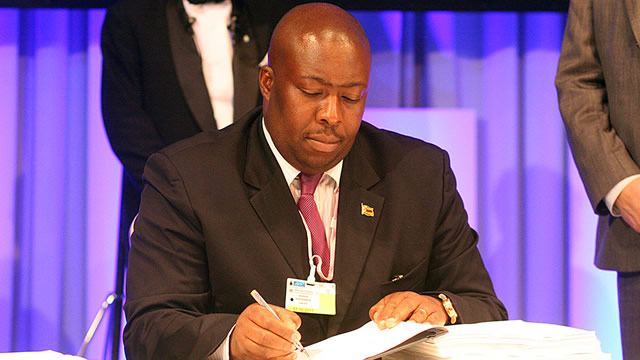
Saviour Kasukuwere
This comes as new Local Government minister Saviour Kasukuwere has threatened to fire the MDC Mayor of Harare Bernard Manyenyeni and his MDC councillors from office and instead allow the government to appoint commissions headed by chief executive officers to run the city.
Kasukuwere said the MDC-run council has failed to deal with a growing vendor menace.
“If Manyenyeni and others are not up to the task, we will find a way to ensure that we have a city that runs and don’t blame it on President Mugabe when that happens,” Kasukuwere was quoted recently.
“Councils must shape up or ship out. If the council does not clean the town, I will clean the Town House.”
The ruling Zanu PF party, which has absolute control of Parliament and can pass any laws it so wishes, has repeatedly lost all elections in major cities to the opposition MDC party since the opposition party was formed 15 years ago.
The MDC said Kasukuwere’s Zanu PF was seeking to regain control in the capital Harare by dismissing the elected councils and appointing pro-Zanu PF commissioners to run the city.
“The long and short of it is that Saviour Kasukuwere has absolutely no lawful authority to dismiss any mayor and councillor simply because they have refused to obey Zanu PF’s unlawful orders to forcibly remove vendors from the streets,” Obert Gutu, the MDC spokesperson said yesterday.
“Indeed, Section 278 of the Constitution clearly sets out the procedure that has to be followed before any mayor or councillor is removed from office. Put simply, an independent tribunal must be established to exercise the function of removing from office mayors, chairpersons and councillors, but such removal must only be on the grounds of inability to perform the functions of their office due to mental or physical incapacity, gross incompetence, gross misconduct, conviction of an offence involving dishonesty, corruption or abuse of office or wilful violation of the law.”
Gutu said the scourge of vending was a direct creation of the Zanu PF regime.
“Because of its ruinous, corrupt and irresponsible system of governance, this regime has run down the Zimbabwean economy over the years and in the process, thousands of workers have been thrown onto the streets as factories and industries continue to close on a daily basis,” Gutu said.
“The MDC calls upon the Zanu PF regime to immediately desist from adopting heavy — handed and unlawful methods of dealing with the vending crisis in Harare as well as in all the other cities, towns and growth points in the country. We shall not accept a situation whereby the Zanu PF regime unleashes its security operatives to ruthlessly clamp down on vendors; beating them up, arresting them and also destroying their merchandise.” Daily News
Controversial businessman Energy Mutodi being arrested by police over a fraud case
By Lloyd Mbiba
HARARE – The social media writings of controversial musician-cum-politician, Energy Mutodi — a prominent Zanu PF supporter and self-confessed follower of Vice President Emmerson Mnangagwa — is getting more bizarre by the day.
Controversial businessman Energy Mutodi being arrested (left)
In his tall tales this week, he insinuated that Vice President Phelekezela Mphoko and Higher Education minister Jonathan Moyo are allegedly part and parcel of the secessionist agenda that is being pushed in some sections of Matabeleland.
Commenting on President Robert Mugabe’s Cabinet reshuffle on his Facebook page, Mutodi claimed that Moyo, now Higher Education minister, allegedly used State media as Information Tsar to attack Mnangagwa, while propping up Mphoko.
“Professor Moyo’s transfer is the biggest positive development that has happened to cabinet which has been much anticipated after reports emerged that the learned Minister was using the Media Ministry to destroy the party from within, promote factionalism in favour of a G40 cabal as well as dictating the pace of the country’s succession politics.
“Under the grand scheme, Professor Moyo would use Zimpapers and other private media houses to destroy Vice President Emmerson Mnangagwa’s reputation using Gukurahundi as a way of blocking Mnangagwa’s chances on the Presidency whenever the time comes.
“On the other hand, he would promote Vice President Phelekezela Mphoko and Saviour Kasukuwere, with Mphoko earmarked to takeover the Presidency from President Mugabe in line with the Unity Accord which Professor Moyo believes should ensure a situation where a Shona President is succeeded by a Ndebele one.
“Upon Mphoko’s assumption of the Presidency, Moyo would ensure he serves only one term as President while he himself would be his Deputy allowing him to takeover from him as Head of State and Commander-in-Chief of the Defence forces.
“During their Presidency, Mphoko and Moyo would cause a referendum to be carried out which would ask the people of Matebeleland if they still wanted to remain a colony of Zimbabwe or form their own separate state called Mthwakazi.
“In their forecasts, a Mthwakazi state would be easy to accomplish if a Ndebele leader was to emerge in the country and its first international partners would be South Africa and Russia. The Mthwakazi state is an unfinished job which they believe was left as work in progress by Dr Joshua Nkomo.
“If allowed to materialise, the Mthwakazi state will take away the three provinces of Matebeleland South, North as well as Bulawayo and Victoria Falls from Zimbabwe. Once given a national status, Mthwakazi would be recognised by the UN and the Sadc and African Union the same as what happened with South Sudan.
“It will also negotiate with South Africa to peacefully take over an original Mthwakazi land currently under Chief Gumede across the Limpopo.
“A recent (Oceanic Omnipresence Organization) OOO report has also intimated that the Mthwakazi group is busy training in South Africa and has so far graduated 10 youths from Matebeleland who were trained in communism, intelligence, guerrilla tactics and sabotage.
“They are training ahead of launching guerrilla attacks in Matebeleland and the whole of Zimbabwe perhaps starting with the disappearance of school children in Bulawayo which must instill fear and anger among residents, compelling them to advocate for a separate Ndebele State.
“Their field commanders include a Mthwakazi youth trainer Ian Beddowes, a dissident Diliza Mangoye Dhlamini, a co-ordinator Prudence Mpofu who is Jason Ziyapapa Moyo’s grand daughter and trainer Andrew Nyathi who is also ZAPU’s South Africa Provincial spokesperson and a close friend of Frederick Mutanda.
“Prudence Mpofu’s Facebook identity is Prudence JZ and she is now based in Bulawayo to coordinate Mthwakazi activities. The youths are being trained in a Conference room at a building close to a Nandos outlet in Braamfontein for a two-week course per cluster.
“Works which the Mthwakazi establishment has already accomplished include the robbing of busses carrying Mashona-speaking people as they enter or exit South Africa. The robberies which are being done at gun point are being used as a revenge for Gukurahundi as well as a fund-raising venture.
“They have also successfully burnt busses and lorries carrying Mashona goods at South African bus rank stations and are also to burn travelers alive while going to South Africa, incidents of which would be publicized as xenophobia attacks,” Mutodi claimed.
Asked by the Daily News yesterday if he was not advancing tribalism, regionalism and division in Zimbabwe, Mutodi said, “My post is not divisive at all. It is based on research. These are facts and facts can never be divisive.
“We are not tribalists. The problem is that some people have a tribalistic agenda and not us. If a Shona person has an agenda, it’s not tribalistic, in the same way if a Ndebele has an agenda, it’s not tribalistic”.
This is not the first time that the controversial businessmen has spewed controversial political conspiracies.
Two weeks ago, analysts told the Daily News that the time may have come for Mnangagwa to publicly distance himself from Mutodi, whose social media postings are getting wackier by the day.
At the same time, there were increasing questions about Mutodi’s mental and emotional state after the discredited musician spun yet another cranky plot on his Facebook page claiming that Mnangagwa was targeted for assassination by a prominent local businessman.
In that posting, Mutodi claimed that an alleged “close ally of Vice President Phelekezela Mphoko, businessman Frederick Mutanda” had since last year been plotting to assassinate the VP.
“According to documents that are now in our possession, Frederick Mutanda approached former MDC-T treasury-general Roy Bennett in Fourways, South Africa, where he told him of his intention to assassinate Mnangagwa for what he said were unwarranted arrests and malicious Exchange Control crimes which were levelled against him at the direction of the VP in post-independence Zimbabwe.
“During the meeting, Mutanda who intimated that he had served as chief bodyguard to the late VP Dr Joshua Nkomo emphasised the need to avenge sufferings he endured from Mnangagwa. He said he had been victimised by Mnangagwa for trying to expose the role he had played in the Gukurahundi killings as well as that of the President.
“Mutanda also briefed Bennett how he had lost millions of dollars after the Commercial Bank of Zimbabwe (CBZ) bank auctioned off his personal property and goods held at Caps Holdings under the orders of VP Mnangagwa.
“Mutanda then promised Bennett that he would help him recover his lost farmland in Chimanimani provided he helped him fight and oust Mnangagwa because he was sure that VP Mphoko was going to be the next president as they would strategically remove President Mugabe from power after tactfully isolating him from his strong and staunch supporters.
“Mutanda further mentioned that there is no way Mphoko will not be President as they have a good link with Russians and the South African government who will help them in getting rid of President Mugabe as soon as Mnangagwa is eliminated.
“Mutanda, who is said to be married to the late Joshua Nkomo’s daughter who was divorced by former Minister Francis Nhema is said to have disclosed in further meetings with different people that he was working with Professor Jonathan Moyo and Vice President Mphoko himself to make sure that Mnangagwa was blocked from taking over from President Mugabe.
“He added that Mphoko would work with a Mthwakazi Liberation Front party to keep the Gukurahundi issue alive in Matabeleland while Professor Moyo would use Zimpapers and other media houses to discredit Mnangagwa,” Mutodi claimed.
Virtually all the people who comment on Mutodi’s myriad claims on his Facebook page savage him, calling the conspiracy theories insane and contrived. Daily News
Chew this plant and propose love to any woman, she will say 'YES'
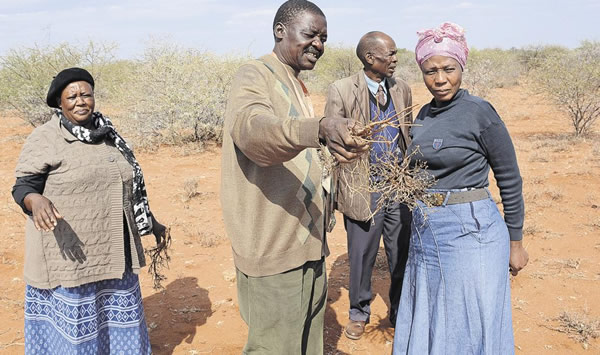
SOUTH AFRICA – From a distance it looks like any other veld plant. But the locals claim the plant does wonders for them – especially the men!
Chew this plant and propose love to any woman, she will say ‘YES’
They said the sweet plant – which they call molomo monate – was discovered by their ancestors in the Ga-Seleka area outside Lephalale in Limpopo.
Locals said only the small shrub’s roots are chewed, and once a man has chewed and swallowed the sweet juice, women can’t say no if he asks for love!
Kautloa Mocheko (63) said: “The tree is well known as a ‘ways opener’– it makes people like you.
“As for women, this muthi is even worse. You attract girls by just opening your mouth and speaking to them,” he said.
Tribal councillor Fanie Giba (69) said the sweet plant can help you to be loved and favoured when you speak to people.
“Even if you are fighting with your wife or husband, you just come to get a piece of it. And whenever you start speaking to your lover when you arrive home, it will be all smiles and tears of joy!” he said.
They said digging the plant from the soil was easy as the surface around it was always wet, making it easy to pull out its roots.
Chief Phetolo Seleka said he felt blessed because the plant brings peace. He added that he wasn’t surprised to see everybody in his community living in harmony.
“The tree is sweet and helps to bring reconciliation between two people and even makes them fall in love,” the chief said. Daily Sun
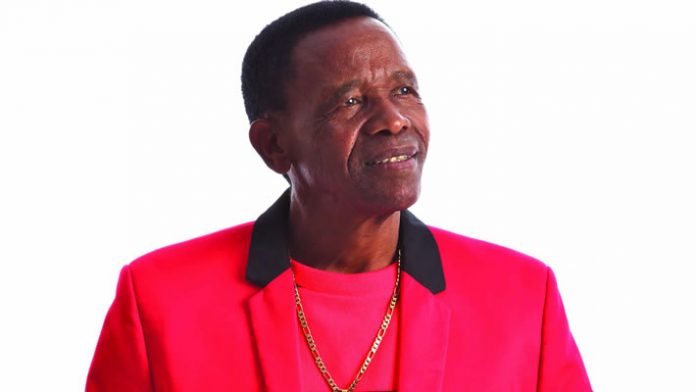
SOUTH AFRICA – The late Soul Brothers legend David “Mdavu” Masondo (67) made a lot of music and he may have made many children.
David “Mdavu” Masondo
“I don’t mean to embarrass my late father, but he had about 40 children. I’ll remember him as someone who loved himself very much,” claimed his eldest son Nkosinathi (47).
Nkosinathi said Mdavu also had two wives.
“He built a house with his wife, Mamsy MaSithole Masondo in Hammarsdale and another house with Wendy MaGumede Masondo in Joburg.”
He said Mamsy is no longer alive.
The news team visited Nkosinathi in the KwaZenzele, Mphophomeni area outside Howick, where David was born and grew up. David’s childhood friend, Smangasendlala Zondi (69), was also present. He said David was born on Dubela Farm.
“He went to Howick Combined School and moved to KwaZenzele here in Mphophomeni. He played in a band and would perform at six-to-six shows,” said Smangasendlala.
Smangasendlala said David visited a girlfriend in Hammarsdale and they went to Joburg and linked up with Hamilton Nzimande.
“They started Soul Brothers there and then. They were badly paid so they bought their own instruments and built their own Soul Brothers,” said Smangasendlala.
He said the name Gandaganda Base Ningizimu Afrika was given to them by the late Ukhozi FM’s Kansas City when they were fighting with Hamilton about the name.
Nkosinathi said his dad died before releasing his new album, which he made with Moses Ngwenya. He said the album included a track by Ladysmith Black Mambazo.
Nkosinathi said his father died on Sunday morning at Garden City Clinic in Joburg after kidney failure.
David’s memorial service will be held tomorrow at the Hammarsdale sports grounds.
One of David’s daughters, Mbali (27), confirmed that Nkosinathi was their brother.
“He is our elder brother but our father did not marry his mother,” said Mbali. Daily Sun
Three Kaizer Chiefs players in hot soup over DJ Sbu's Mofaya drink
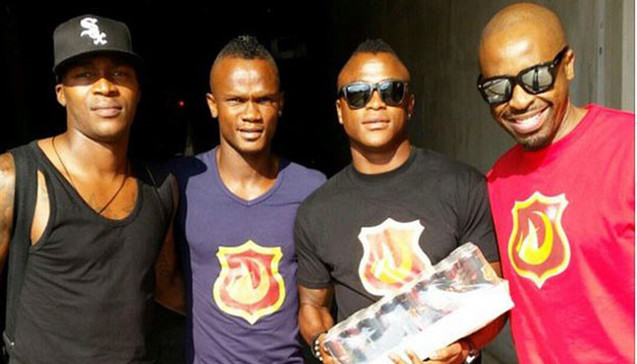
SOUTH AFRICA – Three Kaizer Chiefs players have been fined by the club for posing for a picture with DJ Sbu and his energy drink, Mofaya.
Three Kaizer Chiefs players in hot soup over DJ Sbu’s Mofaya drink
A picture of Morgan Gould, Siboniso Gaxa and Tsepo Masilela wearing shorts with club colours, as well as Mofaya t-shirts, circulated on social media earlier this year.
The energy drink, which has attracted headlines as it is not South African Bureau of Standards approved, is owned by well-known DJ and businessman Sibusiso Leope.
The image did not go down well with Amakhosi’s management, and this website has been reliably informed that all three players have since been disciplined.
DJ Sbu answered his phone and listened to our questions, but then the call was dropped. Several attempts were made to get hold of the businessman again, but his phone went to voicemail.
All the players’ phones also went to voicemail.
Kaizer Chiefs spokesman Vina Maphosa said the issue was a confidential matter that the club was not prepared to discuss.
Earlier this year it was revealed that the drink was not South African Bureau of Standards approved, as claimed. South Africa Latest News
Bobbi Kristina’s paternal aunt Leolah Brown has denied claims that a member of the Brown family was responsible for taking, and attempting to sell, a photo of the unresponsive 22-year-old.
Bobbi Kristina Brown and Whitney Houston
Earlier in July, TMZ broke the news that “an extended family member” was peddling an image, which shows a woman hovering over Whitney Houston’s daughter in her hospice bed. The celebrity news site later reported that as a result of the leak, the security team at the Peachtree Christian Hospice had restricted visitor access to the aspiring actress.
But Bobby Brown’s sister has since hit back telling TMZ that the snap, which was offered to several media outlets for $100,000 (£65,000) “was taken when no other Brown was around her”.
She told the site: “My brothers know this and we have already determined who we are sure it was not. And believe me − it was not a Brown!”
Brown also suggested that everyone should be made to take a lie-detector test to find out the truth once and for all.
“If it were up to me, the sick and sorry people, that continue to have permission to see her even still to this day, they would be completely cut out never to lay eyes on her again,” she added.
Brown previously expressed her outrage that somebody so close would want to cash in on her condition in a scathing Facebook post.
She wrote: “I’ll tell you what! You took that picture thinking you gon get some money for it…and that’s gon be it! …guess what!????!!!! I will myself if no one else does-see to it that -YOU be revealed!!!!”
Bobbi Kristina was found unconscious at her home in Roswell, Georgia, on 31 January 2015, shortly before the third anniversary of her mother’s death. On 25 June, she was moved to hospice care having spent two months at Georgia’s Emory University Hospital and a further 10 weeks at the DeKalb Medical facility.
“Despite the great medical care at numerous facilities, Bobbi Kristina Brown’s condition has continued to deteriorate,” her maternal aunt Pat Houston said in a statement. “We thank everyone for their support and prayers. She is in God’s hands now.” International Business Times
HARARE – Zimbabwe has totally forgotten the victims and neglected the families affected by the National Sports Stadium disaster according to Temba Mliswa.
The National Sports Stadium in Harare, Zimbabwe
On July 9, 2000, 13 people lost their lives when police fired teargas into the crowd during the 2002 World Cup qualifier between Zimbabwe and South Africa.
Yesterday marked 15 years since the tragedy but just like the previous years, there have been no events organised to commemorate the day.
The crowd stampede was ignited after Bafana Bafana midfielder Delron Buckley scored his second goal to give the visitors a 2-0 lead eight minutes before the end.
Warriors fans were not pleased by the team’s performance and began throwing missiles onto the pitch which resulted in the police firing teargas to suppress the unrest.
A stampede followed as close to 40 000 fans inside the venue sought an escape from the teargas fumes.
Alec Fidesi, Eularia Made, T Makonese, Tawanda Gwanzura, Patrick Mpariwa, Killian Madondo, George Chin’anga, Sam Mavhuro, Enock Chimombe, Joyce Chimbamba, Benhilda Magadu, Ronald Kufakunesu and Tonderai Jeke lost their lives during the stampede.
The disaster to this day remains the biggest tragedy to strike Zimbabwean sport.
Mliswa together with former Nigerian international John Fashanu and British boxing promoter Ambrose Mendy were part of a Trust established to spearhead the fundraising and commemorative activities.
Mliswa sadly admitted that the trust and the rest of the country have forgotten about the 13 lives lost and their families.
“In my own opinion I believe we are all responsible for neglecting the families and the memories of the victims of the disaster,” he told the Daily News.
“I’m one of the people who were in the committee which was tasked to ensure that we keep on taking care of these families and the victims are remembered and I can safely say myself and the rest of the nation, we have failed these families.
“This is Zimbabwe and we have a habit of initiating things but there is no follow up to see that we have kept track of these families to see how they are coping.
“We need the whole of Zimbabwe; the government, corporate world and every individual to come on board to ensure the victims are remembered and their families are taken care of.’’
Mliswa added: “Fifteen years is such a huge milestone and as a nation this is something we should not easily forget. We were supposed to touch base with the families of the victims. Some of the victims were the breadwinners of their families and we need to work on giving them something which is sustainable.
“I know that all the families received a once-off compensation payment from Fifa but it is not enough.
“There was a suggestion that the two nations can play a friendly match every year to commemorate the disaster with the proceedings going to the families of the victims but nothing has been done.
“Obviously this was a model that we could have pursued to help raise funds for the families and we could have kept in touch with them.”
The former Hurungwe West legislator, who has a sporting background, said an inquest should have been held after the tragic accident.
“There are a lot of things that should have been done like setting up a commission of inquiry to ensure that such a tragedy does not happen again,” he said.
“You can’t just keep quiet and say it won’t happen again when 13 people have lost their lives. It is the biggest sporting tragedy to have occurred in this country.
“Equally the commission would have found if there were any criminal elements responsible and they should have been brought to book.
“You have to give confidence to the public that we have learned from this disaster and it is safe for people to attend football matches again.” Daily News
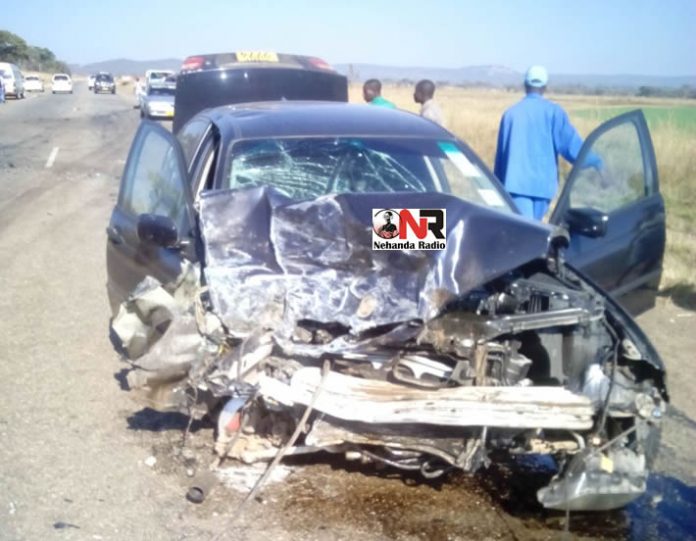
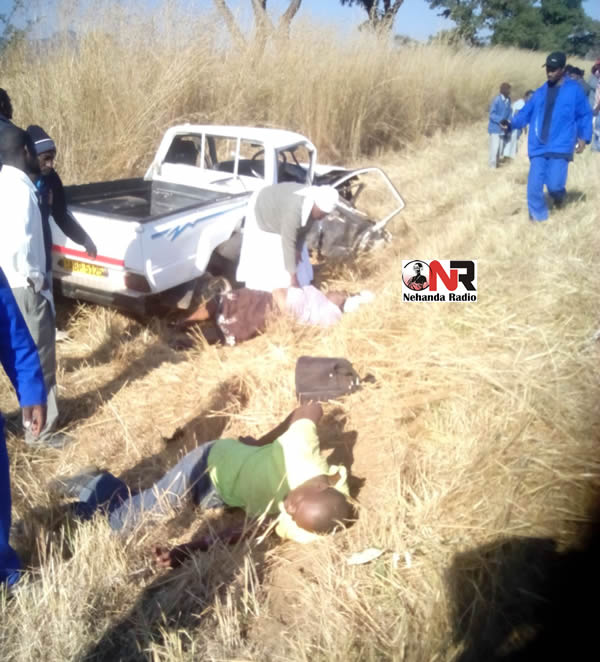
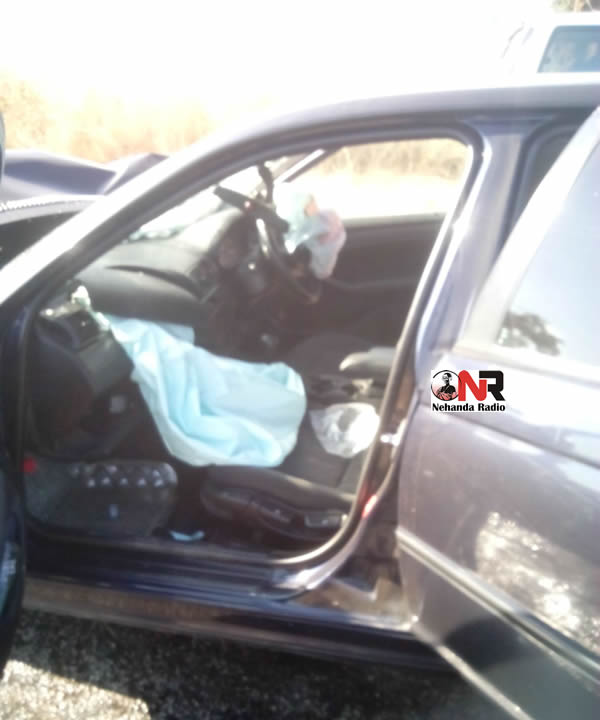
One person died on the spot after this accident in Glendale, some 60km away from Harare.
One person killed in Glendale accident
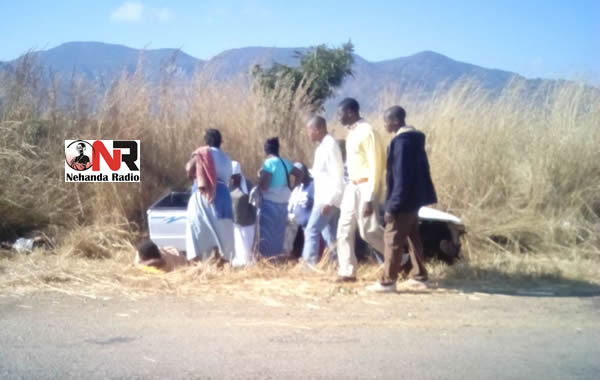
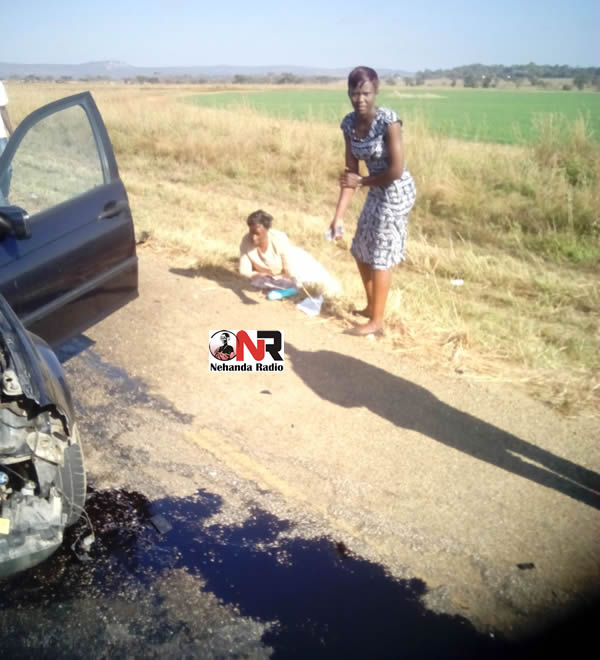
According to a Citizen Reporter who sent these pictures, one person died while 6 others were critically injured and taken to Glendale Clinic by nearby good Samaritans since the ambulances came very late.
“The Toyota Hilux pickup which was heading towards Harare burst a tyre and the driver lost control and encroached in the opposite lane where the BMW was heading towards Bindura.
“At the back of the pick up where people who were thrown out and suffered injuries,” he told us.
The injured being assisted before being taken to Glendale ClinicThe injured being assisted before being taken to Glendale ClinicThe injured being assisted before being taken to Glendale ClinicThe injured being assisted before being taken to Glendale ClinicOne person killed in Glendale accident
Now you have the power to tell the world what is happening in your area, send pictures and videos.
The phrase ‘gore rezhara’ or ‘umyaka wendlala’ – the year of famine – is familiar with most Zimbabweans of my age. Up until the late 1970s, our grandparents and parents tended to calibrate historical eras with ‘landmarks’ of years when hunger and famine were at their worst.
Welshman Ncube
Massive national food deficits especially in vulnerable regions like Matabeleland, the Midlands, Masvingo and some parts of Mashonaland West were a common phenomenon. Yet, it was very rare to hear of anyone dying of starvation.
When Zimbabwe gained independence (not freedom) in 1980, millions of optimists like me were consumed by the euphoria of independence so much that we saw nothing but a blissful future. Once the reality of ‘majority rule’ settled in its tempo of governance incompetence, the frequency of food shortages and malnutrition became routine.
Ironically, it was the ‘food uprising’ of 1998 that sparked the multiparty democracy ‘revolution’ in Zimbabwe. The ZANU PF government, faced with a new and vibrant MDC competition, responded with systematic vindictiveness and struck at the heart of ‘food security’, the farming sector with a vengeance unprecedented anywhere in Africa.
Understand me well. I am not for a minute insinuating that white commercial farmers were the drivers of food self-sufficiency. After all, millions of ‘Master Farmers’ dotted all over communal areas and so called African purchase lands delivered thousands of tons of maize and other crops to the GMB every harvest season.
It remains true that a very significant percentage of commercial maize was grown by commercial farmers, who were mainly white and hence even today you will notice massive grain silos at or around places that were dominated by commercial farming such as Banket, Chegutu, and Bindura, etc, a sign that these places had been granted ‘special food security status’ by the Ian Smith government. Today these silos are white elephants.
One might argue that ‘lack of food’ is not unique to Zimbabwe – but an international phenomenon. Yes, a grain of truth however requiring qualification. Since 1980, rainfall patterns have been irregular in most parts of Zimbabwe, with specific regions in Matabeleland, the Midlands and Masvingo continually being vulnerable.
If you consider what the ZANU PF government has been focusing on since the disastrous and violent ‘land reform’ from year 2000, it has been a litany of policy errors and politicisation of food production. Billions of dollars have been squandered in haphazard ‘agricultural input and mechanisation schemes’ that have done little to alleviate hunger.
If anything, the plunder of public resources, widespread deforestation and primitive cropping procedures have worsened our food situation. Just across the borders in Botswana, Zambia and South Africa – countries some of which have less reliable rain patterns – there is very little or no potential starvation of villagers.
The tragedy is that while we are facing a two-million ton grain deficit this year, we will spend almost a quarter of a billion dollars importing grain from Zambia, ironically grown by Zimbabwean victims of a highly politicized land reform programme, which while absolutely necessary for obvious reasons, should have been carried out responsibly but firmly while allowing white Zimbabweans to remain with some land as would have been sufficient for them to do their cropping while giving up the vast tracts of land they held but did not use.
From an international perspective, later this year in September, the United Nations will, yet again, converge to reconfigure what they call Sustainable Development Goals (SDGs). These are a management tool “to help countries (like Zimbabwe) develop implementation and monitoring strategies for achieving the SDGs and to monitor progress … a report card, to measure progress towards achieving a target and ensure the accountability of governments to their citizens.”
Implementation and tools rely on statistical accuracy, but the danger that we face in Zimbabwe is that public institutions are so partisan that we will never know the real extent of food insecurity. We largely rely on Minister Joseph Made’s ‘helicopter assessments’ and ZANU PF government propaganda intent on trumpeting successes even where none exist.
Nonetheless, one of the focus areas of SDGs is ending hunger and achieving food security. As is stated in one of their documents that “(T)he concept of “hunger” covers many different dimensions that include the periodic lack of sufficient macronutrients; the prevalence of chronic hunger and its severe impact on human development, which is well captured by child stunting; food security; and access to adequate micronutrients.”
When the ZANU PF government boasts that ‘no one will starve in Zimbabwe’, their attention is simplistic: how many buckets of maize each rural family has access to at any one time. Yet “(I)n assessing food insecurity, it is important to consider geographical areas that may be particularly vulnerable (such as areas with a high probability of major variations in food production or supply) and population groups whose access to food is precarious or sporadic, such as particular ethnic or social groups.”
Besides, “(M)icronutrients are essential for good health, commonly deficient micronutrients: the minerals iron, zinc, and iodine, and the vitamins A, B12, and folate.” Let me shift your attention from the academic to mundane aspects of food deficiency.
The problem in Zimbabwe, particularly in the arid parts of Matabeleland, Masvingo and the Midlands is that of poverty. When a people have no means to generate income, it does not matter how much ‘food’ is in grocery shops, tuck shops, supermarkets and vegetable markets – they cannot afford to buy that food.
Mauritius, Botswana, Hong Kong, Israel and possibly South Africa – have no ‘land reform programs’ and ‘agricultural mechanisation’. What they have are responsible governments that allow citizens to express their business acumen to create jobs. They allocate national resources intelligently and focus on improving the quality of democracy, freedom and governance, thus citizens enhance their access to innovation, productivity and wealth creation.
Between 1980 and now, the Southern provinces in particular, have been subjected to war, political abuse, large-scale migration and de-industrialisation. The ‘land reform programme’ has hardly focused on investing in extension services in comparative advantage areas of cattle ranching and tourism.
With an excellent research centre like Matopo Research Station, why has the government not encouraged sophisticated methods of short season grain farming that suits adverse climatic and weather conditions? In areas next to game parks like Hwange and Lupane, hapless villagers have been exposed to marauding vegetarian ‘predators’ that destroy crops.
ZANU PF’s ‘Oliver Twist approach’ to World Food Programme, Food and Agriculture Organisation; the European Union and other NGOs for food support is a myopic, short-term solution. In any case, when such food handouts come, it is only ZANU PF ‘card holders’ who receive first preference and often the only preference while the rest are left to their own devices and yet those who support ZANU PF are in fact indirectly responsible for the national food deficit. Some will say without their misguided support of ZANU PF the suffering of our people would have long come to an end.
For us in the MDC, we know exactly how to put food on the table of millions of Zimbabweans. For almost thirty-five years, Zimbabwe has been ravaged by the woeful policies of deceit, favouritism and gluttonous selfishness perpetrated by the heartless purveyors of poverty and hunger – ZANU PF.
Once in government, the MDC will restore confidence the citizens have in the sanctity of property rights, so that we can attract both domestic and foreign investors to create jobs and produce goods for export. Tertiary institutions will be supported to research on the best ways of agricultural productivity, with well-capitalised agricultural training centres producing graduates ‘conveyor-belted’ into farming enterprises.
Wards will be supervised by agricultural extension experts, while councillors will collaborate with citizens in ward development committees to promote business innovation and cultural tourism. New companies will be given special concessions to recruit apprentices from rural areas so that every family has reasonable disposable income as security against unreliable climate.
Conservation programs will be run in communities while ‘young farmers clubs’ will be encouraged in all schools. We, at the MDC, can change the food security narrative from ‘drip feeding’ to ‘drip irrigation’. It is not beyond our capacity to once again restore Zimbabwe’s breadbasket status so that it is our generation that coins new phrases – “imnyaka yenala”, “makore egowo”, “those years of plenty”.
The former Zimbabwean ambassador to Australia, Jacqueline Zwambila, has dedicated her victory in a defamation case against a freelance journalist, to all women in politics.
Jacqueline Zwambila
On Friday afternoon, the ACT Supreme Court ordered Panganai Reason Wafawarova, to pay $180,000 in damages to Jacqueline Zwambila after an article he wrote wrongly alleged she had stripped in front of embassy staff.
Justice Hilary Penfold awarded Ms Zwambila $160,000 as general damages and $20,000 as aggravated damages.
Justice Penfold said the article would have damaged Ms Zwambila’s reputation through an alleged failure to conduct herself properly in her workplace, and created doubts about her “sexual and other morality”.
“I am satisfied that the defamatory article would have damaged the plaintiff’s reputation among many members of the Zimbabwean community who read the article but who had no personal knowledge of the plaintiff,”Justice Penfold wrote in the judgment.
“I also accept that the allegation against her may have been particularly hurtful in the context of Zimbabwean values and attitudes.”
Zimbabwean state-run newspaper The Herald published the claims about the then newly appointed envoy in November 2010, falsely saying she had disrobed in front of three staff during a heated argument.
Some regard stripping as a traditional protest to shame an opponent.
The allegation could be seen to suggest that Ms Zwambila was uncivilised and not fit to represent her country abroad.
Ms Zwambila was a political activist with Morgan Tsvangirai’s opposition party, the Movement for Democratic Change, and was appointed ambassador under a power-sharing deal with Robert Mugabe’s Zanu-PF party.
She claimed the article had been fabricated in order to undermine her position.
The win is the second for Ms Zwambila, after News Limited – which also published Wafawarova’s claims in The Australian – agreed to a confidential settlement, understood to be worth tens of thousands of dollars, in March 2011.
Mr Wafawarova unsuccessfully fought the lawsuit, claiming that he did not write the story, the allegations were true, an opinion, fair comment, and in the public interest.
Outside court, Ms Zwambila said the lawsuit had not been about money, “but the principle of right and wrong”.
Ms Zwambila said it was a win for all women in politics, from Australia right back to Zimbabwe.
“I’m lucky because I could come to a court where there is respect for the rule of law. This is justice at play,” she said.
“In my country there is nothing like that, there is no way I could have taken this anywhere.
“I’m lucky because [I only suffered] a stroke of a pen, my sisters in Zimbabwe they have been raped, maimed, and suffered all sorts of things and they can’t even go to a court, so this is for them.”
In her judgment, Justice Penfold noted that Ms Zwambila had originally sought a retraction and apology, a request Mr Wafawarova continues to ignore.
The judge said this “refusal to take responsibility for the defamatory article, and his repeated attempts to justify his failure to apologise or retract, have been distressing to the plaintiff and have increased the harm done to her by the defendant’s conduct”.
“Certainly it is true that the defendant has at no stage made any attempt to make amends or otherwise to settle the matter. Instead, as noted, he has repeatedly denied responsibility for the publication and asserted that accordingly he has nothing to apologise for and nothing to retract.”
Justice Penfold also noted that Ms Zwambila was likely to struggle to recover the costs awarded in her favour. Canberra Times