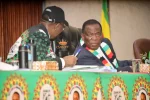
HARARE – The proposed Breaking Barriers Initiative (BBI), a constitutional reform plan reportedly linked to efforts to extend President Emmerson Mnangagwa’s term beyond 2028, has sparked strong criticism from legal experts, analysts, and sections of civil society, who describe it as an unconstitutional attempt to undermine Zimbabwe’s 2013 Constitution.
Constitutional law expert Professor Lovemore Madhuku has dismissed Zanu-PF’s alleged bid to extend Mnangagwa’s term to 2030 as legally impossible, warning that any amendment seeking to alter the presidential term of office would require a national referendum.
Speaking to 263Chat, Madhuku said, “We do not know how they intend to do it; they have not indicated how they would want to amend the Constitution, but what is very clear is that it is not possible to ensure that when the President’s term ends in 2028, he remains in office beyond that. There is no legal mechanism for doing it as it currently stands.”
He added that constitutional provisions were clear on term limits and that any attempt to alter them without consulting citizens would be unlawful.
“If you want to tamper with the term of office of the President, the exercise of executive powers, or the structure of the State, you cannot avoid a referendum,” he said.
“This idea of avoiding a referendum means that they know that this proposal is not popular with the people.”
The proposal to extend Mnangagwa’s term reportedly stems from a Zanu-PF resolution adopted at its 2024 Bulawayo congress.
Since then, the issue has fueled political divisions and revived memories of former President Robert Mugabe’s prolonged rule, which ended in a military-assisted transition in 2017 after 37 years in power.
According to internal documents cited in commentaries by analysts and political observers, the Breaking Barriers Initiative proposes a set of constitutional amendments aimed at suspending elections for up to 10 years under what proponents describe as an “election sabbatical.”
Critics, however, allege that the initiative seeks to create a legal pathway for Mnangagwa to remain in office until 2030 by exploiting technical interpretations of constitutional clauses.
Exiled former government minister Professor Jonathan Moyo, who has been linked to the drafting of the BBI, argued that the proposal can be implemented through parliamentary approval without a referendum.
Writing on X (formerly Twitter), Moyo said, “Amending Section 95(2)(b) to seven years, for instance, would simply recalibrate this flexible duration, enabling the extension to 2030 via a two-thirds vote in each House in Parliament—free from the dictates of Sections 328(6)–(9).”
However, legal experts have rejected this reasoning. Analysts have pointed out that Sections 91(2) and 328(7) of the Constitution expressly prohibit any sitting president from benefiting from amendments that extend the term of office.
Political commentators Tawonga Kurewa and Tinashe Madondo, in separate analytical papers, described the BBI as a “constitutional coup” and a “legal farce,” arguing that the proposal violates the spirit and intent of Zimbabwe’s 2013 Constitution.
Kurewa wrote that the initiative was “a sophisticated, cynical, and fraudulent legal project designed to kill the 2013 Constitution and illegally extend the tenure of a failed president beyond his final mandated term,” adding that it amounted to a direct assault on the principle of popular sovereignty.
“This plot is a confession. It is an admission of their contempt for the people. This is not a ‘Breaking Barriers Initiative’. It is a ‘Breaking the Constitution Initiative’, and it must be exposed and defeated as the treasonous assault on our republic…,” Kurewa stated.
Madondo, in his article, echoed similar concerns, describing the BBI as “a meticulously choreographed legal farce” that sought to “subvert the explicit prohibition against incumbent term-limit extensions in Section 328(7).”
He warned that the plan to replace direct presidential elections with parliamentary selection would “sever the link between the people and their chief executive,” violating Sections 3, 67, and 88 of the Constitution.
“The Breaking Barriers Initiative is not an attempt to interpret the Constitution; it is an attempt to defeat it. It is an affront to the millions of Zimbabweans who voted for the 2013 Constitution in a referendum.
“It treats the Constitution not as a sacred charter of governance but as a legal puzzle to be solved. This project must be opposed, not just by political parties, but by every citizen, every business leader, every lawyer, and every member of civil society who believes in the rule of law.
“The Constitution was intended to be a shield to protect the people from the state. The BBI seeks to re-forge it into a sword for the state to use against the people’s most fundamental right; the right to choose who governs them. We must not allow this to happen,” Madondo stated.
Both analysts argued that the initiative’s attempt to frame elections as “toxic” or as barriers to development was part of a broader strategy to justify authoritarian consolidation under the guise of stability and economic reform.
Analysts suggest that an extension of Mnangagwa’s tenure could strengthen his political allies, including businessman Kudakwashe Tagwirei, who recently joined the party’s Central Committee, while potentially sidelining Vice President Constantino Chiwenga, seen by many as a key contender in the succession race.
Political observers have warned that such internal tensions could destabilise the ruling party and the broader political environment.
Zanu-PF officials have not confirmed plans to introduce the BBI in Parliament or to use it.
Madhuku stated that term limits are a cornerstone of democratic governance.
“Term limits are actually imposed to limit very good presidents,” he said.
“They were invented to ensure that a person would not remain in office merely because they were doing well. Term limits are for good presidents; you do not need term limits for a poor president who will obviously be removed in an election.”