By Helen Kadirire
President Robert Mugabe has condemned the army and police for the ugly scuffle they had in Harare’s central business district (CBD) recently, saying the incident was “regrettable”.
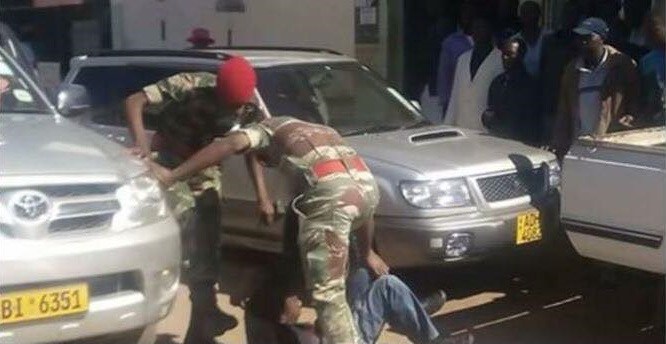
About a fortnight ago, the CBD became a battle ground, as scores of soldiers bashed police officers after they had reportedly punctured their colleague’s vehicle with spikes.
The skirmishes caused chaos in town, prompting the Zimbabwe Republic Police and army to hastily call a press conference a few days later.
Speaking at the Heroes Day commemorations at the National Heroes Acre yesterday, 93-year-old Mugabe said: “That incident that occurred in the streets to the policemen is regrettable.
“I have discussed with the commanders and have asked that they talk about it and try to prevent its recurrence,” he said, adding that “if soldiers and the police go for each other how will they prevent people who are in the streets from doing the same? Our nation is growing peacefully and let that happen”.
Mugabe said the uniformed forces needed to unite to maintain peace throughout, ahead of the 2018 harmonised elections.
“As we draw closer to the elections, we want the exercise to be done in peace. We need peace within our party, we need peace with other parties and we need national peace. Peace and calm in our land creates an environment in which we can do our tasks and our jobs freely. We need that peace,” he said.
In a joint statement by the army and police issued recently, the units said those found on the wrong side of the law would be punished.
“We want to categorically condemn that incident and assure the nation that a joint team has been set up to conduct comprehensive investigations into the matter and appropriate action will be taken against the perpetrators. We also want to reaffirm that, as security forces, we are fully united despite this incident,” police spokesperson Charity Charamba said.
Political and security analysts said the incident, if uncontrolled, could flare up into a fully-fledged war.
Security expert, Josphat Munetsi said for members of the army to just attack and assault every police officer on sight can never be a spontaneous occurrence but a careful execution of an order.
“This is because if the soldiers were to take the law into their hands without a ‘lawful order’ from their superiors, they subject themselves to very serious sanctions,” he said.
Munetsi said their respective roles as part of the coercive State apparatus can only be conflated if they are mired in the political bickering of the day.
“With that in mind, fighting could be a settling of the scores between the army superiors and the police occasioned by the politics of the day. Other than that, any fissures could have been settled outside the public domain.
“This is why it is always mandatory that both the police and army remain independent from the politics,” he said.
Analyst Maxwell Saugweme said the clashes were linked to the infighting in Zanu PF where rival camps are trying to position their proxies to succeed President Robert Mugabe.
“These two groups are armed and their tension may escalate into outright war that will leave the ordinary citizen to bear the brunt of this. We are on the edge as a nation and we should be very worried,” he said.
“I think there have been many clashes such as this before, especially in places such as Gweru where military cadets are trained. This particular one stinks and raises more dust given the capture of police and military by rival Zanu PF factions,” he said. Daily News