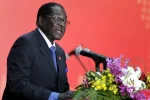
The country may go without a Deputy Chief Justice (DCJ) until after the on-going constitutional amendment that seeks to give President Robert Mugabe power to appoint a candidate of his choice has been completed.
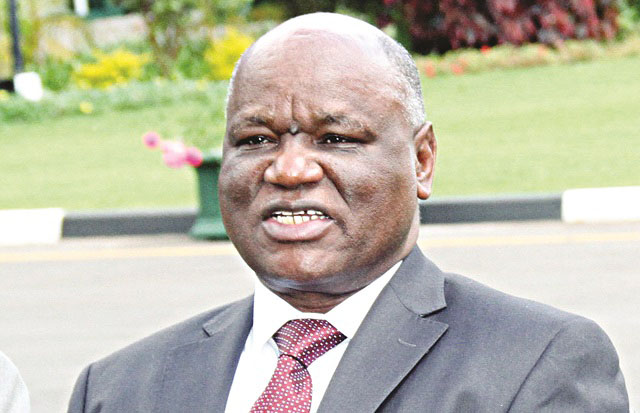
The post fell vacant on April 6 when the then incumbent, Justice Luke Malaba, was sworn in as the country’s new Chief Justice (CJ).
Judicial sources told the Financial Gazette that the Judicial Service Commission (JSC) was expected to immediately flight advertisements, inviting public nominations for candidates to the post, but the body has remained mum, leading to speculation that the post would only be filled after the completion of the on-going constitutional amendment.
Government is in the process of amending section 180 of the Constitution, which deals with the appointment of judges, to give the President authority to handpick candidates for the position of CJ, DCJ and the Judge President of the High Court.
The existing section of the Constitution states: “Whenever it is necessary to appoint a judge, the Judicial Service Commission must advertise the position, invite the President and the public to make nominations, conduct public interviews of prospective candidates, prepare a list of three qualified persons as nominees for the office and submit the list to the President, whereupon, subject to subsection (3), the President must appoint one of the nominees to the office concerned.”
This process should have kicked off immediately after the post fell vacant. The process of amending the Constitution is expected to be complete by June this year.
The process leading to the appointment of Malaba as CJ was nearly derailed after it got entangled in the factional fights that are raging within the ruling ZANU-PF party.
There have been suggestions that Vice President Emmerson Mnangagwa, one of those being touted as a potential successor to President Mugabe, and under whose purview the Justice ministry falls, preferred current Judge President, Justice George Chiweshe to take over the CJ’s post that fell vacant following the retirement of Justice Godfrey Chidyausiku.
Mnangagwa and his camp, however, lost in their bid as President Mugabe took everyone by surprise by settling for Malaba, a middle-of-the-road choice who had emerged tops in the interviews conducted in terms of the current provisions of the Constitution.
Malaba’s appointment did not end the tussle for control of the judiciary arm of the government by ZANU-PF factions, which has since shifted to the DCJ because whoever lands the post stands a good chance of taking over as CJ when Malaba’s four-year term ends in 2021.
If the next DCJ is to be appointed after the Constitution has been amended, anyone can land the position because the proposed method has no clear-cut criteria that the President is obligated to follow in making the appointment.
Among those who stand a chance of landing the post, which ever process is used, is Justice Rita Makarau who was second to Malaba in the race for the CJ’s post after scoring a 90 percent mark compared to Malaba’s 92 percent in the interview held in December last year.
The permanent secretary for Ministry of Justice and Legal Affairs, Virginia Mabhiza, told the media recently that the ideal candidate for the DCJ position should be female if the gender balance requirement in the Constitution is to be honoured.
This effectively gives Makarau —the JSC secretary who is doubles up as the chairperson of the Zimbabwe Electoral Commission (ZEC) — a clear advantage.
Makarau’s position at ZEC —where the opposition accuse her of being sympathetic to the ruling ZANU-PF party — is already a subject of debate with allegations that her appointment is unlawful and also raises issues of conflict of interest. Financial Gazette