By Tatenda Dewa | Harare Bureau |
Main opposition Movement for Democratic Change (MDC) president Morgan Tsvangirai now has a party presidium bigger than that of President Robert Mugabe and certainly most of the political parties around the world.
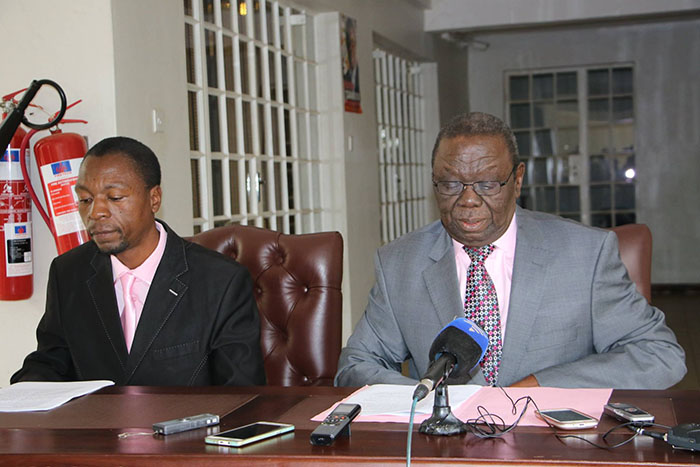
Last Friday, he announced that Nelson Chamisa and Elias Mudzuri, both former party national organising secretaries, would be joining Thokozani Khupe as the two additional vice presidents.
That brought the MDC-T presidium to a bloated four, factoring in Tsvangirai as the man at the helm.
Both Chamisa and Mudzuri had been reduced to mere national executive members after the controversial 2014 MDC-T congress, reportedly at Tsvangirai’s indulgence.
Chamisa had hoped to rise from national organiser to secretary general, but the position he coveted went to Douglas Mwonzora and this generated speculation that Chamisa would break away from the party due to frustration.
Tsvangirai made the announcement of the new presidium just on his return from South Africa where he underwent surgery for colon cancer, a condition that he recently divulged he is suffering from.
It also followed a decision by the party’s national council to give the president the prerogative to make further appointments in the presidium.
The two, he argued, would help in running the affairs of the party.
“In line with the directive given to me by the national council…I have now appointed Nelson Chamisa and Elias Mudzuri as vice presidents of the party.
“The two will join Thokozani Khupe in assisting me in the execution of my responsibilities and preparing the party for the next election,” said Tsvangirai as he addressed journalists at his Highlands home.
Some independent analysts quickly hailed Tsvangirai for making the two new appointments.
Pedzisayi Ruhanya, the Zimbabwe Democracy Institute (ZDI) director, sees the elevation as a necessary decision to recapture the party’s vibrancy.
“There is nothing amiss with bringing in the two into the folder. The post-2014 congress leadership under Tsvangirai was the most incompetent outfit that we have ever seen since the birth of MDC.
“Tsvangirai must have seen this and was under pressure to breathe back life into the party. After all, giving a party leader the power to appoint his preferred lieutenants is now a worldwide trend. The new MDC constitution allows him to do that, and he went ahead and exercised his right,” said Ruhanya.
Being young, energetic and popular within and outside the party structures, added Ruhanya, Chamisa might emerge as the frontrunner to succeed Tsvangira, who looked frail upon his return from South Africa.
Rashweat Mukundu, a media activist who is also with the ZDI, speculated that Tsvangirai’s ill-health could have moved him to bring in Mudzuri and Chamisa as a way of preparing the party for a future without the charismatic opposition leader.
“This seems to be about leadership transition and it sends out a good signal about how political leaders must manage the succession issue within their parties,” said Mukundu.
The thinking is that, Tsvangirai could have realised that his health might burden party processes and, therefore, he is throwing the succession race wide open, enabling MDC-T followers to chose from the three.
That is as far as the positive analysis stretches.
Mukundu admitted that, by bloating his presidium, Tsvangirai was bringing himself into a fatal contradiction.
“For a long time, he has been talking strongly against President Robert Mugabe’s bloated structures in government. It therefore becomes a contradiction when Tsvangirai beats Mugabe to the numbers and sets up a presidium with four people when Zanu PF has three,” said Mukundu.
The big presidium is likely to gift Zanu PF with anti-MDC propaganda material, as Tsvangirai and his party would find it hard to criticise Mugabe’s extravagant and obese government.
The circumstances under which Tsvangirai announced the two new appointments are telling, if not mysterious.
Tsvangirai cut an almost lonely figure as he addressed a hastily invited team of journalists at the government house he still lives in, in Highlands.
He was flanked only by his wife, Elizabeth, and a pensive Luke Tamborinyoka, his spokesperson, as he spoke from behind a common desk that could just as well have been taken out of a classroom.
Under normal circumstances, Tsvangirai would have invited the whole party leadership to make the dramatic announcement, but none were present.
His sole deputy before Friday, Thokozani Khupe, was close to 500km away in Bulawayo, busy preparing for the Beat the Pots protest against the Mugabe government that turned to be a success as thousands of women joined her on Saturday.
When she was asked for her comments on the new presidium, her response betrayed her frustration. “Ask Morgan Richard Tsvangirai!” was all she would say.
More tellingly, she was not even present when the national council met to give Tsvangirai the power to beef up the top leadership.
Tsvangirai seems to have passed a vote of no confidence in her vice presidency by bringing in two extra people without her knowledge or approval.
This, many online observers insist, is likely to rapture the already tense relationship between Tsvangirai and Khupe, disillusion and divide the female support base and rile many followers from southern Zimbabwe who could troop out to Joice Mujuru’s Zimbabwe People First (ZimPF) party.
While Chamisa and Mudzuri have not yet spoken on their appointments, Tsvangirai’s other leadership seems dampened by the appointments.
Obert Gutu, the secretary for information, hastily took to social media to distance himself from the appointments.
He wrote on his Facebook page: “As the MDC-T national spokesperson, kindly be advised that I have absolutely NO comments to make on the appointments for the office of vice president that were announced at a press conference in Harare on Friday, July 15, 2016. I refer all questions and/or queries to President Morgan Tsvangirai.’’
He did not say to Luke Tamborinyoka, the presidential spokesperson, or Lovemore Moyo, the national chair, or Thokozani Khupe, the other deputy.
That sounded like dumping the buck squarely at Tsvangirai’s doorstep and could indicate an unheralded rift in the top structures.
Mwonzora is currently away, and party national chairman, Lovemore Moyo, and his deputy, Morgen Komichi, are out of the picture.
They might be silently smarting that their boss leapfrogged Chamisa and Mudzuri over them, a decision that they could also interpret as a vote of no confidence in them.
Tsvangirai’s choice of the two could offset a harmful regional debate.
Both Mudzuri and Chamisa hail from Masvingo, and southern Zimbabwe is already feeling omitted as Khupe seems sidelined now.
While the chairman is also from the same region, those that hail from Matabeleland will still feel that they are being marginalised as there is no obvious indication that any from there is being positioned for the top post.
Outside that, other critical regions, particularly Manicaland and Mashonaland, are not represented in the top six.
One school of thought argues that, by bringing in Chamisa and Mudzuri, Tsvangirai was apparently anxious to dilute the factions that they seemingly led.
But the move is risky. If is true that both politicians led factions, their closer access to the pole position could enhance their turf wars.
Chamisa and Mudzuri are not known as the best of friends, especially when the former pipped his older counterpart to the organising secretary’s position several years ago.
But, more interestingly, both have been sidelined by Tsvangirai before and it remains to be seen if they will forgive their boss for prior humiliation. Nehanda Radio
Discover more from Nehanda Radio
Subscribe to get the latest posts sent to your email.